How Long Do IRS Audits Take? An Expert Guide
That sinking feeling you get when an IRS notice arrives in the mail is almost always followed by one big question: "How long is this going to take?" There’s no single, easy answer, but you can breathe a little easier knowing that most audits are wrapped up within a year.
Some are over in just a few months, while others can drag on. It all depends on the type of audit you’re facing.
Your Quick Guide to IRS Audit Timelines

I like to think of the audit timeline as a road trip. A simple correspondence audit, handled completely through the mail, is like a quick drive across town. But an intensive field audit, where agents visit your home or business, is more like a cross-country journey with unexpected detours.
The final destination—a closed case—depends entirely on the complexity of your tax return and how quickly and thoroughly you respond to the IRS's questions.
To help you get your bearings, let's break down the typical timeframes you can expect for the most common types of audits.
Average IRS Audit Timelines by Type
This table provides estimated durations for the most common types of IRS audits, helping you understand the potential time commitment for each.
| Audit Type | Average Duration | What It Involves |
|---|---|---|
| Correspondence Audit | 3-6 months | The simplest audit, conducted entirely by mail. The IRS requests specific documents to verify items on your return, like charitable donations or medical expenses. |
| Office Audit | 6-12 months | You (or your representative) will meet with an IRS auditor at a local IRS office to review your records and discuss specific issues. |
| Field Audit | 1 year or more | The most comprehensive audit. An IRS agent visits your home or business to conduct a thorough examination of your financial records. These are often complex and can last a long time. |
Keep in mind these are just averages. The actual timeline can shift based on a few key factors.
Two things, above all else, dictate how long your audit will take: the complexity of the tax issues involved and the quality of your records.
It's simple, really. If your documentation is a mess, the process will take longer. Well-organized records can cut the time down significantly.
It's also worth noting that things happening inside the IRS can affect your timeline. For example, recent workforce reductions and staffing shifts in early 2025 have created backlogs.
With fewer hands on deck, a lot of the focus is on essential tasks like processing returns, meaning audits can sometimes move at a slower pace than they used to. You can get a better sense of how these internal changes might impact audit risk in 2025 on Big Ideas for Small Business.
My goal here is to pull back the curtain on the audit process and give you a realistic idea of the road ahead. Knowing what to expect is half the battle.
The Three Main Types of IRS Audits

First things first: not all IRS audits are the same beast. The type of audit you're facing is the single biggest factor in determining how long this whole process is going to take.
Think of it this way: some issues with your tax return are like a simple typo that the IRS just wants to clarify with a quick question.
Others are more like a full-blown investigation that requires a deep dive into your records. The notice you receive from the IRS will tell you exactly what you're dealing with.
Correspondence Audits: The Quickest Path
The most common and least disruptive audit is the correspondence audit. As the name suggests, everything is handled through the mail. You won't be meeting anyone face-to-face.
Typically, the IRS is just asking for proof for one or two specific items on your return, like verifying charitable donations or medical expenses.
If you send back clear, organized documents right away, most of these audits are wrapped up within three to six months. It's the fastest and most straightforward of the bunch.
Office Audits: A More Detailed Review
One step up the ladder is the office audit. This means you (or, ideally, your tax professional) will need to visit a local IRS office for a sit-down meeting with an auditor. It’s more involved because the scope is usually wider than just one or two line items.
An office audit is a more comprehensive review of your finances. Because of the back-and-forth communication and scheduling required, these audits can easily take anywhere from six months to a full year to close out.
Field Audits: The Deepest Dive
The most serious and in-depth examination is the field audit. This is when an IRS agent comes directly to you—at your business, home, or accountant's office—to conduct a thorough review of your books and records.
These are reserved for the most complex tax returns, usually involving businesses or high-income individuals where the IRS suspects significant discrepancies. Given the level of detail, a field audit lasting a year or more is pretty standard.
Understanding why the IRS might select a return for audit can give you a better sense of your own risk. You can get a better feel for this by reading our guide on what triggers a tax audit.
The Four Stages of an IRS Audit Unpacked
No matter what kind of audit you're facing, the process itself isn't a random, chaotic event. It follows a fairly predictable path. Once you understand the basic roadmap, the whole ordeal feels much less intimidating. It's a journey with four distinct milestones.
This chart gives you a quick visual of how a typical audit breaks down, from the first letter to the final resolution.
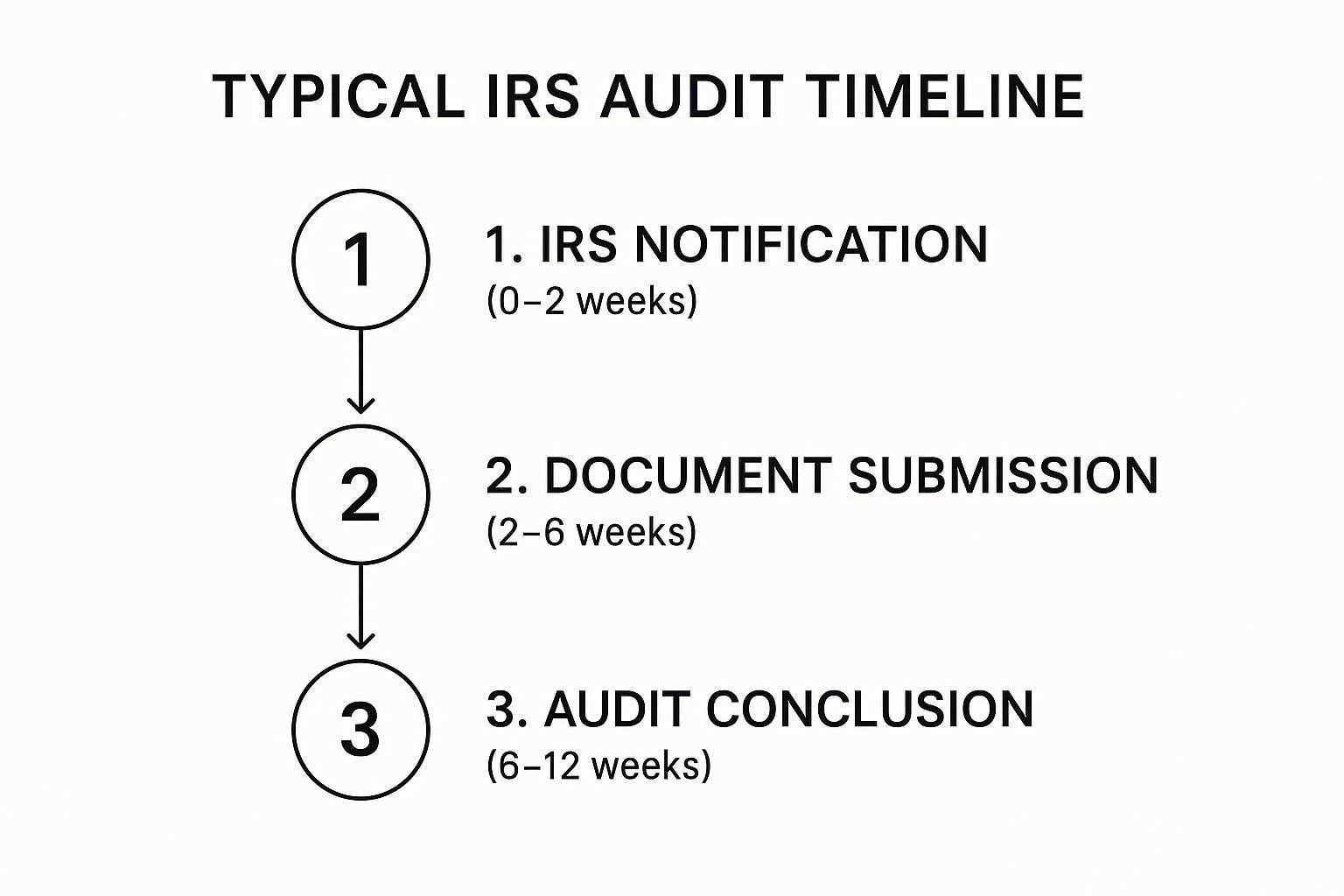
As you can see, after the initial notice, the timeline is largely driven by how quickly documents are submitted and reviewed.
Stage 1: The Notification
This is how it all starts—with a letter from the IRS. You'll receive an official notice, often a CP2000 or a Letter 525, telling you that your tax return is being examined.
This letter is your starting gun. It will lay out which tax year is under review, what specific items they're questioning, and how they plan to conduct the audit (by mail, at an IRS office, or at your home or business). Do not ignore this letter. Your next move, and how quickly you make it, is critical.
Stage 2: Information Gathering
Once you get that notice, the ball is in your court. The IRS has asked for proof, and now you have to provide it. This stage is all about gathering and sending in the documents that back up the figures on your tax return. Think receipts, bank statements, business ledgers, mileage logs—whatever they've asked for.
Your organizational skills are your best friend here. Sending in a complete, well-organized, and clearly labeled package of documents can genuinely speed things up. On the flip side, messy or incomplete records are the number one reason audits drag on, stretching out how long your IRS audit will take.
Stage 3: The Examination
After you’ve sent in your documents, an IRS auditor takes over. Their job is to meticulously comb through everything you provided and compare it to what you reported on your tax return. They are simply verifying that your numbers are accurate and that you followed the tax laws.
It's common for the auditor to reach out with follow-up questions or ask for a few more documents during this phase. Responding to these requests promptly and clearly is key to keeping the process moving and avoiding unnecessary delays.
Stage 4: The Resolution
This is the final chapter. Once the auditor has finished their review, the IRS will issue their findings. It will end in one of three ways:
No Change: This is the best-case scenario. It means your return is accepted as you filed it, and the audit is closed.
Agreed: The IRS proposes changes to your return, and you agree with their assessment. You'll sign an agreement form and pay any extra tax, penalties, and interest you owe.
Disagreed: You don't agree with the changes the IRS wants to make. This isn't the end of the road; you have the right to appeal the decision.
When Does the IRS Audit Clock Actually Start?
A lot of people think the IRS audit clock starts ticking on December 31st of the tax year. That’s a common misconception. In reality, the countdown doesn't begin until the moment you actually file your tax return.
This critical timeframe is officially known as the statute of limitations. It’s the legal window the IRS has to take a closer look at your numbers.
For most people, the IRS sticks to a three-year rule. This means that from the day you file, the agency generally has three years to flag your return for an audit. So, if you filed your 2023 return right on the April 15, 2024 deadline, the IRS would have until April 15, 2027, to initiate an examination.
Exceptions That Extend the Timeline
But that three-year window isn't set in stone. Certain red flags can give the IRS a whole lot more time to dig into your records, which is why it’s so crucial to understand the exceptions.
The big one is a substantial understatement of income. If you underreport your gross income by 25% or more, the statute of limitations doubles from three years to a full six-year period.
This gives the agency a much wider berth to uncover significant errors or omissions. Frankly, the best way to deal with this is to not be in that situation in the first place. You can read more about the IRS audit window on Rush Tax Resolution to see how these timelines play out.
And then there are two situations where the clock never stops ticking at all.
Filing a fraudulent return: If the IRS believes you knowingly and intentionally lied on your return, there is no time limit. They can come knocking anytime.
Failing to file a return: The same goes if you just don't file. If you never file for a given year, the statute of limitations never even starts.
Knowing these rules isn't just trivia—it directly impacts how long you need to hang onto your financial documents. The best strategy is always a proactive one. If you're looking for practical tips, we have a whole guide on how to avoid an IRS audit to help you stay off the radar.
Key Factors That Can Speed Up or Delay Your Audit
While the averages give you a ballpark idea, your personal audit experience isn't etched in stone. A handful of factors can either slam the brakes on the process or put it in the fast lane. Think of it this way: you have more control than you might realize. Your preparation and responsiveness are your biggest assets.
When it comes down to it, a speedy resolution often hinges on one simple thing: organization. If you can hand over complete, neatly organized records right after the IRS makes its first request, you cut out all the frustrating back-and-forth. That's the single best way to shrink an IRS audit timeline.
On the flip side, most major delays stem from a few predictable bottlenecks.
What Slows an Audit Down
The complexity of your return is a big one. If you’re dealing with sophisticated tax issues, the audit will just plain take longer. Common things that tack on extra time include:
Missing or incomplete documents: Can't find that crucial receipt or bank statement? The auditor has no choice but to wait, and the clock keeps ticking.
Complex financial transactions: Things like cryptocurrency trades, foreign assets, or income from partnerships and S-corps automatically add layers of scrutiny and verification.
Disagreements with the auditor: If you and the agent hit a wall over a specific tax law interpretation, resolving it through manager conferences or an appeal can easily add months to the process.
It's also worth remembering that the IRS's own internal workload plays a part. If your case lands on the desk of an overworked agent or if their department is short-staffed, you might face delays that have nothing to do with you.
Taking Control of the Timeline
Your actions have a direct and immediate impact on how quickly things move. Prompt, clear communication is everything. Answer the auditor’s questions quickly and provide exactly what they ask for—no more, no less. This is how you keep the gears turning smoothly.
If the audit concludes and you're suddenly facing a hefty tax bill, don't panic. It’s crucial to know what options are available. For taxpayers who qualify, exploring solutions like the IRS Fresh Start Program can provide a path forward to get that tax debt under control. By understanding all these moving parts, you can take charge of your side of the audit for a much smoother, and hopefully quicker, resolution.
Who Is Most Likely to Face an IRS Audit Today

While the idea of an IRS audit can make anyone nervous, the reality is that the risk isn't spread evenly. The IRS doesn't just throw darts at a board. It uses a powerful microscope, and it points that microscope where it expects to find the biggest discrepancies.
So, who's under the lens right now? It’s overwhelmingly high-income earners and large corporations. The logic is pretty straightforward: the more complex the return and the more money involved, the greater the chance for significant errors. And for the IRS, that means a bigger potential for recovering unpaid tax dollars. This isn't just a guess; it's a very clear enforcement priority.
A Clear Shift in Enforcement
The IRS is making a concerted effort to ramp up its scrutiny of the wealthiest taxpayers and biggest companies. This isn't about punishing success—it's about tackling what’s known as the "tax gap," which is simply the difference between what the IRS is owed versus what it actually receives.
The numbers tell the story. For individuals earning over $10 million, audit rates are expected to climb from 11% to 16.5% by 2026. The jump for large corporations is even starker, with their audit rates projected to soar from 8.8% to 22.6%.
On the flip side, the agency has been very public about its promise not to increase audit rates for small businesses and individuals who earn less than $400,000 a year. You can read more about these targeted IRS audit trends on Taxes for Expats.
Knowing where the IRS is focusing helps you understand your own audit risk and highlights why, for certain taxpayers, keeping immaculate records isn't just good practice—it's essential.
Frequently Asked Questions About the Audit Process
It's completely natural to have a knot in your stomach when an audit notice shows up. The unknown is always stressful. Let's tackle some of the most common questions head-on to give you some clarity and peace of mind.
Can I Request an Extension for Providing Documents?
Absolutely. In nearly every case, you can request an extension if you're struggling to pull your records together. The trick is to be proactive about it.
Don't wait until the deadline has passed. Reach out to the auditor in writing, explain why you need a bit more time, and propose a new, reasonable date. A short extension is usually granted without issue, and it’s a much better look than submitting a messy, incomplete file.
What Happens If I Ignore an IRS Audit Notice?
Ignoring an IRS notice is, without a doubt, the worst move you can make. It doesn't make the problem go away; it just takes you out of the conversation.
If you don't respond, the IRS will make its own decision based on the information it has—which is never in your favor. This almost always results in a tax assessment against you, which quickly snowballs with penalties and interest. Before you know it, you could be facing liens on your property or levies on your bank accounts. Always, always respond.
A qualified tax professional can often streamline the process. While it adds a communication step, an expert who speaks the IRS's language can prevent misunderstandings, organize information efficiently, and lead to a quicker resolution.
If you’ve already made the mistake of ignoring an audit notice and disagree with the outcome, you might still have a chance to fix it. Our guide explains how to request an IRS audit reconsideration and present the information you failed to provide the first time.
Will an Audit of One Year Trigger Audits for Other Years?
Not automatically, no. An audit is typically focused on a single tax year. However, if the auditor uncovers significant, recurring issues—like unreported income or consistently overstated deductions—they absolutely have the authority to expand the review to other open tax years.
Feeling overwhelmed by an IRS notice? At Attorney Stephen A Weisberg, I start with a FREE Tax Debt Analysis to determine exactly how I can help before you ever pay a fee.
➥ Contact Attorney Stephen A. Weisberg for a free Tax Debt Analysis.
Contact Me Here: https://www.weisberg.tax/contact-1
Email: s.weisberg@weisberg.tax
Phone/Text: (248) 971-0885
Address: 300 Galleria Officentre, Suite 402, Southfield, MI 48034
