What Is Delinquent Tax A Guide to Solving Tax Debt
Think of a delinquent tax like a past-due utility bill, but with much heavier consequences. It’s a simple concept, really. Any tax—whether it's for income, property, or sales—becomes delinquent the very next day after its payment deadline has passed and the bill remains unpaid.
What "Delinquent Tax" Really Means

Getting a handle on delinquent taxes is the first real step toward getting your financial life back on track.
This isn't some rare problem that only affects a select few; it's a surprisingly common issue that can catch anyone off guard, often stemming from an unexpected job loss or medical emergency, not deliberate avoidance. My goal here is to help you swap that anxiety for clear, actionable knowledge.
Once that tax deadline comes and goes, the clock officially starts ticking. The government—be it the IRS, your state, or even your local municipality—kicks off a collection process that only gets more serious with time.
This isn't just about a few reminder letters in the mail. We're talking about a systematic process where penalties and interest start piling up, often causing the original debt to balloon into something much larger.
How an Unpaid Bill Becomes a Legal Claim
At first, a delinquent tax is just an overdue bill. But if you let it sit, it can quickly escalate into a much bigger legal problem.
One of the most serious steps the government can take is to file a tax lien against you. A federal tax lien is a legal claim the government places on your property when you fail to pay what you owe.
This lien essentially attaches to everything you own—your house, your car, your bank accounts—and makes the government a secured creditor. It’s also a public record, which can seriously damage your ability to get a loan, sell property, or even pass some employment background checks.
A tax officially becomes delinquent the day after its payment is due. For federal income taxes, that's typically April 16th. There’s no grace period; the IRS can start tacking on penalties and interest right away.
Common Types of Delinquent Taxes at a Glance
Tax delinquency isn't limited to just federal income taxes. It can pop up from a number of different obligations, and knowing which ones apply to you is key to staying out of trouble. Each type is managed by a different government body and has its own specific triggers.
Here's a quick breakdown of the most common taxes that can become delinquent.
| Type of Tax | Governing Authority | Common Trigger for Delinquency |
|---|---|---|
| Federal Income Tax | Internal Revenue Service (IRS) | Failing to pay the amount owed by the annual tax deadline. |
| State Income Tax | State Department of Revenue | Underpayment or non-payment of state income tax obligations. |
| Property Tax | County or Municipal Government | Missing payment deadlines for taxes on real estate. |
| Payroll Tax | IRS and State Agencies | A business failing to remit employee withholdings. |
| Sales Tax | State Department of Revenue | A business not remitting collected sales tax to the state. |
Understanding these distinctions is crucial. Whether you're a homeowner with property taxes, a business owner managing payroll, or just an employee filing your annual return, recognizing your specific obligations is the first line of defense against a small tax issue spiraling into a major financial crisis.
Why Good People Fall Behind on Taxes
Let's get one thing straight: almost no one chooses to fall behind on their taxes. It's not a decision made lightly. Far more often, it’s the result of life throwing a curveball—a sudden crisis or a slow financial squeeze that shoves tax payments down the priority list. The road to a delinquent tax balance is usually paved with good intentions and tough circumstances.
Think about a small business owner. Their entire operation depends on a steady cash flow to make payroll and cover taxes. Then, out of the blue, their biggest client pulls a contract. The income vanishes overnight. What do they do? Do they pay their team to keep the lights on, or do they send that money to the IRS? In that moment, the survival of the business feels like the only option.
This isn't some rare, isolated event. It happens all the time. People who have always been on top of their finances suddenly find themselves in a stressful, overwhelming situation for reasons completely beyond their control.
Common Triggers for Tax Delinquency
A handful of common life events are notorious for pushing people into tax debt. These situations don't just disrupt a budget; they can make meeting tax deadlines feel downright impossible, showing just how easily anyone can end up with a delinquent tax problem.
Here are some of the most frequent causes we see:
Sudden Job Loss: When your main income disappears, you go into financial triage. Paying the mortgage and buying groceries naturally come before sending a check to the government.
Major Medical Expenses: An unexpected illness or a serious accident can bring on a mountain of medical debt, even with insurance. Savings that were earmarked for taxes get wiped out in an instant.
Divorce or Family Changes: The financial fallout from a divorce—from legal fees to the sheer cost of setting up two separate households—can shatter even the most well-laid financial plans.
Business Cash Flow Problems: If you're a freelancer or small business owner, you know how inconsistent income can be. A slow quarter can make it incredibly difficult to find the cash for quarterly estimated tax payments.
Misunderstanding Tax Obligations: This is a big one for independent contractors. Many don't realize they're on the hook for self-employment taxes until they're hit with a massive, unexpected tax bill. Forgetting to file in the first place creates its own set of problems; our guide on what to do if you forgot to file taxes dives deeper into this common trap.
What these scenarios show is that falling behind on taxes is usually a symptom of a much larger financial strain, not a reflection of someone's character.
The Broader Economic Picture
This isn't just about taxes. The struggle to keep up with payments is a growing problem across the country, reflecting a widespread economic stress that hits households hard, especially those with lower incomes.
Just look at the data on other types of debt. Delinquency rates for things like credit cards have been climbing sharply since mid-2021. For example, research from the St. Louis Fed shows that in the lowest-income communities, the rate of debts overdue by 90 days or more skyrocketed from 12.6% in late 2022 to 20.1% by early 2025. That’s a staggering 59% jump.
This trend makes a critical point: when people are struggling to make essential payments, tax obligations often become just one more bill they can't afford to cover. It’s a domino effect, where one financial hardship quickly triggers another.
"Many IIR [International Information Return] penalties were assessed against unsuspecting lower-income taxpayers, small businesses, and immigrants... Taxpayers should not be penalized when they discover errors or mistakes and voluntarily come forward and file late or corrected tax or information returns."
This perspective highlights why it's so important to understand the story behind a delinquent tax issue. Even the IRS is starting to acknowledge that automatically penalizing people who are trying to get back on track can do more harm than good.
By recognizing what causes people to fall behind, we can shift the focus from blame to solutions. It’s about acknowledging that good, hardworking people can find themselves in tough spots and need clear, practical ways to get back on their feet.
The Snowball Effect of Unpaid Taxes

Think of a small, overdue tax bill as a snowball perched at the top of a very steep hill. It might not look like much at first—small, seemingly manageable. But once it starts rolling, it picks up speed and mass at an alarming rate, quickly turning into a destructive force that’s incredibly hard to stop. This is a perfect picture of what happens when you have a delinquent tax balance.
What begins as a straightforward debt doesn't stay that way for long. The very moment your tax bill becomes delinquent, tax authorities like the IRS start tacking on penalties and interest. And these aren't one-time fees; they compound daily, causing the total amount you owe to swell continuously.
This first stage is usually marked by a series of escalating notices arriving in your mailbox. These letters are official warnings, spelling out your growing debt and detailing the increasingly serious consequences if you keep ignoring it.
From Penalties to Liens
If those initial notices and the mounting debt don't get your attention, the tax agency will take more aggressive steps to secure what it's owed. This is where the snowball really starts to become a massive financial problem. The next major escalation is typically the filing of a tax lien.
A tax lien is a legal claim the government places on all your current and future assets as security for the delinquent tax debt. It attaches to just about everything you own.
Real Estate: Your home, vacation properties, and any land you own.
Personal Property: Cars, boats, and other high-value possessions.
Financial Assets: Bank accounts, investments, and even retirement funds.
The lien essentially makes the government a secured creditor. That means they get first dibs on the money if you sell your assets, getting paid before most others. Even worse, a tax lien is a public record. This means lenders, employers, and landlords can see it, which can wreck your ability to get a mortgage, a car loan, or even rent an apartment.
The Power of a Tax Levy
A tax levy is a much more direct and disruptive action than a lien. While a lien simply secures the government's interest in your property, a levy is the actual seizure of that property to satisfy the tax debt. Think of it this way: the lien is the claim, but the levy is the collection.
The government doesn't need to ask for permission to take your assets. Once a levy is in place, the tax authority can legally drain money directly from your bank accounts or start garnishing your wages.
Example of a Wage Garnishment: Let’s say you owe $15,000 in delinquent taxes. The IRS issues a wage levy to your employer. Your employer is now legally obligated to send a chunk of every paycheck directly to the IRS before you ever see it. You're left with a significantly smaller income to cover your rent, groceries, and other bills.
This move can be sudden and financially crippling. The IRS can also levy other assets, like retirement accounts or the accounts receivable from your business, making it incredibly difficult to manage your day-to-day life.
How Delinquent Taxes Can Derail Your Life
The consequences of a delinquent tax problem go far beyond the original amount you owed. The snowball effect creates a cascade of financial and personal challenges that can throw your entire life off track.
Imagine a family planning to sell their home to downsize. During the title search, the buyer's attorney discovers a federal tax lien for $25,000 filed against the property. The sale immediately grinds to a halt. The deal can't close until that lien is paid off, and if the sellers don't have the cash on hand, the sale collapses, taking their financial plans down with it.
The progression is painfully clear:
Initial Delinquency: The tax bill goes unpaid.
Penalties and Interest: The debt starts growing every single day.
Tax Lien: The government secures its claim against all your property.
Tax Levy: The government actively starts taking your assets to pay the debt.
Each step makes the problem more complex and more expensive to solve. This escalating process highlights why it's absolutely critical to address any delinquent tax issue as quickly as possible—before that snowball grows too large to handle.
Navigating Delinquent Property Taxes
Of all the tax issues a person can face, falling behind on property taxes is in a league of its own. It's a uniquely stressful situation because the asset on the line isn't just an investment—it's your home. For most people, their property is their bedrock of stability and their single largest financial asset, which raises the stakes considerably.
Unlike the income taxes you send to the IRS for national programs, your property tax payments are the lifeblood of your local community. This is the money that keeps the lights on, funding everything from public schools and libraries to the salaries of firefighters and police officers.
It paves the roads and maintains the parks. When homeowners don't pay, it punches a hole in the local budget, and you can bet the municipality will be aggressive in trying to collect.
The Escalating Risk to Your Home
The process of collecting overdue property taxes is methodical, serious, and it doesn't happen overnight. But make no mistake, every official notice you receive brings you one step closer to potentially losing your home. Ignoring the problem won't make it disappear; it just makes it worse—and more expensive.
This is how quickly a manageable tax bill can spiral out of control.
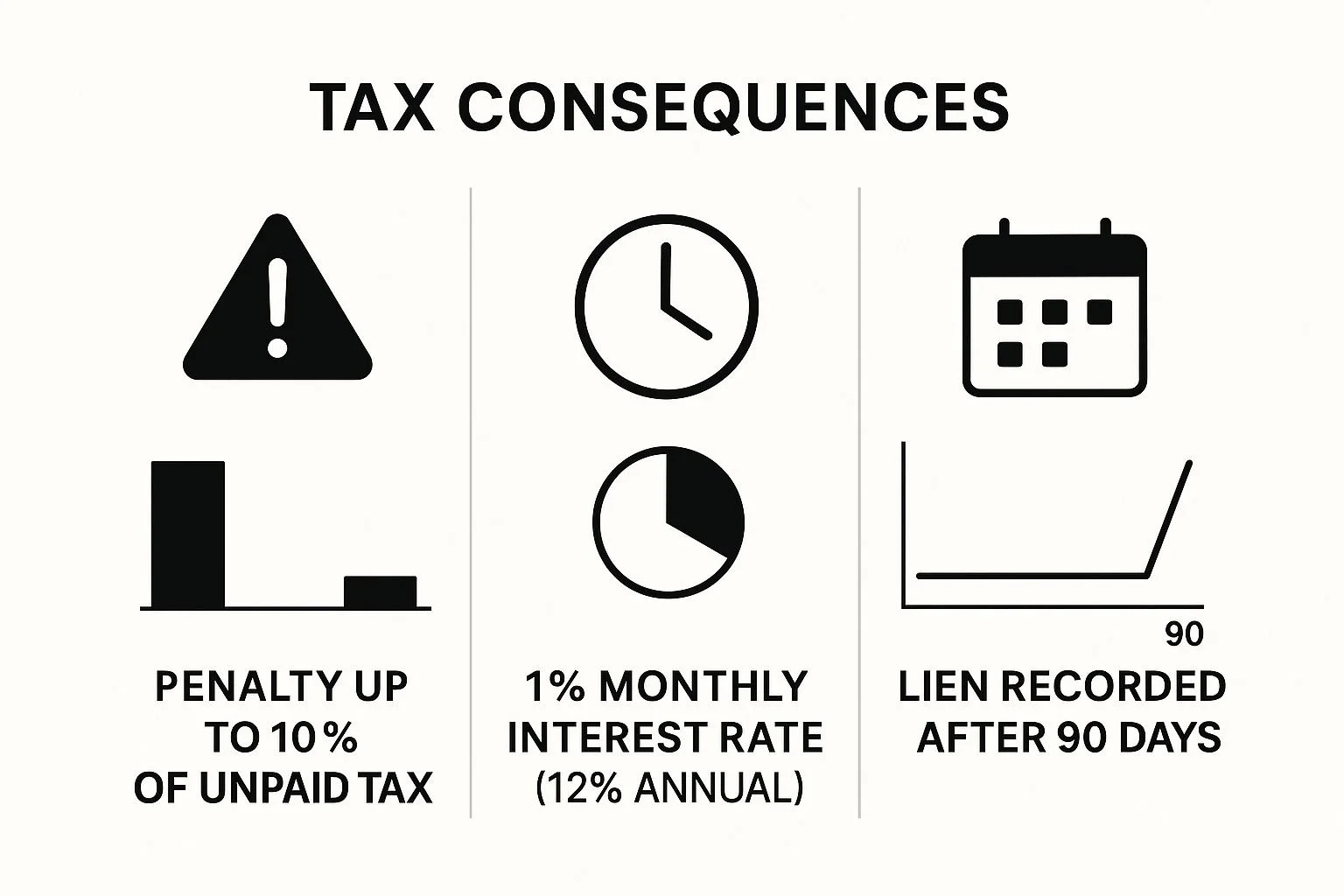
As you can see, the initial penalties are a gut punch, but it’s the relentless monthly interest that truly causes the debt to swell. Eventually, this leads to a tax lien, which is the county's formal, legal claim against your property.
This isn't a rare problem, either. As property values have shot up, so have tax assessments. In fact, property taxes across the nation surged by a staggering 27% between 2019 and 2025. This has put immense pressure on household budgets, pushing the national delinquency rate up to 5.1% in 2025 from a historic low of 4.3% in 2019.
Understanding Tax Lien States vs Tax Deed States
The way your local government handles a delinquent property tax bill depends entirely on the laws of your state. Broadly, states fall into one of two categories: tax lien states or tax deed states. Knowing which system you're in is absolutely critical because it dictates the process, the timeline, and what ultimately happens to your home.
The path from a missed payment to foreclosure varies dramatically, so let's break down the two systems.
Understanding Tax Lien States vs Tax Deed States
This table shows a direct comparison of how delinquent property taxes are resolved in tax lien versus tax deed states, outlining the process and what it means for the homeowner.
| Feature | Tax Lien State | Tax Deed State |
|---|---|---|
| What is Sold | The debt on the property (the lien) is sold to an investor. | The property itself is sold to the highest bidder at auction. |
| Homeowner's Rights | You have a "redemption period" to pay the investor back (plus interest and fees) to keep your home. | You lose all ownership rights immediately after the tax sale is finalized. |
| Typical Outcome | The investor hopes to collect high interest from you. Foreclosure is the last resort if you fail to pay. | The winning bidder gets the deed and immediate ownership of your property. |
In a tax lien state, the county doesn't immediately try to sell your home. Instead, they sell your tax debt to a private investor at an auction. That investor pays your overdue taxes to the county and, in return, gets the right to collect the money from you—along with some hefty interest and penalties.
The good news is that this process comes with a redemption period, typically lasting one to three years. This is your window of opportunity to pay back the investor in full and clear the lien.
If you succeed, you keep your home. If you can't, the investor can then start foreclosure proceedings to take ownership of your property. These situations can get complicated fast, which is why we offer various real estate tax lien solutions to help homeowners find a way out.
Things are much more direct—and often more brutal—in a tax deed state. After you've been delinquent for a certain period, the county seizes your property and sells it outright at a public auction. The person who buys it at the auction gets the deed, and just like that, you lose your home.
This isn't just a technical distinction. It's a fundamental difference that impacts your rights, your options, and the timeline you have to save your home. Knowing the rules of the game where you live is the first step toward building a strategy to fix the problem.
Your Action Plan for Resolving Tax Debt

Getting a notice for delinquent tax can be paralyzing. The natural instinct might be to just set it aside, but the absolute worst thing you can do is nothing. Ignoring the problem won't make it go away; it just allows penalties and interest to pile up while the government's collection tactics get more serious.
The most powerful move you can make is to take that first step: open a line of communication with the tax authority. Simply reaching out signals that you want to resolve the issue, which can immediately change the dynamic.
Tax agencies like the IRS aren't just there to collect; they have programs specifically designed to help people get back on solid ground. Your goal is to find the right one for your situation.
Set Up a Payment Plan
For many people, the issue isn't that they disagree with the tax bill—it's that they can't possibly pay the whole thing at once. If that’s you, an Installment Agreement is often the most straightforward path forward.
Think of it like any other payment plan. You agree to make consistent, affordable monthly payments over a set timeframe until the entire balance, including interest and penalties, is cleared. It’s a common-sense solution that helps you resolve your delinquent tax liability without facing harsher collection measures like a bank levy or wage garnishment.
Explore an Offer in Compromise
But what if your tax debt is so overwhelming that even a long-term payment plan feels impossible? For these specific situations, an Offer in Compromise (OIC) might be on the table.
An OIC is exactly what it sounds like: an agreement with the IRS to settle your tax debt for less than what you originally owed. This isn't a simple negotiation, though. The IRS has very strict criteria and will only consider an OIC if you can prove that paying the full amount would cause you significant economic hardship. Be prepared for a deep dive into your finances, as they’ll scrutinize everything:
Ability to Pay: Your current income versus your necessary living expenses.
Income Potential: What you're likely to earn in the near future.
Asset Equity: The value of things you own, from your car and home to your savings accounts.
An Offer in Compromise can be a lifeline, but it demands full financial transparency and a detailed application. It’s never a guarantee, but for those who truly qualify, it provides a genuine fresh start.
This program is a real option for taxpayers buried under debt. In fiscal year 2024 alone, the IRS accepted over 7,199 Offers in Compromise, resolving $163.4 million in tax liabilities. This shows that settling for a lower amount is a viable, though tough, path for those who qualify.
Currently Not Collectible Status
Sometimes, life throws a real curveball, like a sudden job loss or a serious illness. In cases of extreme financial hardship, you may qualify for Currently Not Collectible (CNC) status. This puts a temporary pause on all collection activities.
If the IRS determines you can't even afford your basic living expenses, let alone a tax bill, they will stop trying to collect—for a while. It's crucial to understand that CNC status doesn't erase the debt. Penalties and interest continue to grow, and the IRS will check in on your financial situation periodically to see if anything has changed.
The Power of a Proactive Strategy
Whichever route you end up exploring, being proactive is your greatest strength. Many of these relief options are part of larger government initiatives aimed at helping taxpayers.
As you build your action plan, consider using modern tools to get a better handle on your finances. Solutions like these AI tools for financial monitoring can give you the clarity you need to stay on top of your obligations and prevent future issues.
By understanding your options and talking to the tax authorities, you can turn a mountain of stress into a manageable plan. The key is to stop hiding from the problem and start looking for the solution.
Common Questions About Delinquent Taxes
When you're dealing with unpaid taxes, a lot of "what if" questions start to surface. It's easy to feel like you're the only one in this situation, but these questions are far more common than you might think. Let's clear the air and tackle some of the biggest concerns head-on.
How Quickly Does a Tax Become Delinquent?
Instantly. The moment the clock strikes midnight on your tax deadline, any unpaid balance officially becomes a delinquent tax. There's no grace period.
For most people, that magic date is April 15th. If you haven't paid what you owe by then, your taxes are considered delinquent on April 16th. That’s the day the IRS can start tacking on interest and penalties, which can snowball surprisingly fast.
This is exactly why filing for an extension is a bit misleading. An extension gives you more time to get your paperwork together, but it does not give you more time to pay. If you know you'll owe money, you have to send in an estimated payment by the original deadline to stay on the right side of the line.
Will Delinquent Taxes Ruin My Credit Score?
This is a huge point of confusion, so let's set the record straight: no, not directly. Back in 2018, the big three credit bureaus—Equifax, Experian, and TransUnion—stopped including tax lien data on consumer credit reports.
But don't breathe a sigh of relief just yet. The indirect damage can be just as bad, if not worse. A federal tax lien is a public record, meaning anyone can find it with a simple search.
Lenders, landlords, and even some employers run these checks. Finding a tax lien screams "financial risk," and it can absolutely torpedo your chances of getting a mortgage, a car loan, or even signing a lease on a new apartment.
While a tax lien won't show up and drag down your FICO score, its public visibility can slam the door on major financial opportunities. It’s a red flag for anyone evaluating your reliability.
Can I Sell My Home with Delinquent Property Taxes?
Technically, yes, you can sell your house with unpaid property taxes. But there's a big string attached: the debt has to be paid off before the deal can close. You can't legally transfer a "clean" title to a buyer while the government has a claim against the property.
Here's how it plays out. During the closing process, the title company will run the numbers and figure out the total amount you owe—the original tax bill plus all the penalties and interest that have piled up. That full amount is then deducted directly from your profits from the sale.
If your proceeds aren't enough to cover what you owe on your mortgage and the tax bill, the sale gets blocked unless you can come up with the cash to cover the shortfall.
What Is the Difference Between Tax Delinquency and Tax Evasion?
The line between these two comes down to one critical word: intent.
Tax Delinquency is a civil issue. It means you failed to pay what you owe. Maybe you hit a rough financial patch, made an honest mistake, or just got overwhelmed. The consequences are serious, but the government assumes it wasn't a malicious act.
Tax Evasion is a federal crime. This is about deliberately and illegally trying to avoid paying taxes. We're talking about willful deceit—things like hiding income, creating fake documents, or claiming deductions you know you don't qualify for. Because this is an intentional act to cheat the system, the penalties are far more severe, including massive fines and potential jail time.
Think of it this way: delinquency is about failing to pay, while evasion is about cheating to avoid paying.
Navigating the complexities of a delinquent tax situation can be overwhelming, but you don't have to do it alone. Attorney Stephen A Weisberg starts with a FREE Tax Debt Analysis to determine the best path forward for your specific circumstances. Find out how to resolve your IRS issues by visiting weisberg.tax today.
Think of a delinquent tax like a past-due utility bill, but with much heavier consequences. It’s a simple concept, really. Any tax—whether it's for income, property, or sales—becomes delinquent the very next day after its payment deadline has passed and the bill remains unpaid.
Want to understand your options before you call anyone?
Download my free book — Freedom From Tax Debt — a plain-language guide to how the IRS collections process actually works and what resolution really looks like.
➥ Contact Attorney Stephen A. Weisberg for a free Tax Debt Analysis.
Contact Me Here: https://www.weisberg.tax/contact-1
Email: s.weisberg@weisberg.tax
Phone/Text: (248) 971-0885
Address: 300 Galleria Officentre, Suite 402, Southfield, MI 48034
