How to Prepare for IRS Audit: Tips to Win and Stay Compliant
It's the envelope everyone dreads seeing in their mailbox. That official notice from the Internal Revenue Service can make your stomach drop, but what you do in the first few hours and days is absolutely critical.
My advice? Do not panic and do not ignore it. A calm, methodical approach right from the start can make a world of difference. It all begins with taking a deep breath and carefully reading the letter. This document isn't just a notification; it's your roadmap for the entire process.
Your First Moves After an IRS Audit Notice Arrives
Inside that letter, you'll find the essential details: the tax year in question and the specific items on your return that raised a flag. It also tells you exactly what kind of audit you're facing, which will shape your entire response strategy.
When you get that letter, your first instinct might be to call the IRS immediately or just start mailing them every receipt you can find. Resist that urge.
A hasty, disorganized response can do more harm than good. Instead, a measured approach will set you up for a much smoother, less stressful experience.
Here’s a quick-reference table outlining the first five things you should do right away.
Immediate Actions After Receiving an IRS Audit Letter
| Action Step | Why It's Important | Key Takeaway |
|---|---|---|
| 1. Read the Notice Carefully | The letter contains the scope of the audit, the tax year, and the deadline. Misunderstanding this is a common mistake. | Know exactly what the IRS is asking for before you do anything else. |
| 2. Identify the Audit Type | Your strategy depends entirely on whether it's a mail, office, or field audit. Each requires a different level of preparation. | The type of audit dictates the "rules of engagement." |
| 3. Calendar the Deadline | The IRS provides a firm deadline, usually 30 days. Missing it can lead to automatic adjustments and penalties. | Time is not on your side. Get the deadline on your calendar immediately. |
| 4. Do Not Call the IRS Yet | Speaking with an agent unprepared can lead to you saying something that unintentionally expands the audit. | Get organized and seek professional advice before initiating contact. |
| 5. Consult a Tax Professional | An experienced professional knows the process, can spot potential issues you might miss, and can represent you. | You don't have to go through this alone. Expert guidance is invaluable. |
This initial checklist helps you replace panic with a clear plan of action. Having these steps handled puts you back in a position of control.
Understanding the Type of Audit
Not all audits are the same beast. The notice you receive will clearly state which type you're dealing with, and your game plan will change accordingly.
There are really only three kinds:
Mail Audit: This is the most common and least intimidating audit. You’ll get a letter, often a CP2000 notice, asking for documentation to support specific credits or deductions you claimed. You handle everything through the mail.
Office Audit: This one is a step up. You'll be required to visit a local IRS office and meet an auditor face-to-face. You'll need to bring very specific records to back up the items listed in your notice.
Field Audit: The most serious of the three, a field audit is typically reserved for complex individual returns or businesses. An IRS agent comes to you—at your business, home, or CPA’s office—to conduct a deep dive into your books and records.
The overwhelming majority of IRS audits are conducted by mail. While less intrusive, they demand a precise and complete response. An incomplete or sloppy package can easily escalate what should have been a simple inquiry. You can learn more about major IRS audit trends from recent years.
Creating Your Immediate Action Plan
Once you know the what and the how of the audit, it's time to get organized. Your immediate job is to gather only the specific documents the IRS has requested in the notice.
For example, if the letter questions your reported charitable giving, that's your sole focus. Don't start pulling records for business mileage or medical expenses.
Volunteering information that wasn't requested is a classic mistake—it can open up new lines of questioning and expand the scope of the audit.
I always tell my clients to create a dedicated "audit file" right away. This can be a physical folder or a secure digital one. Make copies of everything.
Never, ever send original documents to the IRS.
This organized, methodical approach does more than just keep you on track. It shows the IRS that you are taking this seriously and are prepared to substantiate your return. It’s about replacing that initial fear with a sense of control and setting a professional tone from day one.
Understanding Why the IRS Picked You

"Why me?" It’s the first thing everyone thinks when they open that dreaded letter from the IRS. While it’s true that some audits are just a matter of bad luck—completely random selections—most are not.
The vast majority are triggered because something on your tax return caught the eye of the IRS's computer system.
The IRS uses a sophisticated algorithm to score every single tax return filed. This system has a secret formula, but its core function is to flag returns that deviate from the norm.
This is what’s known as the Discriminant Information Function (DIF) score. Think of it as a comparison tool. The DIF system looks at your return and stacks it up against what's typical for taxpayers in similar financial situations.
If your numbers look unusual compared to those benchmarks, your DIF score rises, and so do your chances of a human auditor giving it a second look.
Knowing what raises these red flags is your best defense. It gives you a roadmap to what the auditor will likely scrutinize, so you can focus your preparation on having rock-solid proof for those specific items.
Common Audit Red Flags
From my experience, certain line items on a tax return are far more likely to get flagged than others. Reporting legitimate figures is always the correct approach, but if your return includes any of the following, you should be prepared for potential questions.
Here are a few classic examples that tend to increase a return's DIF score:
Unusually High Charitable Donations: Let's say you earn $60,000 a year but claim $25,000 in charitable giving. The IRS computers know the typical percentage of income people donate, and a number like that will almost certainly be flagged for review.
Large Losses from a "Hobby Business": The IRS is always skeptical of taxpayers writing off hobby expenses as business losses. If your side gig—be it photography, art, or horse breeding—shows significant losses year after year, they'll want proof that it’s a real business with a genuine intent to make a profit.
Claiming 100% Business Use of a Vehicle: This is a huge one. It’s an immediate signal for scrutiny. Unless you can prove you have a separate vehicle for all personal errands and you keep flawless, detailed mileage logs, this claim is incredibly difficult to substantiate.
The Home Office Deduction: While a perfectly valid deduction for millions of self-employed people, it's also frequently abused. The IRS will want to verify that the space is used exclusively and on a regular basis for your business.
The Shifting Tides of IRS Scrutiny
It’s also crucial to understand that the IRS's enforcement priorities aren't static; they evolve based on funding and strategic goals. Recent announcements show a clear shift in focus toward specific groups of taxpayers.
By 2026, IRS audit rates for high earners and large corporations are set to increase dramatically. For instance, audits for taxpayers earning over $10 million are projected to jump from 11% (in 2019) to roughly 16.5%.
The change for large corporations is even more stark, with audit rates expected to climb from 8.8% to 22.6%.
The good news? The IRS has been clear that it does not intend to increase audit rates for taxpayers earning less than $400,000.
Key Takeaway: An audit is not a personal attack. At its core, it's a verification process. The IRS is simply asking you to prove that the numbers you reported are accurate and supported by real documentation.
By understanding what auditors look for, you can be proactive. If your return contains one of these common triggers, don't sweat it.
Just make sure your records for that specific item are impeccable. This targeted prep work can make the entire audit a much smoother, less stressful experience.
Building Your Audit-Proof Documentation Arsenal

When you're facing the IRS, your best defense isn't a clever argument—it's solid, undeniable proof.
The moment that audit notice lands in your mailbox, your documentation becomes your most valuable asset.
Putting together a complete, well-organized file is the single most important thing you can do to prepare.
This isn't just about rounding up a few receipts. It's about systematically building a case that proves every single number on your tax return.
A messy pile of papers just signals to an auditor that you're unprepared, which can invite them to dig even deeper.
On the other hand, presenting a neat, categorized set of documents shows you're professional, organized, and confident.
The goal is to anticipate what they need and have it ready, painting a clear picture that leaves very little room for questions.
Start With The Foundational Documents
Before you get into the weeds of specific deductions, you need to pull together the core documents that form the very foundation of your tax return. These are the non-negotiable items that prove your income and basic financial situation for the year in question.
Income Verification: This means all W-2s from your jobs, any 1099-NEC or 1099-K forms if you're a freelancer or contractor, and 1099-INT or 1099-DIV forms for interest and dividend income.
Bank and Financial Statements: You'll need all bank statements for the entire year. These are crucial for corroborating the deposits with the income you reported. If you have brokerage accounts, grab those statements too.
A Copy of Your Tax Return: It sounds obvious, but you must have a clean copy of the exact tax return being audited (your Form 1040 and all its schedules). This is your roadmap.
Getting these core documents organized is the first layer of defense in your audit-proof arsenal.
Proving Your Deductions and Credits
This is where audits are truly won or lost. The burden of proof is entirely on you, the taxpayer, to show you were entitled to every last deduction and credit you claimed.
The IRS demands specific, contemporaneous proof—records you created at the time of the transaction, not something you pieced together months later.
Crucial Insight: My best advice is to provide the IRS with only what they've specifically asked for. Never volunteer extra information or hand over documents for items that aren't under review. This disciplined approach prevents "scope creep," where an auditor starts poking around other areas of your return.
The sheer scale of IRS enforcement shows why this preparation is so critical. In fiscal year 2024, the agency wrapped up over 505,000 audits, which led to recommendations for more than $29 billion in additional taxes.
And that's not all—the Automated Underreporter Program alone flagged enough discrepancies to generate $7.7 billion in extra tax assessments. The scrutiny gets even more intense for high-income earners.
This data makes it crystal clear: having your documentation in perfect order isn't just a good idea—it's a vital financial defense strategy. To make sure you cover all your bases, using a comprehensive tax checklist can be a lifesaver.
A Deeper Look at Proving Common Deductions
So, what does "proof" actually look like? If the IRS is questioning your business expenses or charitable gifts, a simple bank statement entry won't cut it. You need more.
Below is a quick guide to the kind of documentation you’ll need for some of the most frequently audited categories. It’s what I tell all my clients to have ready.
Documentation Checklist by Expense Category
| Deduction Category | Primary Document Needed | Secondary Proof (If Available) |
|---|---|---|
| Business Expenses | Itemized receipts or paid invoices showing the vendor, date, amount, and business purpose. | Canceled checks, credit card statements, a detailed log explaining the expense. |
| Vehicle Expenses | A detailed, contemporaneous mileage log showing dates, destination, business purpose, and starting/ending odometer readings. | Gas receipts, maintenance records, and repair invoices. |
| Medical Costs | Invoices from providers, explanation of benefits (EOB) from insurance, and pharmacy receipts. | Canceled checks or credit card statements that match the invoice dates and amounts. |
| Charitable Gifts | A bank record (canceled check or statement) AND a written acknowledgment letter from the charity for any contribution of $250 or more. | For non-cash donations, a list of items and their fair market value. |
The way you organize this matters more than you think. I always advise a simple folder system: one folder for each category of income or deduction listed on the IRS notice. Inside each folder, sort every document by date.
This simple structure lets you pull the exact document the auditor asks for in seconds. It shows you're in complete control of your financial records, and that confidence is your key to a much smoother and more successful audit.
Communicating With the IRS and When to Hire a Pro

How you engage with the IRS during an audit can dramatically shape the outcome.
The way you communicate, the information you volunteer, and the boundaries you set are all part of a critical strategy.
Handling these interactions poorly can quickly turn a simple inquiry into a much bigger headache.
The first rule of talking to an IRS auditor is simple: be professional, calm, and courteous. Always. Remember, the agent across the table is just a person doing their job. Getting adversarial or hostile won't make the audit disappear—it will only work against you.
A disciplined approach to answering questions is your best defense. The strategy is to answer only the specific question asked.
Give concise, direct answers. Do not elaborate, don't speculate, and absolutely do not offer up information about other tax years or expenses not listed in the audit notice.
For instance, if the auditor asks for proof of a particular charitable donation, you provide the acknowledgment letter and proof of payment.
That's it. You don't start explaining your entire philosophy on charitable giving or mention other deductions you think you might have missed. Every extra word you offer is a potential new line of questioning.
Knowing When You Need Professional Help
While you might be able to handle a simple mail audit on your own, there are clear signals that it’s time to call in a professional.
Deciding to hire representation isn't an admission of guilt; it’s a smart, strategic move to protect your rights and aim for the best possible outcome.
You should seriously consider hiring a tax professional if:
The audit is an office or field audit. These in-person audits are far more intensive and carry much higher stakes than a simple audit by mail.
The amount of tax in question is significant. When tens of thousands of dollars are on the line, the cost of expert representation is a very wise investment.
You feel overwhelmed or intimidated. The stress of an audit is real. A professional can lift that burden and manage the entire process for you.
You suspect the audit could lead to criminal charges. If there is any hint of tax evasion or fraud, you must stop all communication with the IRS and immediately hire a qualified tax attorney.
When you hire a professional, they become a buffer between you and the IRS. This is incredibly valuable. They know the procedural rules, understand what auditors can and cannot ask for, and can prevent the scope of the audit from expanding unnecessarily.
The Role of a Tax Representative
Once you bring on a tax pro—whether it's a CPA, an Enrolled Agent, or a tax attorney—they take over all communications. You will no longer speak directly with the auditor. This is a crucial step that prevents you from accidentally saying something that could damage your case.
To make it official, you'll need to sign a Form 2848, Power of Attorney and Declaration of Representative, which legally authorizes them to act on your behalf.
An expert can analyze your situation, negotiate with the auditor on technical points of tax law, and carefully manage the flow of information.
This is especially important if the audit results in a proposed tax increase that you want to dispute. And if the audit does uncover a legitimate tax bill you can't afford, an expert can help you explore solutions.
Ultimately, deciding to manage an audit yourself or hire a professional is a personal choice based on the complexity of your return and your own comfort level. Making an informed decision here is a key part of preparing for whatever the audit holds.
Navigating the Audit Outcome and Your Appeal Rights
The audit isn't truly over until the IRS sends you its final examination report. This is the moment of truth—the document that lays out the auditor's findings and officially tells you where you stand. What you do next can have serious financial implications, which is why understanding this final stage is so critical.
Once the dust settles, you'll receive a formal report, usually a Form 4549, Income Tax Examination Changes. This form spells out any proposed adjustments to your tax return. An audit really only ends in one of three ways, and each one requires a very different reaction from you.
Understanding the Three Potential Outcomes
The auditor's report won't be vague; it will clearly state a conclusion that falls into one of these buckets:
No Change: This is what we all hope for. It means the auditor went through your records and found everything acceptable. The IRS accepts your return as filed, you don't owe another dime, and the case is closed. You can breathe a sigh of relief.
Agreement: The report proposes changes that mean you owe more tax, plus penalties and interest. If you look over the adjustments and agree with the auditor's reasoning, you can sign Form 4549 to make it official.
Disagreement: You review the proposed changes and firmly believe the auditor got it wrong, either on the facts or their interpretation of the law. In this situation, you absolutely do not sign the report. Instead, you prepare to challenge the findings.
Signing that Form 4549 is a big deal. It's a legally binding confirmation that you accept the proposed tax bill, and it effectively closes the door on your right to appeal.
Once you sign, the IRS will send you a bill for the total amount due. Only sign if you are 100% certain you agree with every single adjustment. If there's any doubt, don't sign.
Your Rights When You Disagree
If you believe the auditor’s conclusions are incorrect, don't let yourself be pushed into signing anything. You have clearly established rights to fight the decision. This is where knowing the proper channels becomes crucial.
Your first move is often the simplest: request an informal conference with the auditor's direct manager. I’ve seen many cases where just getting a fresh set of eyes on the disputed items is enough to clear up a misunderstanding and resolve the issue.
If that meeting doesn't work, your next formal step is taking your case to the IRS Independent Office of Appeals. This is a completely separate division within the IRS, staffed by seasoned professionals whose entire job is to settle tax disputes fairly.
This workflow visualizes the basic process, which is especially important to get right when you're heading into a potential appeal.
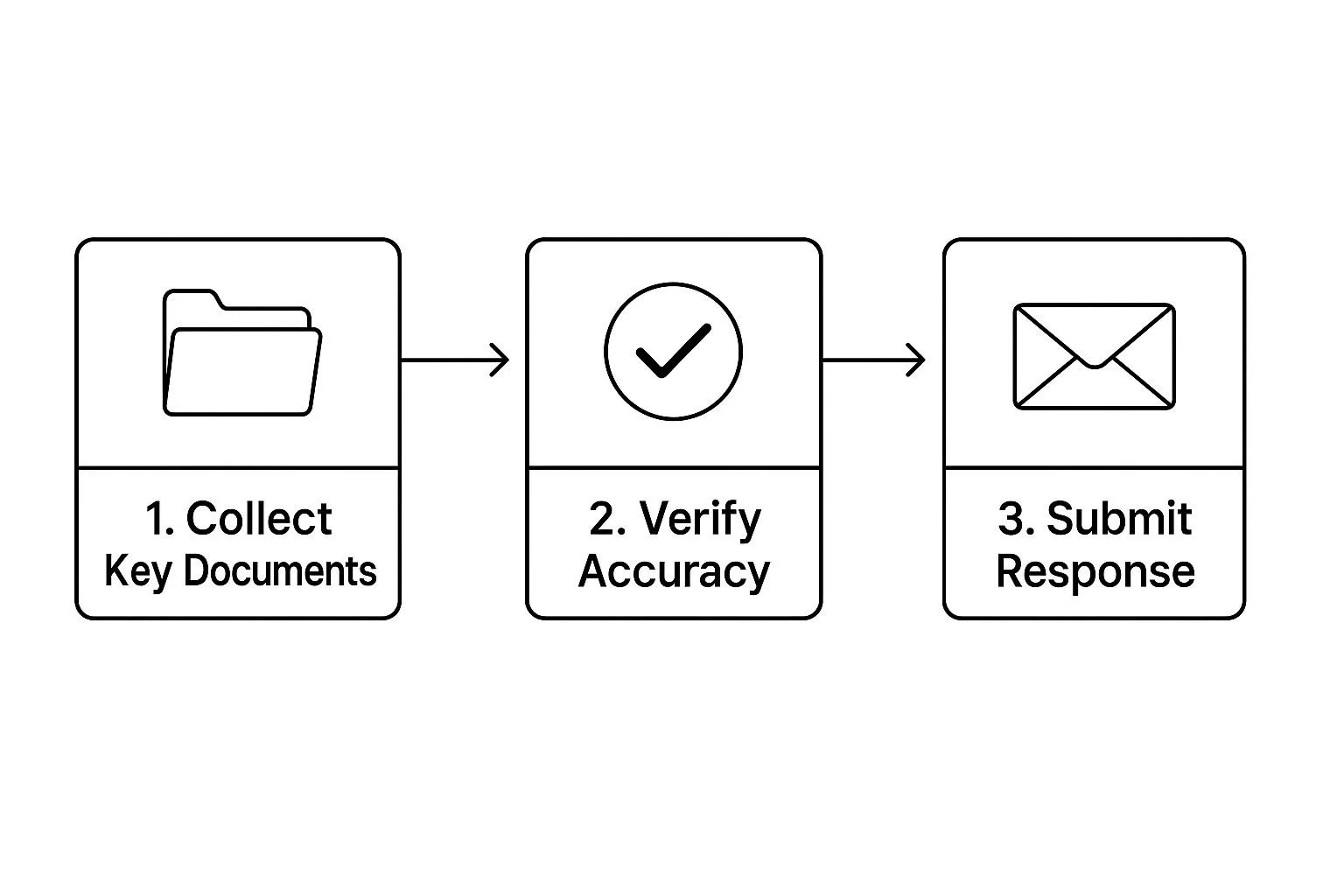
To start the appeals process, you'll file a formal "protest." This isn't just a letter of complaint; it's a detailed written statement explaining exactly why you disagree with the audit findings, backed up by the specific facts and laws that support your position.
Expert Insight: Think of the appeals process as a much less formal and less expensive alternative to going to court. The Appeals Office aims to resolve tax controversies without litigation, striking a balance that's fair to both the taxpayer and the government.
If you go through the entire appeals process and still don't reach a resolution, your final recourse is to take your case to the U.S. Tax Court. Knowing these options exist gives you the confidence to stand your ground and ensure you aren't forced to accept an incorrect assessment.
Common Questions About IRS Audits
Even when you're meticulously prepared, getting that audit notice can trigger a flood of questions. It's a stressful situation, and it’s easy to feel like you're the only one going through it, but trust me, you're not. Most people facing an audit have the exact same worries.
Let's clear the air and tackle some of the most common questions I hear from clients. Getting straight answers to these "what ifs" can make the whole process feel less intimidating and give you the confidence to handle whatever comes your way.
How Long Does an IRS Audit Usually Take?
This is the million-dollar question, and the honest answer is: it depends. The timeline for an audit hinges almost entirely on its type, complexity, and how deep the IRS wants to dig.
A simple mail audit, where they’re just asking about one or two specific items, can sometimes be wrapped up in a few months. That’s especially true if you get them clear, organized documents right away.
On the flip side, a full-blown field audit of a small business with messy books? That can easily drag on for a year, sometimes even longer. The one factor you can influence is your own preparedness. The faster you respond with complete records, the faster you can put it all behind you.
Key Insight: You can’t control the auditor's schedule, but you can control how quickly you respond. Dragging your feet on document requests will only make the process longer and test the auditor's patience.
Can I Amend a Return That Is Under Audit?
I get this question a lot. In short, no—you generally cannot file an amended return (Form 1040-X) for a tax year that the IRS is actively examining. Once the audit starts, that tax return is effectively frozen.
But that doesn't mean you're stuck with an error you’ve found. If you uncover a mistake or have new information that affects what you owe, you absolutely should bring it to the auditor's attention.
The auditor can incorporate those changes directly into their final examination report. If you both agree on the corrections, it becomes part of the official audit outcome—achieving the same goal as if you had filed an amendment.
What Happens If I Ignore an IRS Audit Notice?
Let me be blunt: ignoring an audit notice is one of the worst things you can do. The problem won't disappear. It will snowball.
If you don't respond, the IRS will simply move forward without you. They’ll make their decision based only on the information they have, which almost always means disallowing every single deduction and credit they were questioning. This is known as a default assessment.
That leads to a Notice of Deficiency—a legal bill for the new tax amount, plus a mountain of penalties and interest. From there, the IRS will start aggressive collection actions. This can include:
Filing a Federal Tax Lien on your home and other property.
Issuing levies to seize funds from your bank accounts and paychecks.
Taking possession of your assets.
The fallout is far more severe and financially damaging than the audit itself. Just don't do it.
Will One Audit Trigger Audits for Other Years?
This is a legitimate fear, and while it can happen, it's not a given. An audit of one tax year doesn't automatically put all your other years under the microscope.
An auditor might expand the audit to other years if they find what they believe are significant, intentional errors. For example, if they discover you’ve been writing off personal vacations as business travel in 2022, they'll have every reason to suspect you did the same in 2021 and 2023.
This is precisely why you must be honest and provide only the specific information requested for the year being audited. Never volunteer information about other years.
You could accidentally open a Pandora's box the auditor never intended to look into. If the audit does result in a tax bill you can't manage, it's important to explore your relief options.
At the office of Attorney Stephen A Weisberg, we understand the stress an IRS audit can cause. With over a decade of experience, I work directly with taxpayers to navigate complex audits, protect their rights, and achieve the best possible outcomes. Don't face the IRS alone.
For a free, no-obligation tax debt analysis and to see how we can help, visit us at https://weisberg.tax.
➥ Contact Attorney Stephen A. Weisberg for a free Tax Debt Analysis.
Contact Me Here: https://www.weisberg.tax/contact-1
Email: s.weisberg@weisberg.tax
Phone/Text: (248) 971-0885
Address: 300 Galleria Officentre, Suite 402, Southfield, MI 48034
