A Guide to IRS Forms 433B for Businesses
When the IRS sends you a Form 433-B, it’s time to pay close attention. This form, officially known as the Collection Information Statement for Businesses, is how the IRS gets a detailed look under the financial hood of your company when you have outstanding tax debt.
Think of it as a mandatory financial physical for your business. The IRS uses the information you provide to determine exactly what your business can afford to pay and how they'll proceed with collecting what's owed.
What's the Real Purpose of Form 433-B?

A request for Form 433-B from an IRS Revenue Officer signals a serious turn in the collection process. This isn't just routine paperwork; it's a comprehensive deep dive into your business's finances. The form asks for everything from bank balances and accounts receivable to real estate holdings and day-to-day operating expenses.
The IRS isn’t just being nosy. All this data is crunched to calculate what they call your business’s “reasonable collection potential.” In short, this document becomes the bedrock for any negotiation about your business tax debt. Without it, the IRS is flying blind; with it, they have a clear path forward.
The Key to Unlocking Tax Relief
Completing Form 433-B accurately is your first, and most critical, step toward resolving your tax issues. It’s the key that opens the door to negotiating a solution and avoiding more aggressive collection actions, like the IRS levying your bank accounts or seizing company assets.
The numbers you provide will directly impact whether the IRS considers your business for relief options, such as:
An Installment Agreement, which lets you pay down the debt in manageable monthly chunks.
An Offer in Compromise (OIC), a potential settlement for less than the total amount you owe.
Currently Not Collectible (CNC) status, a temporary pause on collections for businesses facing extreme financial hardship.
At its core, Form 433-B is all about painting a clear, fact-based picture of your company’s ability to pay. Honesty and accuracy are non-negotiable here, as this form dictates the entire tone and direction of your talks with the IRS.
To give you a clearer picture, here’s a quick summary of what Form 433-B is all about.
Form 433-B At-a-Glance
| Aspect | Description |
|---|---|
| Official Title | Collection Information Statement for Businesses |
| Primary Purpose | To determine a business's ability to pay its overdue tax liabilities. |
| Who Files It | Partnerships, corporations, and LLCs with outstanding tax debt, when requested by the IRS. |
| Key Information Required | Business assets (cash, real estate, vehicles), income (gross receipts, receivables), and expenses (payroll, rent, supplies). |
| How the IRS Uses It | To evaluate eligibility for tax resolution options like Installment Agreements, Offers in Compromise, or Currently Not Collectible status. |
This table highlights that the form is a comprehensive financial disclosure specifically for business entities, forming the basis for all collection negotiations.
Keeping Business and Personal Finances Separate
It’s crucial to understand the difference between Form 433-B and its sibling, Form 433-A. While both are Collection Information Statements, their focus is worlds apart. Form 433-B is exclusively for business entities.
The IRS designed Form 433-B to assess the financial capacity of a company—be it a partnership, corporation, or LLC—by looking only at business income, assets, and expenses.
This keeps your personal finances out of the picture, unless unique situations like the trust fund recovery penalty come into play. Maintaining this distinction is essential for preserving the legal wall between you and your company.
You can find more details on how the IRS uses Form 433-B for tax resolution to understand the process better.
When and Why the IRS Wants a Form 433-B
Getting a request from the IRS to fill out Form 433-B isn't something that happens out of the blue. It’s a very specific and serious step in their collection process. It means your business's tax debt has crossed a threshold, and the IRS now requires a complete, under-the-hood look at your company's finances.
This isn't a form you can just decide to file on your own. It’s sent by an IRS Revenue Officer only after your business has racked up a significant tax bill and earlier, less direct attempts to collect have gone nowhere. Think of it as the IRS shifting from automated letters to a hands-on, manual investigation.
Who Has to File Form 433-B?
The IRS uses Form 433-B for specific types of businesses, not individuals. If you're a sole proprietor, you'd use a different form (Form 433-A). This one is strictly for business entities.
The list of who gets this form includes:
C-Corporations
S-Corporations
Partnerships
Limited Liability Companies (LLCs) (if they're taxed as a corporation or partnership)
Exempt Organizations that owe taxes
Basically, if your business is its own legal entity, separate from you personally, Form 433-B is the tool the IRS uses to dissect its financial situation. This is a critical distinction because it keeps the focus on the business's assets and ability to pay, not your personal finances.
Common Triggers for a Form 433-B Request
So, what gets a Revenue Officer to show up asking for this form? While every situation is different, it almost always boils down to a serious, unresolved tax debt that’s been lingering for too long.
One of the biggest red flags for the IRS is unpaid payroll taxes. They take this very seriously. That money was withheld from your employees' paychecks and is considered a "trust fund" tax—it technically belongs to the government the moment you withhold it. When a business falls behind on these payments, the IRS tends to get aggressive, fast.
Another common reason is a growing corporate income tax debt. If your business has been filing returns that show you owe money but you haven't paid, the collection notices will start piling up. Ignore them long enough, and a Revenue Officer will be assigned, and a Form 433-B will soon follow.
Make no mistake: responding to a Form 433-B request is not optional. If you fail to provide it, the IRS can and will move forward with aggressive collection actions. We’re talking about levying your business bank accounts, seizing assets, and filing liens against company property.
At the end of the day, this form is your key to finding a solution. The IRS needs this complete financial picture to figure out if your business can get on a payment plan or qualify for other programs.
For instance, the information you provide is the foundation for an IRS Offer in Compromise, which can be a lifeline for a struggling business. Seeing the form for what it is—a necessary step toward resolution—is the first move in getting back on track.
A Guide to Tackling Each Section of IRS Form 433-B
Opening up IRS Form 433-B can feel like you're about to perform a deep financial autopsy on your own business. It's intimidating, but the best way to approach it is to break it down into smaller, more manageable parts.
Think of it as telling your company's financial story to the IRS, one piece at a time. The whole game is about being thorough, honest, and organized.
My goal here is to walk you through the form section by section, going beyond the dry, official instructions. We'll get into what the IRS is really looking for and how you can present your information in a way that builds a strong, credible case for a tax resolution.
To get started, here's a quick visual that lays out the core steps you'll be taking.
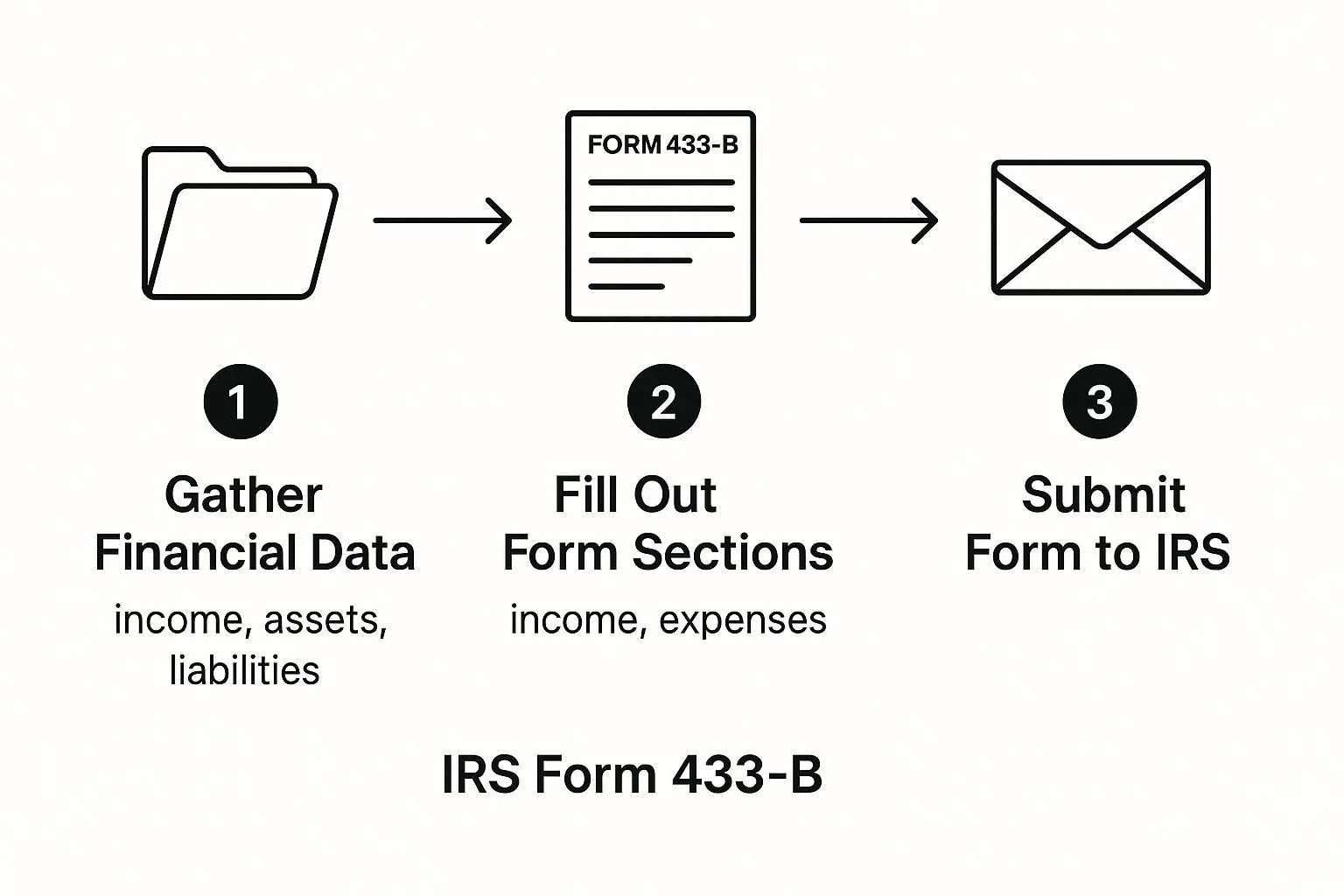
As you can see, the real work begins long before you write a single number on the form. Solid preparation is everything.
Section 1: Business Information and Key Personnel
The first section of Form 433-B is all about the fundamentals. This is where you lay the groundwork, providing the basic identity of your business—its official name, Employer Identification Number (EIN), address, and how it’s structured (like an S-Corp, C-Corp, or Partnership).
It seems simple, but getting these details exactly right is crucial. Any mismatch with IRS records can stop the process in its tracks.
But it doesn't stop there. The form then asks about your operations: how many people you employ, your monthly payroll expenses, and even which payment processors (think Square or PayPal) and credit cards you accept. This gives the Revenue Officer an immediate feel for the size of your business and where your cash comes from.
You’ll also have to list all the key players—partners, officers, or anyone with a major ownership stake. For each individual, you need to provide:
Their name, title, and home address
Their Social Security Number
Their annual compensation or draw from the business
A clear statement of who is responsible for making federal tax deposits
That last point is a big one. The IRS uses this information to identify who could be held personally responsible for certain unpaid business taxes, especially payroll taxes.
Section 2: Painting the Asset Picture
Next up, Section 2 dives deep into everything your business owns. This is where you need to be completely transparent. The IRS wants a full, honest accounting of every business asset, so this isn't the place for vague estimates. You’re essentially creating a detailed inventory of your company’s financial worth.
This asset declaration is pretty comprehensive. You'll list cash in the register, details for every bank account (including account numbers and current balances), and the contents of any safe deposit boxes.
You also have to disclose any investments and, importantly, the available credit on business credit cards or lines of credit. From the IRS's perspective, unused credit is a potential source of funds to pay the tax debt.
A huge part of this section is dedicated to:
Accounts Receivable: You need to list all outstanding invoices—who owes you money, how much, and for how long. The IRS wants to see how much cash is expected to flow into the business in the near future.
Real Property: If the business owns any land or buildings, you must detail its current market value, what you still owe on it, and the monthly payment.
Vehicles and Equipment: All company vehicles, machinery, and other major equipment get listed here. You’ll need to provide their value, any loan balances, and the resulting equity.
The ultimate goal for the IRS here is to calculate the "quick sale value" of your assets. This is the figure they believe could be generated by liquidating everything quickly to pay down the tax debt, and it heavily influences what kind of deal they're willing to make.
Section 3: The Income and Expense Breakdown
This final major section is often the most challenging. Here, you have to calculate your business's average monthly income and all necessary monthly expenses. The result of this calculation determines your net disposable income—the amount the IRS thinks you have left over each month to pay them.
First, you have to pick a representative timeframe for your numbers, usually the past 3, 6, or 12 months. If your business has seasonal peaks and valleys, using a full 12-month period is the only way to give the IRS an accurate, annualized view of your finances.
To help you visualize it, here’s a look at the top portion of the form itself.
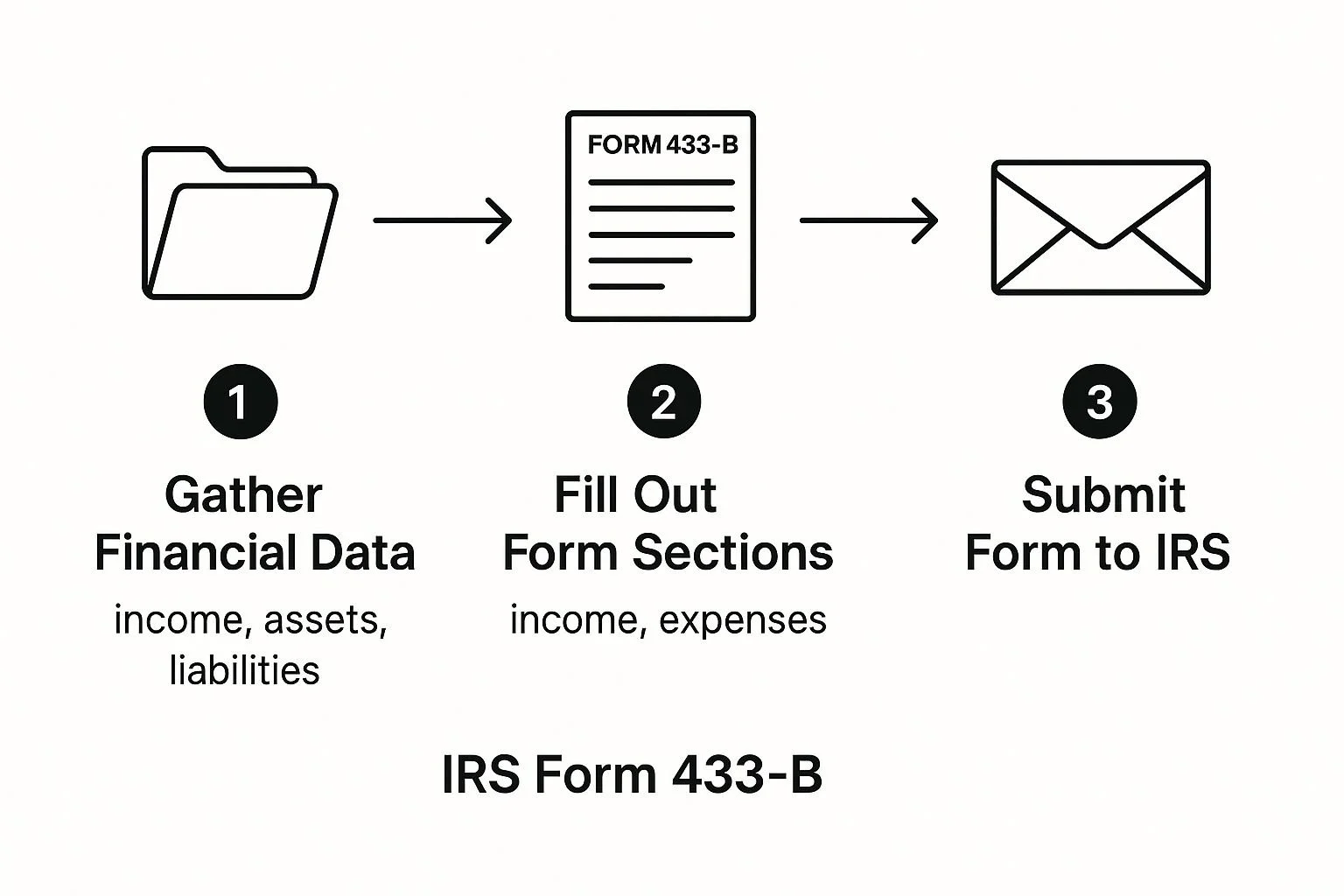
This snapshot shows where you'll input the foundational business information before diving into the more complex financial disclosures that follow.
On the income side of the ledger, you’ll report gross monthly receipts from all your sales and services. Then, for expenses, you must list all your necessary operating costs, and the IRS has very strict ideas about what qualifies as "necessary." Allowable expenses typically include:
Wages and salaries (but not for the officers, who are listed separately)
Rent or mortgage payments for your business location
Business supplies and raw materials
Utilities
Fuel and maintenance for business vehicles
The IRS will go over these expenses with a fine-tooth comb. Any costs that seem too high or can't be proven will be disallowed, which in turn increases your calculated ability to pay.
After you've totaled all your income and subtracted all the allowable expenses, you'll be left with a net income figure. This single number is what the IRS will use as the starting point for negotiating a monthly installment agreement.
If that number is negative, it might open the door to other solutions, like being placed in Currently Not Collectible status.
For individuals facing similar collection actions from the IRS, the process is a bit different. You can find more information about the simpler, personal version of this form, the IRS Form 433-F. While the core idea is the same, the forms and specific requirements are distinct.
Assembling Your Supporting Financial Documents

When you fill out Form 433-B, the numbers you write down are just claims. They don't become facts until you back them up with solid proof. Think of the form as the story of your business's financial situation, and your supporting documents are the evidence that makes that story believable. The IRS simply won't take your word for it.
Submitting a messy or incomplete package of documents is one of the fastest ways to get on a Revenue Officer's bad side. It screams disorganization, or worse, that you might be hiding something.
This only invites a deeper, more painful investigation and delays any chance of resolving your tax debt. A clean, organized submission, on the other hand, builds instant credibility and helps the whole process move along much more smoothly.
What Documents Will I Need?
Think of this part of the process as a financial scavenger hunt. Your mission is to gather all the specific paperwork that paints a clear, verifiable picture of your business's assets, income, and essential expenses. This isn't just about grabbing your last bank statement; it’s about creating a consistent financial narrative over the past several months.
To help you get started, the table below outlines the most common documents the IRS will ask for. This isn't an exhaustive list, but it covers the core items you'll definitely need to pull together.
Supporting Document Checklist for Form 433-B
| Financial Area | Required Documents |
|---|---|
| Cash and Bank Accounts | Complete bank statements for at least the last 3 months for all business accounts (checking, savings, money market, etc.). |
| Business Financial Health | Your most recent Profit & Loss (P&L) statement and a current Balance Sheet. |
| Income/Receivables | A detailed Accounts Receivable aging report showing who owes you money, how much, and for how long. |
| Assets and Liabilities | Current statements for all business loans, lines of credit, credit cards, and mortgages, showing balances and payments. |
| Income Verification | Copies of filed business tax returns for the past two years. |
| Expense Verification | Payroll registers, copies of lease agreements, and invoices/receipts for major recurring expenses. |
Getting these documents in order before you even start filling out the form will make the entire process less stressful. It ensures the numbers you report are accurate and instantly verifiable.
Proving Your Income and Expenses
Simply writing down your average monthly income and expenses isn't going to cut it. The IRS needs to see the paper trail behind those figures. This means providing documents that validate both the money coming in and, just as importantly, the money going out for necessary business operations.
To back up your claims, be prepared with:
Payroll Records: Pull complete payroll registers for the same period as your bank statements (usually three months or more) to verify what you're paying your team.
Lease or Rent Agreements: Have a copy of your current, signed lease agreement for your business location to prove your monthly rent or mortgage expense.
Receipts for Major Expenses: For significant, recurring costs like supplies, materials, or vehicle expenses, you'll need the invoices or receipts to match.
The IRS essentially operates on a "trust, but verify" model. Your goal is to make the "verify" part as painless as possible for the Revenue Officer. The more organized and complete your documentation is, the more credible your entire submission becomes.
It’s also crucial to understand which expenses the IRS will even allow. They don't just accept everything; they follow strict national and local guidelines known as the IRS Collection Financial Standards.
These standards dictate what the IRS considers a "necessary" and "reasonable" expense. Reviewing these ahead of time can save you a lot of headaches and help you anticipate which of your expenses might get challenged.
To get a handle on your company's overall financial picture, including the value of assets you must report, using a business valuation estimator can be a helpful resource as you prepare your package for the IRS.
Being meticulous here is non-negotiable. It's the difference between a smooth review and a frustrating, drawn-out battle with the IRS that could sink your chances of a good resolution.
Critical Mistakes to Avoid on Your Form 433-B
Filling out IRS Form 433-B isn't just paperwork; it's a high-stakes financial disclosure. Think of it as a credibility test with the IRS. Even small, honest mistakes can have massive consequences, leading to a rejected payment plan or, even worse, triggering a much deeper financial investigation.
The best way to get this right is to learn from the mistakes others have made. Knowing the common pitfalls ahead of time helps you build a submission that's accurate, honest, and puts you in the best possible position for a favorable outcome with the Revenue Officer.
Misrepresenting Your Financial Picture
One of the quickest ways to lose credibility is to provide a financial snapshot that doesn't quite add up. This happens more often than you'd think, and the IRS has seen every trick in the book.
A classic mistake is messing up your average monthly income. It’s tempting to use a single, really good month as your baseline, but that’s not how it works.
The IRS wants to see a realistic average, usually based on the last 3 to 12 months of activity. If you inflate your income, they’ll expect a higher monthly payment that your business probably can't afford long-term.
Underreporting assets is another huge red flag. "Forgetting" to list a secondary bank account, lowballing the value of company vehicles, or leaving out a key piece of equipment isn't seen as an oversight. To the IRS, it looks like you're trying to hide something, and they have the tools to find those assets anyway.
The name of the game is transparency. The moment a Revenue Officer suspects you're trying to minimize income or conceal assets—whether you meant to or not—you've lost their trust. Getting that trust back is incredibly difficult.
Leaving sections blank is just as bad. An incomplete form forces the IRS to fill in the gaps with their own assumptions, which are rarely in your favor. It's a guaranteed way to get the form sent back, causing frustrating delays.
Overstating and Unsubstantiated Expenses
Just as you can't misrepresent your income, you can't get creative with your expenses either. Business owners often want to list every dollar going out the door, but the IRS is only interested in expenses that are both necessary and reasonable for keeping the lights on.
Here are a few expense-related blunders to watch out for:
Including Disallowed Costs: Trying to claim personal expenses, lavish meals, or other discretionary spending is a non-starter. The IRS will shred these claims.
Using Estimates Instead of Actuals: "About $2,000 a month for supplies" won't cut it. If you can only show receipts for $1,200, then $1,200 is the number they'll use. You need proof.
Lacking Proper Documentation: Every major expense requires a paper trail. If you can't back it up with a receipt, invoice, or bank statement, it simply doesn't count in the eyes of the IRS.
When the IRS disallows your expenses, your net disposable income on paper goes up. This means they'll calculate that your business can afford a much higher monthly payment, regardless of what your actual cash flow looks like. This is precisely why having organized, solid proof for every single claimed expense is non-negotiable when you prepare your IRS Form 433-B.
What to Expect After Submitting Your Form

Hitting "send" or mailing your Form 433-B is a big step, but it’s the beginning of the negotiation, not the end. Once that form lands on a Revenue Officer's desk, they'll start digging in, verifying every single number you provided. Think of it as a laser-focused financial review of your business's ability to pay its tax debt.
The officer's main job is to figure out your business's Reasonable Collection Potential (RCP). This is the magic number the IRS believes it can realistically get from you. They calculate it by looking at your net monthly income and the equity you have tied up in your assets. This single calculation shapes every decision that follows.
Potential Outcomes of the IRS Review
After the Revenue Officer crunches the numbers, your case will head in one of several directions. The outcome depends entirely on the story your Form 433-B and supporting documents tell about your business's financial situation.
Here are the most common results:
An Installment Agreement: If your form shows you have a steady positive cash flow each month, the IRS will likely offer a monthly payment plan based on that amount.
A Demand for Full Payment: Does your business have a lot of cash in the bank or valuable equipment? If the officer sees significant equity in your assets, they might demand you sell them to pay off the debt immediately.
An Offer in Compromise (OIC): When your tax debt is far greater than your ability to pay (your RCP), the IRS may be willing to settle the debt for less than the full amount owed.
Currently Not Collectible (CNC) Status: If your business is truly struggling, with no extra income and no assets to speak of, the IRS might temporarily halt all collection efforts.
The Back-and-Forth Communication
It’s almost unheard of for the IRS to accept a Form 433-B without a single question. Get ready for some back-and-forth. The Revenue Officer will likely call or send a letter asking for more details on certain expenses or requesting updated documents, like more recent bank statements or a current accounts receivable aging report.
Responding quickly and completely is your most important job here. Any delays or vague answers can hurt your credibility and might lead the officer to assume the worst about your finances, resulting in a less favorable outcome for you.
Staying engaged and cooperative is the best way to steer the process toward a resolution your business can actually live with.
Answering Your Top Questions About Form 433-B
When you're staring down an IRS Form 433-B, questions are bound to pop up. It's a detailed form, and the stakes are high. Let's walk through some of the most common things business owners ask when they get to this point.
Form 433-B vs. Form 433-B (OIC)
So, what's the deal with the two versions of this form? It's a common point of confusion.
Think of it this way: the standard Form 433-B is what the IRS uses to figure out what your business can afford to pay on an ongoing basis. It’s the go-to form for setting up something like an Installment Agreement.
The Form 433-B (OIC), on the other hand, is a different beast entirely. You only use this one if you're submitting an Offer in Compromise—basically, asking the IRS to settle your tax debt for a lower amount. Because you're asking for a significant break, the OIC version of the form is far more intensive and requires a much deeper dive into your finances to prove you can't pay the full debt.
Do My Personal Assets Go on This Form?
For the most part, no. Form 433-B is all about the business. Its whole purpose is to get a clear picture of your company's financial health, separate from your personal situation.
But there's a big "however" here. If the IRS is coming after you personally for certain business debts, like unpaid payroll taxes (often called trust fund taxes), they'll want to see your personal finances, too. In that scenario, you'll probably be asked to fill out Form 433-A, the personal version, in addition to the business form.
How to Handle Income That's All Over the Place
What if your business income isn't a neat, predictable monthly number? This is super common for seasonal or project-based businesses.
The IRS gets it. The form isn't designed to trip you up. It actually lets you average your income and expenses over a longer period—like 3, 6, or even 12 months.
If you run a landscaping company that's busy in the summer and dead in the winter, using a 12-month average is the only way to go. It smooths out the peaks and valleys, giving the IRS a realistic view of what your business can actually afford year-round.
Key Takeaway: Choosing the right timeframe to average your numbers is critical. It ensures the payment plan you negotiate is one your business can actually stick to, not one based on your best (or worst) month.
Should I Get Professional Help?
You absolutely can, and for many business owners, it's a smart move.
Bringing in a tax professional—like a CPA, Enrolled Agent, or tax attorney who specializes in this stuff—can be a game-changer. They've been through this process countless times. They know how to present your information accurately and persuasively, sidestep the common pitfalls, and negotiate with the IRS on your behalf. It often leads to a much better outcome than trying to go it alone.
Navigating IRS collections can feel like a maze, but you don't have to find your way out by yourself. At Attorney Stephen A Weisberg, our focus is on guiding businesses through complex tax problems. If you'd like to see how we can help, please visit weisberg.tax for a free, no-pressure tax debt analysis.
When the IRS sends you a Form 433-B, it’s time to pay close attention. This form, officially known as the Collection Information Statement for Businesses, is how the IRS gets a detailed look under the financial hood of your company when you have outstanding tax debt.
Want to understand your options before you call anyone?
Download my free book — Freedom From Tax Debt — a plain-language guide to how the IRS collections process actually works and what resolution really looks like.
➥ Contact Attorney Stephen A. Weisberg for a free Tax Debt Analysis.
Contact Me Here: https://www.weisberg.tax/contact-1
Email: s.weisberg@weisberg.tax
Phone/Text: (248) 971-0885
Address: 300 Galleria Officentre, Suite 402, Southfield, MI 48034
