IRS Fresh Start Tax Program a Complete Guide
If you're staring down a mountain of tax debt, the IRS Fresh Start Tax Program is the lifeline you need to know about. It’s not one single solution, but rather a collection of relief options the IRS created to help people get back on their feet. Think of it as a set of pathways—like payment plans and settlement offers—designed to resolve your tax issues without crushing you financially.
What Is the IRS Fresh Start Program, Really?
It’s easy to get lost in the jargon, so let’s simplify. The Fresh Start Program isn't some form you fill out. Instead, it’s a toolbox. Inside, you’ll find different tools meant for different problems. This initiative signals a huge shift in how the IRS operates, moving away from a purely punishment-first approach to one that offers practical, manageable solutions for taxpayers in a tough spot. It’s a lifeline, not a loophole.
The whole point is to give folks a fair chance to get right with the tax system. Rather than letting penalties and interest spiral out of control, the program carves out a structured way forward.
The Philosophy Behind Fresh Start
At its core, the Fresh Start Program is the IRS's way of acknowledging that life happens. People lose jobs, face unexpected medical bills, or see their business struggle. The agency gets that people can fall behind for reasons beyond their control. This initiative tries to strike a balance between the government's need to collect taxes and the reality that burying someone in debt makes it impossible for them to ever pay.
The program is designed to prevent financial ruin, not cause it. By offering flexible solutions, the IRS helps taxpayers resolve their liabilities and encourages future compliance, which is a win-win for both parties.
Key Components of the Program
The Fresh Start initiative is an umbrella term for several distinct relief options. Getting a handle on these is the first step to figuring out which path is right for you. The main options include:
Offer in Compromise (OIC): This is the big one. It allows certain taxpayers to settle their tax debt with the IRS for less than the full amount they owe.
Installment Agreements: This option gives you a structured way to pay off your tax debt over time, often for up to 72 months.
Penalty Abatement: If you can show a "reasonable cause" for why you didn't file or pay on time, the IRS might agree to remove certain penalties.
Tax Lien Relief: This makes it easier to have a federal tax lien withdrawn, which is crucial because a lien is a public claim against your property that can wreck your credit.
One of the most significant changes to the program was raising the threshold for filing a federal tax lien from $5,000 to $25,000. This single update has saved countless taxpayers from serious credit damage, leading to a nearly 76% drop in tax lien notices filed between 2010 and 2023.
Could You Qualify for Tax Relief
Trying to figure out if you're a good fit for the IRS Fresh Start Tax Program isn't as intimidating as it sounds. The program isn't some rigid, pass-fail test. Instead, think of it as a set of financial signposts designed to identify taxpayers who genuinely need a more flexible way to settle their debt.
The IRS uses these guidelines to make the process smoother for everyone involved. If your financial picture aligns with certain common hardship scenarios, you’ll have a much better shot at qualifying for one of the program’s relief options. These aren't just random numbers; they’re based on realistic levels of financial strain.
Checking the Core Eligibility Boxes
While each type of relief has its own specific rules, a few ground rules apply to everything. The absolute first step is tax compliance. The IRS won't even consider a relief plan until all your required tax returns are filed. It’s simple, really—they can't negotiate a payment plan if they don't know the full extent of what you owe.
Once your filings are up to date, the IRS looks at your total tax debt and annual income. The program is built for people and businesses who owe a significant amount, but one that’s not completely insurmountable.
Here are the typical benchmarks the IRS looks for:
Total Tax Debt: Your combined tax, penalty, and interest debt is generally under $50,000.
Annual Income: For streamlined installment plans, your income needs to be below $100,000 (single filers) or $200,000 (married filing jointly).
Business Income Loss: If you're self-employed or a small business owner, you might also get in the door by showing your income has dropped by 25% or more.
Who Benefits Most from This Program
The Fresh Start program isn't a one-size-fits-all solution. It offers several different paths, each designed for a specific situation. Whether you qualify often boils down to your ability to pay, how much you owe, and your history of compliance. The Offer in Compromise (OIC), for instance, is one of the program's most powerful tools, letting you settle your entire tax liability for less than the full amount.
The IRS Fresh Start Program provides multiple avenues for resolving tax debts, from installment plans to settling for a lower amount. However, it's important to have realistic expectations; in 2021, the IRS accepted just over 30% of the OIC applications it received, highlighting the need for a strong and well-documented case. For more details on these relief options, you can explore valuable insights on who can benefit from the Fresh Start program.
That statistic alone shows why it's so critical to understand the fine print for each option. If an OIC seems like a long shot, a more straightforward installment agreement could be the perfect solution.
A Quick Self-Assessment Checklist
Want a clearer picture of where you stand? Run through these questions. If you find yourself answering "yes" to one or more, the IRS Fresh Start Program is likely a path worth exploring.
Is your total IRS debt (including penalties and interest) under $50,000? This is the magic number that opens the door to streamlined payment plans.
Are all your past-due tax returns filed? This is a non-negotiable first step. No exceptions.
Can you prove that paying your full tax debt would cause serious financial hardship? This is the core argument for an Offer in Compromise.
Are you self-employed and has your income recently taken a nosedive? A significant drop could get you special consideration from the IRS.
If you’re nodding along to any of these, it’s a pretty strong signal that it's time to dig deeper into the solutions this program has to offer.
Breaking Down Your Tax Relief Options
The IRS Fresh Start Program isn't a single, one-size-fits-all solution. Think of it more like a toolkit, where each tool is designed for a specific kind of financial problem. Getting to the root of your tax issue is the first step, and from there, you can figure out which tool will get the job done.
It’s a lot like managing any other kind of debt. You might try to negotiate a lower payoff amount, set up a payment plan you can actually afford, get late fees waived, or even ask for a temporary break from collections. The Fresh Start Program essentially formalizes these commonsense approaches, giving you a structured path back to good standing with the IRS.
The infographic below really breaks down how the program's main benefits work together to help taxpayers in different situations.
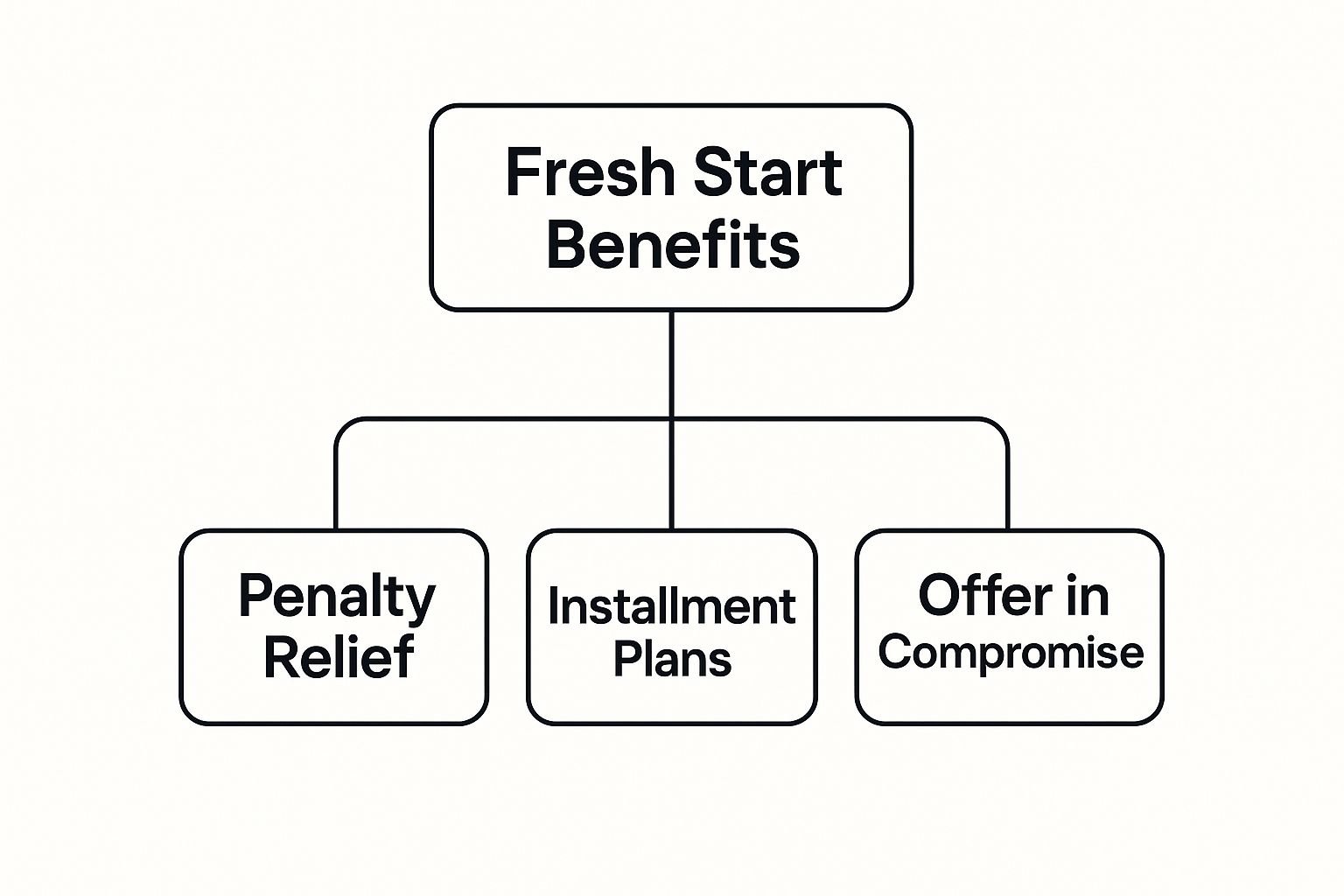
As you can see, it all boils down to three core pillars: settling the debt for less, paying it off over time, or getting penalties removed. Each one offers a different kind of lifeline.
Offer in Compromise: Settling for Less
The Offer in Compromise (OIC) is the one everyone's heard about—the chance to settle your tax debt for less, sometimes much less, than the full amount you owe. But it's also the most misunderstood. This isn't a casual negotiation; it's a deep financial review where the IRS determines if you truly can't afford to pay what you owe.
Think of it this way: if you owed a huge credit card bill you had no hope of paying, you might show the bank your income, assets, and living expenses to prove it.
The bank might then agree to accept a smaller lump sum, figuring it's better than getting nothing at all. The OIC works on a similar idea, using a strict formula called Reasonable Collection Potential (RCP) to figure out the absolute most the IRS believes it could ever get from you.
This path is really for people in a serious financial bind with no light at the end of the tunnel for paying off the full debt. The application is intense, so be prepared to open up your books completely.
Installment Agreements: A Structured Payment Plan
If an OIC isn't in the cards, an Installment Agreement is often the next best thing. This is the most straightforward option in the toolkit. You agree to pay the full amount you owe, but you get to do it over time in manageable monthly payments. It’s less of a settlement and more of a predictable repayment plan.
The Fresh Start initiative blew the doors open on these agreements, making them way more accessible. One of the biggest game-changers was extending the maximum repayment term to 72 months (that’s six years), giving people a lot more breathing room.
There are a few different flavors of these agreements:
Guaranteed Installment Agreements: If you owe less than $10,000, you're almost certain to get approved as long as you meet some basic filing requirements.
Streamlined Installment Agreements: This is for debts up to $50,000. It requires less paperwork and can often be set up right on the IRS website.
Partial Payment Installment Agreements: This is for unique cases where you can't pay the full debt before the time limit for collections runs out, but you can still pay something each month.
This option is perfect for taxpayers who have the ability to pay their debt but just need more time to do it without the stress of aggressive collection actions.
Penalty Abatement: Wiping Away the Late Fees
Sometimes, the original tax bill isn't the killer—it's the mountain of penalties and interest that has piled up on top of it. Penalty Abatement is the process of asking the IRS to forgive, or "abate," those extra charges. While it won't touch the actual tax you owe, it can slash your total balance significantly.
Ever miss a credit card payment, get hit with a late fee, and call up to ask for a one-time waiver because of a good reason or a long history of on-time payments? It’s the same concept.
The most common path to getting penalties removed is by proving "reasonable cause." This means showing the IRS you did your best to be responsible but were prevented from filing or paying on time by circumstances you couldn't control.
A serious illness, a death in the immediate family, or getting hit by a natural disaster are all classic examples. There's also a First-Time Abatement (FTA) waiver for taxpayers who have a perfect three-year track record of compliance leading up to the mistake.
Currently Not Collectible: Hitting the Pause Button
What if you're in such a tough spot that even a small monthly payment is out of the question? For taxpayers facing extreme financial hardship, the IRS can place their account in Currently Not Collectible (CNC) status. This isn't debt forgiveness—it's a temporary halt on all collection activity.
Think of it as the IRS hitting the pause button. They'll stop trying to garnish your wages or levy your bank account, giving you space to get back on your feet. Your debt will still be there, and interest and penalties will keep growing, but the immediate pressure is off.
CNC is reserved for people whose income is so low that it doesn't even cover basic living expenses. The IRS will check in on your financial situation periodically to see if things have improved. It’s a crucial safety net for those who need to focus on just getting by.
Comparing IRS Fresh Start Relief Options
To help you see how these options stack up, here’s a quick side-by-side comparison. This table breaks down what each program does, who it's best for, and a key point to keep in mind.
| Relief Option | What It Does | Best For Taxpayers Who... | Key Consideration |
|---|---|---|---|
| Offer in Compromise (OIC) | Settles your tax debt for less than the full amount owed. | Have a low income, few assets, and no foreseeable way to pay the full debt. | The application is complex and requires full financial disclosure. |
| Installment Agreement (IA) | Allows you to pay your full tax debt over time through monthly payments. | Can afford to pay the full debt but need more time (up to 72 months). | Interest and penalties continue to accrue until the debt is paid in full. |
| Penalty Abatement | Removes certain penalties from your account, reducing your total balance. | Had a valid reason for filing/paying late or have a clean compliance history. | This does not reduce the original tax you owe, only the penalties. |
| Currently Not Collectible (CNC) | Temporarily pauses IRS collection efforts due to severe financial hardship. | Cannot afford basic living expenses, let alone a tax payment. | This is a temporary status; the IRS will review your finances periodically. |
Choosing the right path depends entirely on your unique financial circumstances. Understanding the purpose and requirements of each option is the first step toward finding a permanent solution to your tax problem.
How to Apply for the Fresh Start Program

Alright, let's talk about actually applying for the IRS Fresh Start Program. Looking at a stack of IRS forms can feel overwhelming, but don't let it intimidate you. The key is to break the process down into a few logical steps.
Think of it this way: you’re building a case for yourself. And like any good case, it starts with solid preparation and accurate information. The IRS needs a completely transparent view of your financial situation to figure out how they can help.
Stage 1: Gather Your Financial Documents
Before you even think about filling out a form, your first job is to get all your financial ducks in a row. This is non-negotiable. Every number you put on an application has to be backed up by proof, so this groundwork is absolutely the most important part of the entire process.
Here’s what you need to start collecting:
Proof of Income: Grab your recent pay stubs, W-2s, and any 1099s you have. If you're self-employed, pull together your income records for the last three to six months.
Bank Statements: Print out statements from all your checking and savings accounts for that same period.
Monthly Expense Records: This is where you build your budget. Collect your mortgage or rent statements, utility bills, car payments, insurance bills—everything that shows where your money goes each month.
Asset Information: You'll need a list of everything you own. This includes real estate, cars, retirement accounts, and investments, along with a reasonable estimate of what they're worth today.
Tax Documents: The IRS won't even look at your application until you're caught up on filing. Make sure every required tax return has been filed before you start.
Having all this organized from the get-go will make the next stage a whole lot smoother.
Stage 2: Identify and Complete the Correct Forms
Once you have your financial story laid out, it's time to translate it onto the right IRS forms. Which forms you need depends entirely on which solution you're asking for.
Let's break down the main ones you'll encounter:
Form 433-A (OIC) or 433-F: This is your Collection Information Statement. It’s a deep dive into your financial life, where you’ll list everything from income and expenses to assets and debts. The IRS uses this to calculate your "ability to pay," making it essential for both Offers in Compromise and most Installment Agreements.
Form 656: This is the application for an Offer in Compromise. It's where you formally propose a settlement amount to the IRS. You’ll submit this along with Form 433-A and an application fee (unless you qualify for a low-income waiver).
Form 9465: This is the Installment Agreement Request. If you just need a payment plan, this is your ticket. If you owe under $50,000, you can often do this online in minutes and skip the more detailed paperwork.
I can't stress this enough: be brutally honest and accurate on these forms. If the IRS finds a discrepancy between what you've claimed and what they can verify, your application will almost certainly be rejected.
Stage 3: Submit Your Application and Wait
With your paperwork double-checked and signed, you'll mail it off to the IRS. And then... you wait.
The timeline really depends. A simple payment plan could get a thumbs-up in a few weeks. An Offer in Compromise, on the other hand, is a much longer game—expect it to take anywhere from 6 to 12 months, sometimes even longer.
The IRS might reach out with questions. When they do, respond immediately. Any delay on your part just adds to the waiting time.
Most importantly, while you wait, you have to stay current. Keep filing your tax returns on time and pay any new taxes you owe. Becoming non-compliant while the IRS is reviewing your case is the quickest way to get a denial.
Myths And Truths About Tax Relief
Let's be honest, navigating the world of tax relief can feel like walking through a minefield of bad information. There are so many rumors and half-truths floating around that they often stop people from getting the help they desperately need, turning a fixable problem into a full-blown crisis.
The IRS Fresh Start Tax Program was designed to be a lifeline, but these persistent myths can make it seem more like a trap. It’s time we cut through the noise and separate fact from fiction. By busting these common fears, we can help you make a clear-headed decision based on reality, not on scary stories you might have heard from a neighbor.
Myth 1: Applying For Relief Will Trigger An Audit
This is probably the biggest and most stubborn myth out there. A lot of taxpayers worry that raising their hand for help is like painting a giant target on their back, inviting the IRS to comb through every corner of their financial life. The fear is that asking for something like a payment plan or an Offer in Compromise automatically puts them at the top of the audit list.
The truth is actually the opposite. Think of the IRS as having different departments with different jobs. The Fresh Start program is handled by the IRS Collections division, which is a completely separate group from the Examination (or audit) division. They have totally different goals. The Collections team wants to find a realistic way for you to pay your tax debt. The Audit team, on the other hand, is looking for things like unreported income or bogus deductions.
Applying for tax relief is seen as an act of compliance. You're proactively working with the IRS to resolve a debt. That’s exactly what they want you to do. The whole point of the program is to prevent harsh collection actions, not to create new problems for you.
Now, could something on your application raise a red flag? Sure, if the financial information you provide has massive, unexplainable holes in it. But the application itself is not an audit trigger.
Myth 2: Tax Relief Magically Erases All Your Debt
The idea of an Offer in Compromise (OIC) gets a little romanticized. People hear the phrase "settle for pennies on the dollar" and start picturing the IRS just wiping the slate clean for anyone who fills out a form. This leads to the dangerous belief that an OIC is an easy escape hatch for any large tax debt.
In reality, getting an OIC is a tough negotiation based on a rigid financial formula. The IRS will only agree to settle for less than what you owe if you can prove, without a doubt, that you can't pay it back—not now, and not in the foreseeable future. They will put your finances under a microscope, looking at:
Income: Every dollar you have coming in.
Expenses: Your necessary and allowable living costs each month.
Assets: The value of everything you own, from your house and car to savings and investments.
The IRS uses this data to calculate your "Reasonable Collection Potential," which is the absolute lowest amount they'll accept. It's a numbers game, not an appeal to their better nature. While an OIC can be an incredible lifeline, it’s a solution reserved for those in genuine financial distress, not a simple get-out-of-debt-free card.
Myth 3: You Can Hide Assets From The IRS
This is a terrible idea. Some people get the clever notion that they can outsmart the IRS by stashing cash or transferring property to a relative right before applying for relief. The thinking is, "If they can't see it on paper, it doesn't exist." This is an incredibly naive and risky game to play.
The IRS has powerful tools to see right through these schemes. They have access to public records, bank information, and all sorts of third-party data that paints a crystal-clear picture of your financial history. Trying to hide assets isn't just frowned upon; it's considered tax fraud.
If you're caught, your application will be rejected on the spot, and you could face severe civil penalties or even find yourself in criminal trouble. When dealing with the IRS, honesty and transparency aren't just the best policy—they're your only real option.
Staying on Track After Getting Relief
Getting approved for relief through the IRS Fresh Start Tax Program feels like a massive weight has been lifted. It's a huge win, but it's not the end of the road. Think of it less as crossing the finish line and more as getting a clean start in a new race.
The key to making this relief last is staying in the IRS's good graces. You've entered into an agreement—whether it's an Offer in Compromise or an Installment Agreement—and it’s a two-way street. The IRS gave you a path forward; now it’s on you to hold up your end of the deal.
The Non-Negotiables of Staying Compliant
Once your agreement is in place, the IRS will be watching your tax situation closely for the next several years. If you slip up, you could default on the entire deal. That often means the original tax debt, along with all the old penalties and interest, comes roaring back to life.
To keep that from happening, you absolutely must stick to a few core rules:
File All Future Tax Returns On Time: This is the big one. No exceptions, no extensions (unless properly filed). Every single future return must be on time.
Pay All Future Taxes in Full: Any new taxes you owe must be paid when they're due. If you're self-employed, this means keeping up with your quarterly estimated tax payments.
Make Every Agreed-Upon Payment: If your OIC or Installment Agreement has a payment plan, you have to make every single payment on time and for the full amount. No skipping.
Failing on any of these points can trigger a default. That cancels your Fresh Start relief and puts you right back where you started, often in a worse position.
"Securing relief is a significant victory, but maintaining compliance is the path to lasting financial freedom. The Fresh Start Program is designed as a bridge to stability, not a one-time fix. Consistent, timely filing and payment are the pillars that support that bridge."
What to Do If Your Situation Changes
Life happens. A job loss, a sudden medical bill, or another financial curveball can make it tough to stick to your payment plan. If you find yourself in this spot, whatever you do, don't just stop paying and hope the IRS doesn't notice. They will.
Ignoring the problem is the worst possible move. You have to be proactive. Get on the phone with the IRS or your tax professional the moment you know there's an issue. Explain what's going on. It’s often possible to modify your agreement, especially if you can document the hardship. When things get tough, open communication is the best tool you have to keep your relief intact.
Frequently Asked Questions
Even after walking through all the details of the IRS Fresh Start Tax Program, a few specific questions always seem to come up. It's completely normal. When you're dealing with something this important, you want to be sure you have all the facts straight.
Let's tackle some of the most common questions we hear from taxpayers just like you. Getting these final points ironed out can give you the confidence you need to take that next step.
What Happens If My Offer in Compromise Is Rejected?
Getting a rejection letter for an Offer in Compromise (OIC) feels like a punch to the gut, but I promise you, it's not the end of the road. The IRS has to tell you why they denied it, and that reason is gold. You have 30 days from the date on that letter to file an appeal.
This is your opportunity to respond directly to their concerns, maybe by providing extra paperwork or clarifying a detail about your finances. Sometimes, a rejection is simply a sign that a different path, like a straightforward Installment Agreement, is a better fit for your situation and more likely to get approved.
A rejection isn’t a dead end; it's a detour. Use the IRS's feedback to build a stronger case on appeal, or pivot to another Fresh Start option that makes more sense for you financially.
Can I Apply If I Have Unfiled Tax Returns?
No, and this one is a hard-and-fast rule. Before the IRS will even look at your application for any Fresh Start program, you must be current on all your tax filings. That means every single overdue return has to be submitted first.
Think about it from their perspective: they can't figure out a payment plan or a settlement amount if they don't know the full extent of what you owe. Getting all your returns filed is the absolute first step you have to take.
How Long Does the Application Process Take?
The timeline for the IRS Fresh Start Tax Program can be wildly different depending on which program you're going for. Your personal financial picture is the biggest factor in how long it will take.
Streamlined Installment Agreement: This is the fast lane. If you qualify, you can often get this set up directly on the IRS website in just a few minutes.
Offer in Compromise (OIC): This is a marathon, not a sprint. The IRS does a deep dive into your finances, and that investigation can easily take 6 to 12 months—sometimes even longer if your case has a lot of moving parts. Patience is absolutely essential if you're pursuing an OIC.
Trying to navigate tax debt on your own is overwhelming, but you don’t have to. Attorney Stephen A Weisberg begins with a FREE Tax Debt Analysis to map out the best strategy for your specific circumstances.
It’s easy to get lost in the jargon, so let’s simplify. The Fresh Start Program isn't some form you fill out. Instead, it’s a toolbox. Inside, you’ll find different tools meant for different problems. This initiative signals a huge shift in how the IRS operates, moving away from a purely punishment-first approach to one that offers practical, manageable solutions for taxpayers in a tough spot. It’s a lifeline, not a loophole.
Want to understand your options before you call anyone?
Download my free book — Freedom From Tax Debt — a plain-language guide to how the IRS collections process actually works and what resolution really looks like.
➥ Contact Attorney Stephen A. Weisberg for a free Tax Debt Analysis.
Contact Me Here: https://www.weisberg.tax/contact-1
Email: s.weisberg@weisberg.tax
Phone/Text: (248) 971-0885
Address: 300 Galleria Officentre, Suite 402, Southfield, MI 48034
