A Practical Guide to Settling Tax Debt
When a huge tax bill lands on your desk, it’s easy to feel overwhelmed. It can feel like you're cornered, but the truth is, you have more options for settling tax debt than you might realize. The IRS has three main programs to help people get back on track: the Offer in Compromise (OIC), an Installment Agreement, and Currently Not Collectible status.
Figuring out which one fits your situation is the first real step toward getting your financial life back in order.
Your Real Options for Settling Tax Debt

Staring down a significant tax liability feels daunting, but there’s a structured path forward. This isn't about finding some magic loophole; it's about understanding the official programs the IRS offers and seeing which one actually matches your financial reality.
It’s also worth noting the bigger picture. With public debt projected to hit nearly 100% of global GDP within the decade, tax agencies everywhere are under pressure to collect. They're trying to balance being aggressive with offering workable solutions, which means it’s more important than ever for you to take decisive action.
The Three Main Paths to Resolution
Your journey to resolve tax debt will almost certainly follow one of three main roads. Each one is built for a different kind of financial situation, so you need to be brutally honest with yourself about where you stand.
Offer in Compromise (OIC): This is the one everyone hears about. It lets you resolve your tax liability for less than what you owe, but it's not easy to get. The OIC is reserved for people in genuine, provable financial hardship.
Installment Agreement (IA): This is the most common route. It’s pretty straightforward—you make affordable monthly payments over a set period until the debt is paid off. It’s a solid way to get back into good standing without upending your life.
Currently Not Collectible (CNC) Status: If you can prove to the IRS that you can't even afford basic living expenses, let alone a tax payment, they might temporarily pause collections. This isn't a permanent solution, but it gives you breathing room until your situation improves.
Choosing the right path means taking a hard look at your finances. Often, the best move is consulting with a CPA firm to get a professional take on your specific circumstances.
Whatever you do, don't just ignore IRS collection notices. The problem won't disappear—it just gets worse. Penalties and interest will keep piling up, and the IRS will eventually escalate to liens or levies on your assets.
To help you get a clearer picture, I've put together a quick comparison of these options.
Tax Debt Settlement Options at a Glance
This table breaks down the key features of each settlement route, helping you quickly see which one might be the best fit for your circumstances.
| Settlement Option | Best For | Key Requirement | Potential Outcome |
|---|---|---|---|
| Offer in Compromise (OIC) | Individuals with very limited income/assets and no ability to pay the full debt. | Demonstrating severe financial hardship and that the offer is the most the IRS can expect to collect. | Settling your tax debt for a significantly lower amount than what was originally owed. |
| Installment Agreement (IA) | Taxpayers with a steady income who can afford to make regular monthly payments. | Having the ability to pay off the full tax debt, including penalties and interest, over time. | Paying off the debt in manageable chunks over an extended period (up to 72 months). |
| Currently Not Collectible (CNC) | Those experiencing temporary hardship, like unemployment or illness, who can't afford basic living expenses. | Providing detailed financial information that proves an inability to pay anything toward the tax debt. | A temporary halt on collection activities until your financial situation improves. |
This at-a-glance view should give you a starting point for discussion and planning.
Which Path Is Right for You?
So, how do you decide? It all boils down to your ability to pay.
An OIC sounds great, but it has very strict eligibility rules and a notoriously low acceptance rate. The IRS has to be completely convinced that the amount you're offering is truly the most they could ever hope to get from you.
On the other hand, an Installment Agreement is much more attainable, especially if you have a reliable income and can stick to a payment schedule.
For a more detailed breakdown of these strategies, you can explore our guide on. Getting informed is the best way to weigh the pros and cons before you commit to a plan. In the end, settling tax debt is all about finding a solution that works for the IRS and allows you to move on with your life.
How to Navigate an Offer in Compromise
An Offer in Compromise (OIC) can feel like hitting the jackpot when you're buried in tax debt. It's the chance to settle everything for a fraction of the total bill. But let's be clear: the IRS doesn't hand these out like candy. They see it as an absolute last resort.
To get an OIC approved, you have to prove, without a shadow of a doubt, that your offer is the most they could ever hope to collect from you. It all comes down to a single, critical number: your Reasonable Collection Potential (RCP). The IRS calculates this by dissecting your income, expenses, and the equity in your assets. Your offer has to be at least that much. If it's not, it's dead on arrival.
This is why just filling out the forms and hoping for the best rarely works. You need to build an airtight case, backed by rock-solid financial proof.
Proving Your Financial Situation
To even get the IRS to look at your offer, you have to open up your entire financial life for inspection. We're not just talking about showing a low bank balance. You need to demonstrate a consistent, long-term inability to pay off the full tax debt.
Be prepared to gather a mountain of paperwork. Key documents they'll demand include:
Proof of Income: Every penny. This means recent pay stubs, profit and loss statements if you run your own business, and records of any other income you receive.
Expense Verification: They want to see where your money goes. Get ready with bank statements, utility bills, mortgage or rent statements, and even receipts for necessary living costs like food and medical bills.
Asset Documentation: They'll look at everything you own. This includes statements for bank accounts, retirement funds, investment portfolios, and appraisals for your home, vehicles, and any other valuable property.
The IRS will comb through these documents, comparing your spending against their own national and local standards. Trying to inflate your expenses or hide an asset is the fastest way to get your OIC thrown out.
Think of an OIC application as a full-blown financial audit. The IRS will verify every single number. Absolute honesty isn't just the best policy—it's the only policy. Any little discrepancy can tank your credibility and lead to an instant rejection.
Common Mistakes That Get an OIC Denied
The OIC process is a minefield, and I've seen countless people get denied for simple, avoidable mistakes. Knowing what not to do is just as important as knowing what to do.
The biggest killer? Failing to stay current on your taxes. Before the IRS even opens your OIC package, they check your compliance history. If you have unfiled tax returns, they'll send the application right back. You also have to keep making any required estimated tax payments while they're reviewing your offer.
Another classic blunder is submitting an incomplete application. Leaving sections of Form 433-A (OIC) or Form 656 blank or forgetting to attach all the required documents is a recipe for disaster. The IRS isn't going to call you to ask for missing paperwork; they’ll just deny the whole thing. For a full rundown of what it takes, check out our guide on how to qualify for an Offer in Compromise.
Framing Your Offer for Success
A winning OIC is more than just a pile of financial documents. It’s about telling a story—your story. You have to clearly explain why you can't pay the full amount.
Did you lose your job? Suffer a major illness? Did your business go under? Your application needs a short, factual explanation of the circumstances that got you here.
The IRS will only consider an OIC under one of three specific conditions:
Doubt as to Collectibility: This is the most common path. You're proving you simply don't have the income or assets to pay what you owe in full.
Doubt as to Liability: This one is rare. It means you have concrete evidence that you don't actually owe the tax in the first place.
Effective Tax Administration: This is for unique situations where paying the tax would create an extreme economic hardship or would simply be unfair.
By focusing your case on the right grounds and backing it up with irrefutable proof, you show the IRS that your offer is a realistic solution, not just a lowball attempt to get out of your tax bill.
Securing a Sustainable IRS Payment Plan

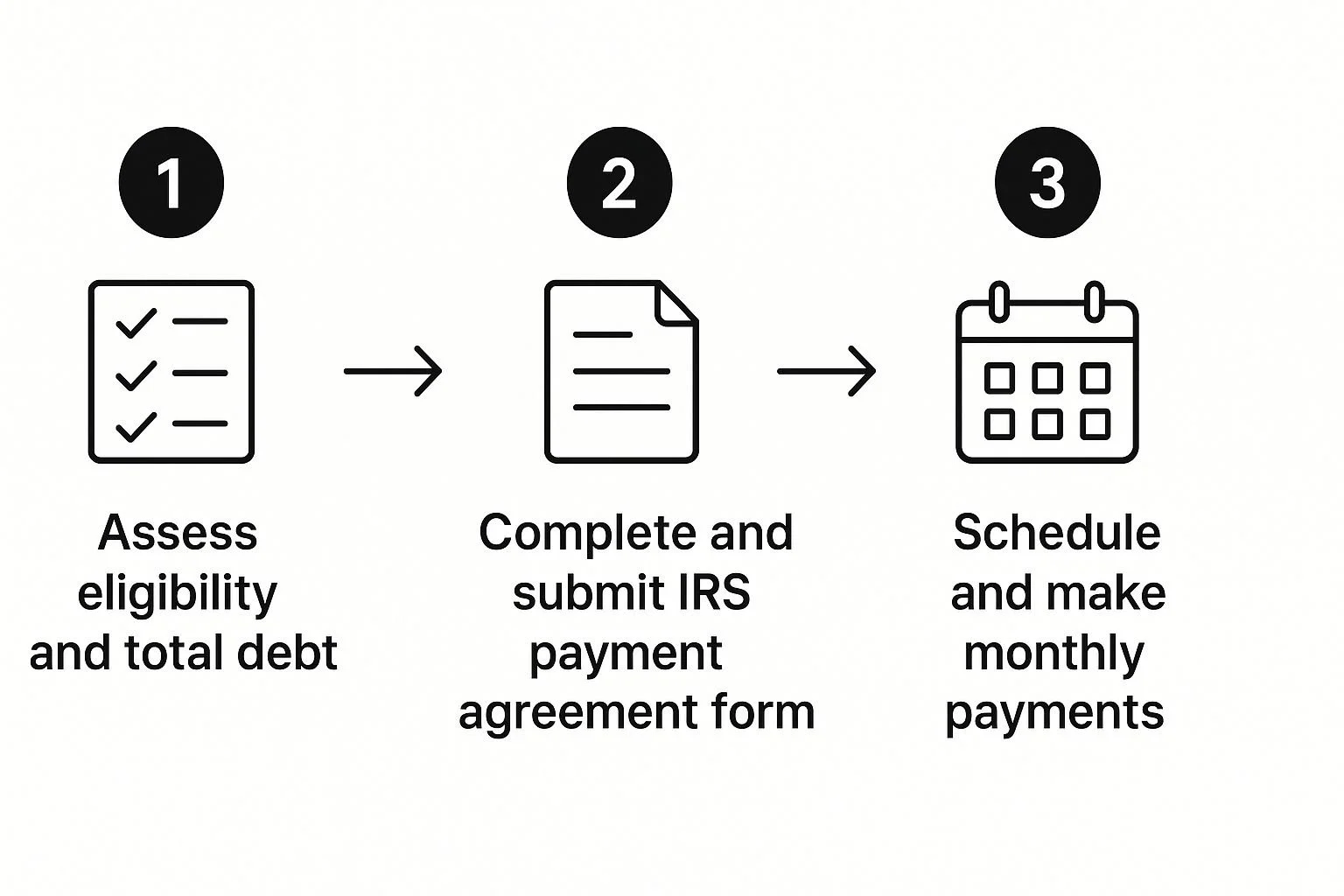
While the Offer in Compromise gets a lot of attention, the most common and reliable path for most people is a good old-fashioned Installment Agreement.
Think of it this way: it's a structured roadmap to getting out of tax debt without needing to prove you're on the brink of financial collapse. It’s the go-to solution for anyone who can pay what they owe, but just can't do it all at once.
This approach breaks down that overwhelming lump sum into a series of manageable monthly payments. The trick, though, is locking in a payment you can actually afford for the long haul. A common pitfall is agreeing to a monthly payment that's too high, which just sets you up for default down the road.
Understanding Your Payment Plan Options
Not all payment plans are built the same. The IRS has a few different flavors, each designed for specific debt amounts and financial situations. Knowing which one you might qualify for is the first step to getting the best terms.
Here are the main players:
Guaranteed Installment Agreement: This is a sure thing if you owe $10,000 or less in tax (not including penalties and interest) and meet a few other basic criteria. The IRS is legally required to give it to you.
Streamlined Installment Agreement: The most popular option, this covers debts up to $50,000 (including tax, penalties, and interest). The best part? The application process is much simpler, and you typically don't have to submit a detailed financial statement.
Partial Payment Installment Agreement (PPIA): This one is for situations where you simply can't pay the full debt before the clock runs out on the IRS's ability to collect. It's more complex and involves proving you can't afford the full payment, but it can be a lifesaver.
Figuring out the right fit comes down to your total debt and your ability to pay. To get a clearer picture, check out our IRS payment plan calculator guide to see what your options might look like.
Negotiating a Payment You Can Afford
This is where the real work begins, especially if you owe more than $50,000. Once you cross that threshold, the IRS will ask you to fill out a Collection Information Statement (Form 433-F). They'll use this form to calculate exactly how much they think you can afford to pay each month based on your income and their "allowable" expenses.
Don't be surprised if the number they come back with seems way out of line with your actual budget.
Your job is to paint an accurate and realistic picture of your necessary living expenses. You need to document everything—rent or mortgage, utilities, car payments, groceries, healthcare costs. A well-organized, well-supported budget is your single most powerful tool for negotiating that proposed payment down to a number you can actually live with.
The IRS uses national and local standards for living expenses, but these aren't set in stone. You can absolutely negotiate them, provided you have legitimate reasons and the proof to back them up. Don't just accept their first offer. Be ready to make your case for a payment that reflects your reality.
Getting this part right is everything. An unaffordable plan is just a temporary fix that inevitably leads to default, leaving you right back where you started, but with even more penalties and interest tacked on.
The Long-Term View of Your Agreement
Getting an agreement approved is a huge win, but it's not the finish line. Remember, interest and penalties keep piling up on your unpaid balance until it's paid off completely. That means the total amount you repay will be higher than your original tax bill.
On top of that, the pressure from tax authorities is only increasing. A 2025 PwC survey revealed that 71% of businesses are seeing more tax inquiries, a trend that’s not slowing down as governments everywhere look to close budget gaps. This global focus on enforcement just highlights how critical it is to stick to your plan.
If your financial situation changes while you're on a payment plan—for better or for worse—you have to let the IRS know. Lose your job? You may be able to get your payments lowered. Get a big raise? You might be expected to pay more. Staying proactive is the key to preventing default and making sure you stay on a clear path to finally settling your tax debt.
When Standard Solutions Just Won’t Cut It
Sometimes, tax problems aren't as simple as missing a payment or two. A standard installment agreement or even a basic Offer in Compromise won't work for every situation. Things get a lot more complicated—and the stakes get much higher—when you're dealing with business-related debts or cleaning up a financial mess created by a spouse.
When you’re staring down these more complex issues, the rulebook changes. The IRS plays hardball, and the consequences can be devastating. Knowing your way around these advanced strategies is crucial for protecting your assets and finding a way out when the easy path is closed.
The Nightmare of Payroll Taxes and the TFRP
If you're a business owner, listen up. There is almost nothing that gets the IRS's attention faster than falling behind on payroll taxes. This isn't just another business debt. The IRS views the money you withheld from your employees' paychecks as their money, held in trust by you. When you don't turn it over, they take it personally.
This is where the dreaded Trust Fund Recovery Penalty (TFRP) comes into play. The IRS can use the TFRP to hold individuals personally liable for the business's unpaid payroll taxes. They can and will go after the personal assets—your house, your savings, your retirement accounts—of anyone they deem a "responsible person." That could be an owner, a C-level executive, or even a bookkeeper who had signature authority on the bank account.
So, how does this process unfold?
The IRS plays detective: They'll launch an investigation, interviewing everyone involved to figure out who had the authority to decide which creditors got paid.
You get the bad news: If they pin you as a responsible party, you’ll receive a formal notice proposing the TFRP assessment against you personally.
You get one shot to fight back: You have the right to appeal the assessment. But make no mistake, the burden is entirely on you to prove you weren't responsible.
The TFRP is one of the most powerful weapons in the IRS arsenal. It’s a debt that is notoriously difficult to get rid of, even in bankruptcy.
Getting a Break with Penalty Abatement
Let's be honest, the penalties the IRS tacks on can be brutal, sometimes jacking up your total bill by 25% or more. The good news? These penalties aren't always a done deal. You might be able to get them removed through a process called penalty abatement.
To have a real shot, you need to show you had reasonable cause for not filing or paying on time. This isn't a get-out-of-jail-free card for simple financial hardship. We're talking about serious, unavoidable life events.
Think situations like:
A debilitating illness or a death in your immediate family.
Your business records being destroyed in a fire, flood, or another disaster.
Relying on bad advice from a tax professional you had every reason to trust.
"To establish reasonable cause, you must show that you acted with ordinary business care and prudence but were unable to file the return within the prescribed time or were unable to pay the tax by the due date."
There's another way, too. If you've been a model taxpayer for the three years prior, you might qualify for First-Time Abate (FTA) relief. Getting those penalties wiped away can be a game-changer, making an insurmountable debt suddenly feel manageable.
Untangling the Mess with Innocent Spouse Relief
What happens when the tax debt hanging over your head isn't even yours? It’s a gut-wrenching scenario, often stemming from a joint return filed with a spouse (or ex-spouse) who was hiding income or fabricating deductions. Fortunately, the IRS has a program called Innocent Spouse Relief to protect people in this exact situation.
You generally have three potential paths to relief:
Innocent Spouse Relief: This is for when your spouse or ex-spouse messed up the return without your knowledge (e.g., unreported income, bogus deductions), and it would be unfair to hold you accountable.
Separation of Liability Relief: This option essentially splits the tax bill from a joint return. You'll only be on the hook for the portion of the tax debt directly attributable to your own income and deductions.
Equitable Relief: This is the fallback option. If you don't qualify for the first two but the IRS agrees it would be fundamentally unfair to make you pay, they can grant relief on a case-by-case basis.
These situations get even trickier for anyone with international financial ties. As of late 2023, nearly 50 countries have adopted new international tax rules, making global compliance a minefield. According to insights from ey.com, these changes require meticulous data management to avoid steep penalties.
Life After Your Tax Debt Is Settled

Getting that tax debt settled feels like a massive weight has been lifted. Whether you managed to secure an Offer in Compromise or worked out an Installment Agreement, take a moment to breathe. You've earned it.
But don't get too comfortable. Reaching this point isn't crossing the finish line—it's the start of a new race. The agreement you have with the IRS is conditional, and one misstep can send you right back to square one.
A single missed payment or an unfiled return could void the entire deal. If that happens, the original debt often comes roaring back, complete with all the penalties and interest you worked so hard to get away from.
Staying Compliant With Your Agreement
Job number one is to follow the terms of your agreement to the letter. This isn't just about making the payments; it's a total commitment to staying on the right side of the IRS from here on out.
If you have an Offer in Compromise, the IRS is watching you very closely. You’re typically locked into a five-year compliance period. During this time, you absolutely must:
File every single tax return on time.
Pay any new taxes you owe, in full and on time.
Avoid getting into any new tax debt.
Mess up on any of these points, and you can default on the OIC. For Installment Agreements, the biggest thing is making your payments without fail. My best advice? Set up automatic withdrawals. It’s a simple move that takes human error out of the equation.
Proactive Steps to Avoid Future Tax Debt
True freedom from tax problems means changing the habits that got you here. Now is the time to build a solid financial foundation so this never happens again.
A great place to start is your payroll withholding. If you’re a W-2 employee, take a hard look at your Form W-4. Having an extra $50 or $100 taken out of each paycheck can be the difference between owing the IRS at the end of the year and getting a refund.
For my self-employed clients and business owners, the solution is quarterly estimated tax payments. Don't skip them. Paying your taxes as you earn your income prevents that monster tax bill from showing up after you file. Now that your old debt is handled, it's the perfect time to explore strategies to minimize future tax liabilities and keep your finances healthy.
A tax settlement is your fresh start. Don't waste it by falling back into old patterns. Treat tax compliance not as a chore, but as a core part of your financial health strategy. Your future self will thank you.
Rebuilding Your Financial Health
Once you have a solid plan for staying compliant, you can start rebuilding. A settled tax debt often leaves a federal tax lien in its wake, and that can do a number on your credit score.
Your work isn't quite done even after you make that final payment. The IRS is supposed to release the lien within 30 days, but you need to be proactive and make sure they actually do it.
Better yet, request a withdrawal of the Notice of Federal Tax Lien. This is a game-changer. It essentially removes the lien from your credit history as if it never happened, which can give your credit score a serious boost.
Life after tax debt is all about moving forward. Stick to your agreement, adjust how you handle your taxes, and actively clean up your credit. You'll turn what was once a major source of stress into a valuable lesson in financial discipline.
Common Questions About Settling Tax Debt
Trying to resolve tax debt always kicks up a lot of questions. It's completely normal. Getting clear answers is the only way to feel confident about the path forward and avoid some pretty costly mistakes.
Let’s walk through some of the most common uncertainties people have when they decide to tackle their IRS problems.
Can I Settle Tax Debt on My Own?
Technically, yes. But the better question is, should you?
If your situation is straightforward—say, a relatively small debt you want to put on a simple Installment Agreement—handling it yourself through the IRS website is usually no problem. That system is designed for it.
But when things get complicated, the stakes go way up. I'm talking about an Offer in Compromise or a situation with huge penalties. A seasoned tax professional, like a tax attorney or an Enrolled Agent, knows the IRS's internal playbook.
We know how to frame your case, what documentation an agent will demand, and how to negotiate from a position of strength. That expertise can literally be the difference between a successful settlement and a flat-out rejection.
How Long Does It Actually Take to Settle?
This is a big one, and the answer varies wildly depending on which resolution you're aiming for. Setting realistic expectations right now will save you a ton of frustration later.
Here’s a rough idea of what to expect:
Streamlined Installment Agreement: This is the fastest route by far. If you qualify, you can often get it set up online in just a few minutes.
Offer in Compromise (OIC): Settle in, because this is a marathon, not a sprint. The IRS investigation is incredibly thorough. You need to be prepared for the process to take a minimum of 6 to 12 months. It can easily stretch longer if they need more information or if your case has any complex parts.
Other Complex Agreements: Things like a Partial Payment Installment Agreement or fighting for penalty abatement also take time. Expect a review process that lasts several months before you get a final decision.
Patience isn't just a virtue here; it's a requirement. Responding quickly and completely to every letter from the IRS is the only way to keep your case moving. If you drag your feet, the whole process will take even longer.
What Happens If My Financial Situation Changes?
Life happens. Your income can change dramatically after you’ve locked in a deal with the IRS. How you handle it depends entirely on the kind of agreement you made.
If you’re on an Installment Agreement and your income tanks, you need to call the IRS right away. Don’t just stop paying. You can often renegotiate for a lower monthly payment that fits your new financial reality. Communication is everything.
The rules for an Offer in Compromise are much, much stricter. If your income drops, it doesn't change the settlement amount you promised to pay. More importantly, an OIC puts you on a five-year compliance probation. If you fail to file and pay all your future taxes on time during that period, the IRS can void the entire deal. Your original tax debt comes roaring back, along with all the penalties and interest.
Will Settling Tax Debt Ruin My Credit Score?
This is a huge fear for a lot of people, but here's the good news: the settlement itself doesn't directly touch your credit score. The IRS does not report your OIC or Installment Agreement to Experian, Equifax, or TransUnion.
The real credit score killer is the Notice of Federal Tax Lien. If the IRS files a lien against you, that’s a public record. It will show up on your credit report and can seriously drag your score down.
But there's a path to recovery. Once you've paid off your settlement, the IRS will release the lien. Even better, after meeting certain conditions, you can often request to have the lien withdrawn. A withdrawal removes it from your credit history as if it never happened, which can give your score a powerful boost.
Navigating tax debt is complex, but you don't have to do it alone. At Attorney Stephen A Weisberg, I start with a FREE Tax Debt Analysis to determine the best path forward for your specific situation. Find out how I can help you resolve your IRS issues by visiting weisberg.tax.
Staring down a significant tax liability feels daunting, but there’s a structured path forward. This isn't about finding some magic loophole; it's about understanding the official programs the IRS offers and seeing which one actually matches your financial reality.
Want to understand your options before you call anyone?
Download my free book — Freedom From Tax Debt — a plain-language guide to how the IRS collections process actually works and what resolution really looks like.
➥ Contact Attorney Stephen A. Weisberg for a free Tax Debt Analysis.
Contact Me Here: https://www.weisberg.tax/contact-1
Email: s.weisberg@weisberg.tax
Phone/Text: (248) 971-0885
Address: 300 Galleria Officentre, Suite 402, Southfield, MI 48034
