IRS Tax Audit Representation: Your Complete Defense Guide
Understanding Your Audit Notification and What Comes Next
Seeing that official IRS envelope in your mailbox is enough to make anyone’s stomach drop. But before you panic, remember this: an audit notice is a request for information, not a guilty verdict.
The key is to treat it like a conversation starter, albeit a very formal one. Your first and most important move is to figure out exactly what the IRS wants to discuss. Don’t toss it aside; this notice holds all the clues you need to plan your next steps strategically.
Decoding the Different Types of Audits
Not every audit involves agents showing up at your door. In fact, most are much less dramatic. Your IRS tax audit representation strategy starts by identifying the specific type of audit you're dealing with, as this shapes the entire process.
The IRS has been leaning heavily on mail-based inquiries for years. By the end of fiscal year 2023, correspondence audits accounted for over 77% of all individual audits.
This shift is mostly due to IRS staffing challenges, but that doesn't make these audits any less serious. You can find more insights on this by exploring what to know about audit risk from Big Ideas for Small Business.
The following infographic gives you a clear picture of the most common audit types and how often they happen.
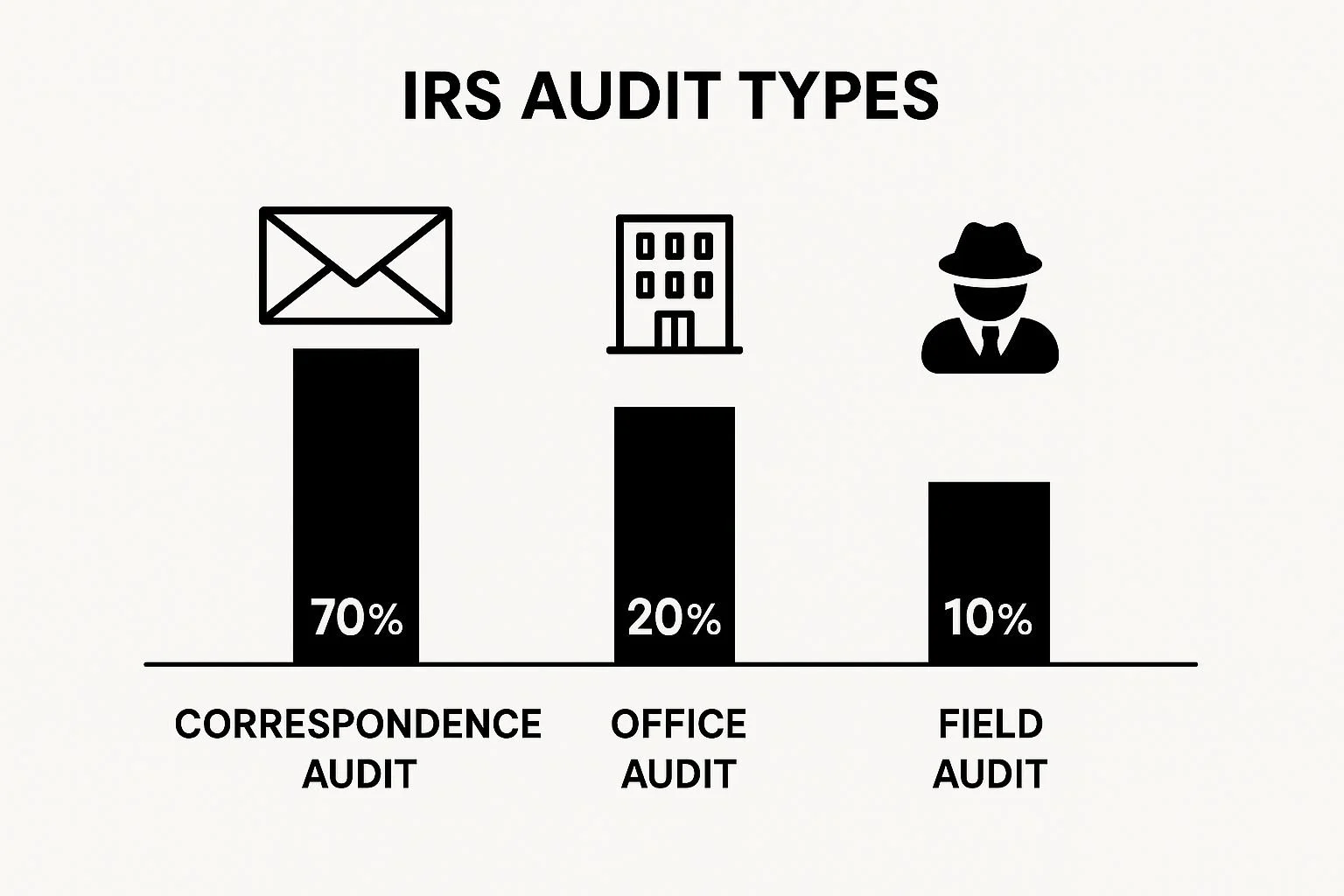
As the data shows, you're far more likely to get a letter than a personal visit from an IRS agent. Here’s a closer look at what you might be facing:
Correspondence Audit: This is the most frequent type. The IRS will mail you a letter, often a CP2000 notice, asking for more details or proof for a specific item on your return. This could be anything from unreported income to a deduction that looks questionable. The whole process is handled through mail or fax.
Office Audit: This is a more involved process. You (or your representative) will need to go to a local IRS office for a face-to-face meeting with an examiner. They'll ask you to bring specific documents related to certain parts of your tax return.
Field Audit: This is the most thorough and serious kind of audit. An IRS agent comes to your business, home, or your accountant's office to conduct a deep dive into your financial records. These are typically reserved for complex returns or situations with major red flags.
To help you understand what each audit entails, here’s a table comparing them side-by-side.
| Audit Type | Complexity Level | Typical Duration | Representation Need | Success Rate with Rep |
|---|---|---|---|---|
| Correspondence Audit | Low | 3–6 months | Recommended | High |
| Office Audit | Medium | 6–12 months | Strongly Recommended | Very High |
| Field Audit | High | 1 year+ | Essential | Crucial for a fair outcome |
This table shows that while correspondence audits are the simplest, having representation significantly boosts your chances of a good outcome across the board. The need for a professional becomes critical as the complexity increases.
Knowing which type of audit you're facing is fundamental to building a solid response. You might handle a straightforward correspondence audit on your own, but an office or field audit notice is a clear sign that you should seek professional IRS tax audit representation right away.
Of course, the best approach is to stay off the IRS's radar from the start. You might find our guide on how to avoid an IRS audit helpful for future tax filings.
Building Your Defense Strategy Before You Respond

A solid defense starts way before you ever write a response letter or speak with an agent. Good IRS tax audit representation is about more than just reacting to questions; it’s about figuring out why your return was flagged in the first place and building your case from there.
An experienced pro doesn't just glance at the numbers you submitted. They view your return from an IRS examiner's perspective, looking for common audit triggers and potential weak points.
For example, did your charitable donations seem unusually large for your income level? Or maybe your business expenses for meals and travel are much higher than the average for your industry? These are the kinds of classic red flags a tax professional spots right away.
They understand that an examiner's questions aren't random—they're targeted. By identifying these areas first, you can pull together the strongest possible proof to back up your claims before the IRS even has to ask.
Evaluating Your Position and Potential Weak Spots
Think of this process like prepping for a court case. You wouldn't just walk in and hope for the best; you'd anticipate the opposing arguments and get your evidence ready. For a tax audit, this means doing a mini-audit on yourself before the real one begins.
A good representative will help you honestly assess:
Documentation Gaps: Do you have organized receipts for every business expense you claimed? If some are missing, are there other ways to prove the expense, like bank statements or sworn affidavits?
Inconsistencies: Does the income reported on your 1099 forms perfectly match what you put on your tax return? Even a small mismatch is a low-hanging fruit for the IRS.
High-Risk Areas: If you're a sole proprietor, did you claim a large home office deduction or significant vehicle expenses? These areas are always under the microscope and require rock-solid documentation.
Finding these potential problems early gives you time to build a file of supporting documents and craft clear, reasonable explanations for each item.
Deciding on Professional Representation
While overall audit rates have been low in recent years, the IRS is changing its approach. The agency plans to nearly triple the audit rate for large corporations to 22.6% by 2026 and is also increasing its focus on high-income individuals.
This shift means that while fewer taxpayers might get audited, those who do will likely face a much more thorough review.
You can learn more about the IRS's evolving audit strategy here.
This is exactly why deciding to hire a professional is so important. If your self-assessment turns up several weak spots or if your tax situation is complex, trying to handle it alone is a huge gamble.
A professional provides an objective eye and years of experience. They know which arguments are worth making and how to present your case in a way that resonates with an examiner. This preparation phase is truly where an audit is won or lost.
Gathering and Organizing Your Documentation Like a Pro
Once you’ve gone through the IRS notice and figured out where you stand, it's time to roll up your sleeves and gather your proof. Solid IRS tax audit representation hinges on having clear, convincing documents.
This isn't about dropping a shoebox full of crumpled receipts on the table; it’s about using your records to tell a clear and credible story. A well-organized file makes the audit process run much more smoothly and shows the examiner you’re on top of things.
The first thing to do is collect every single document related to the tax year being audited. Think systematically.
You'll need things like:
All your bank and credit card statements for the year.
Canceled checks, both personal and business.
Receipts that back up every deduction or credit you claimed.
If you're a business owner, your ledgers, mileage logs, and appointment books are essential.
Any letters or emails from third parties that support your case.
Your goal is to draw a straight line from every number on your tax return to a piece of paper that proves it's accurate. For example, if the IRS is questioning your charitable donations, you need to provide both the official acknowledgment letter from the non-profit and proof of payment, like a copy of the canceled check or a credit card statement showing the transaction.
Tackling Missing Documents and Electronic Records
It’s perfectly normal to discover you're missing a few things. A receipt might have faded beyond recognition, or a bank statement might have vanished. Don't panic. If a document is gone, your representative can help you reconstruct the expense.
This could mean getting sworn statements (affidavits) from vendors or using your bank statements to demonstrate a consistent pattern of spending. The important part is to address the gap head-on and have a reasonable explanation.
This is also where you can see how the IRS uses its own data. The agency constantly looks at tax return data to find things that seem out of the ordinary.
For example, in Tax Year 2021, the number of individual returns filed went down by 2.2%, but the total adjusted gross income (AGI) reported shot up by 17.5%. Statistics like these help the IRS create a baseline for what’s "normal."
Typically, they have a three-year window to audit a return. To get a deeper look at how the IRS uses this information, you can explore their annual data book.
The IRS notice itself is your primary guide. It will clearly state the tax year and the specific forms or schedules they are reviewing. This is your starting point for pulling documents together.
Ignoring these details can lead to much bigger problems, and our guide to understanding an IRS notice of levy outlines what can happen when things escalate.
Communicating Effectively with IRS Examiners

How you and your representative talk to an IRS examiner can absolutely make or break your case. This isn't a courtroom drama; it's a careful conversation where every word counts.
The objective is to be cooperative without accidentally giving them information that leads to more questions. This is where a professional handling your IRS tax audit representation becomes invaluable. They know how to keep the dialogue focused, professional, and strictly limited to what the IRS has asked for.
One of the most common pitfalls taxpayers fall into is oversharing. An examiner might ask a straightforward question about a single business meal, and suddenly the taxpayer is detailing their entire marketing plan for the fiscal year.
This can unintentionally plant seeds for the examiner to dig into entirely new areas of your return. Your representative acts as a vital filter, making sure every response is direct, concise, and backed by the right documents.
The Psychology of Audit Negotiations
Building a strong case means seeing things from the examiner's point of view. Their job is to confirm your tax return is accurate based on tax law and the facts presented. Your representative's role is to make it as easy as possible for the examiner to agree with your position.
This is achieved by following a few simple but powerful rules:
Answer only the question asked: No more, no less. If the IRS requests your 2022 bank statements, you provide only the 2022 statements. Handing over 2021 or 2023 statements "just in case" is a rookie mistake.
Keep a professional tone: Every communication, whether it's an email or a phone call, should be respectful. Getting emotional or aggressive will only make the situation worse and prolong the audit.
Never guess or speculate: If you don’t have an immediate answer, it’s far better to say, “I will need to check my records on that and get back to you.” Providing an incorrect or half-remembered answer can damage your credibility.
Imagine an examiner questions a large expense for "supplies." A weak, unhelpful response would be, "I think that was for that big project, but I'm not really sure."
A much stronger response, delivered by your representative, would sound like this: "That expense corresponds to invoices from ABC Supplier for the Miller project. We can provide copies of those invoices for your review." This kind of specific, confident communication builds trust and often helps resolve the audit much faster.
The way you communicate directly impacts the audit's outcome. Below is a table that illustrates how different communication styles can play out with an IRS examiner.
| Communication Style | Examiner Response | Time to Resolution | Typical Outcome | Best Used When |
|---|---|---|---|---|
| Cooperative & Concise | Examiner sees you as organized and credible. | Shorter | Favorable resolution; agreement on facts. | This should be the default approach for all interactions. |
| Aggressive & Confrontational | Examiner becomes defensive, may dig deeper. | Longer | Unfavorable adjustments; potential penalties. | Never. This approach is counterproductive. |
| Evasive & Vague | Examiner becomes suspicious, may expand the audit. | Significantly Longer | Increased scrutiny; less trust. | Never. It's better to state you'll find the information. |
| Overly Friendly & Talkative | Examiner may uncover new audit issues from volunteered info. | Longer | Unintended new lines of questioning are opened. | While being polite is good, avoid casual chatter. |
This table clearly shows that a professional, direct, and cooperative style is the only effective strategy. Your representative is trained to maintain this tone, preventing the common communication errors that can otherwise complicate your audit and lead to a less desirable result.
Negotiating Adjustments and Managing Disagreements
A lot of people think an auditor's report is the final word, leading straight to a huge tax bill. But that's not how it usually works. The initial report is really just the opening offer in a negotiation.
A professional handling your IRS tax audit representation knows that proposed adjustments aren't set in stone. The real skill is figuring out which points to contest and where a compromise is the smarter move.
Think about this common scenario: an examiner sees a few missing receipts for a business expense category and decides to disallow the entire category. Rather than just accepting that, a seasoned representative will push back.
They’ll argue for a partial allowance using the documents you do have, like bank statements that show a clear and consistent pattern of that type of spending. This is a standard and often successful tactic.
The objective isn't always to get a "no-change" result, but to keep the financial hit as low as possible and dodge unnecessary penalties.
Strategizing Your Response to Proposed Changes
Once the examiner's report lands on your desk with all the proposed changes, it's time to sit down with your representative and plan your counter-move. You’ll go through every single point and sort them into a few buckets:
Clearly Correct: These are the items where you know you messed up. It's usually best to concede these points right away to show you’re acting in good faith.
Arguable Gray Areas: This is where the tax law is open to interpretation. Your representative’s deep knowledge is crucial here, as they can bring up different legal arguments or court cases that back up your position.
Clearly Incorrect: These are flat-out mistakes by the examiner, either because they misunderstood the facts or applied the wrong rule. You’ll fight these points the hardest.
By giving ground on the smaller, less important issues, you build credibility with the examiner. This can make them more willing to listen when you challenge the bigger, more costly adjustments. It reframes the discussion as a team effort to get the facts straight, not just a fight.
When You Can’t Agree: Exploring Your Options
If you and the examiner just can't see eye to eye, the process doesn't end there. You have the right to appeal. Your representative can ask for a meeting with the examiner's manager to get a second opinion.
If that doesn’t resolve things, you can take your case to the IRS Independent Office of Appeals, which is a separate group within the IRS designed to settle tax disputes without going to court.
Even if you do end up owing more tax, your representative can still work to soften the impact. They can push for penalty abatement, arguing that your mistakes were due to a reasonable cause, not a deliberate attempt to avoid taxes.
If you can't pay the new balance all at once, they can negotiate solutions like an installment agreement. To get a better handle on these payment options, check out our guide on how to negotiate IRS debt. This helps ensure the final bill is something you can actually manage, turning a stressful audit into a closed chapter.
Preventing Future Audit Issues and Maintaining Compliance

After the stress of an audit finally subsides, the last thing you want is a repeat experience. The silver lining is that the lessons learned during the audit process are your best tools for future prevention.
This is your chance to switch from a reactive to a proactive approach, building solid systems that keep you compliant while still allowing you to claim the deductions you deserve. It's about developing simple habits that will make any future IRS questions a breeze to answer.
Your first move should be to get serious about record-keeping. This doesn't require a complex accounting setup, just a consistent one.
For instance, if you run a business, a simple but powerful change is to use a dedicated bank account and credit card for all company transactions. This single step makes it incredibly easy to isolate and prove your business expenses.
Balancing Deductions and Red Flags
Being "audit-proof" doesn't mean you should shy away from taking valid deductions. The idea is to be assertive yet fully prepared to defend your claims. Your IRS tax audit representation experience has already given you a behind-the-scenes look at the areas the IRS scrutinizes most. Put that knowledge to work.
Here are a few practical habits you can start today:
Document in Real-Time: Don't wait until tax season to reconstruct your mileage log. Track it weekly with a simple app or a notebook kept in your vehicle. For business meals, immediately jot down who you met with and the business purpose on the back of the receipt before you file it away.
Go Digital with Receipts: Snap a photo of every single receipt and save it to a designated cloud folder. Paper receipts are notorious for fading or getting lost, but a digital copy is permanent. This small action can save you thousands if an expense is ever questioned.
Ask Your Preparer Questions: When you review your return, have your tax pro walk you through any large or unusual deductions. Understanding why a certain deduction is being claimed helps you ensure you have the proper documentation to support it.
Ultimately, staying out of future trouble is about building a strong, ongoing relationship with a tax professional who offers guidance year-round, not just during tax season.
They can help you identify potential red flags long before they ever appear on your tax return. If you're still dealing with the financial aftermath of a past audit, our complete guide to the IRS Offer in Compromise can provide useful strategies for settling tax debt.
By putting these practices into place, you can file your returns each year with confidence and peace of mind.
Your Action Plan for Audit Success
After breaking down the entire IRS audit process, from reading that dreaded notice to finalizing a settlement, let's pull it all together into a solid game plan.
This isn't just a recap; it's a practical roadmap to help you feel in control, whether you're facing an audit right now or just want to be ready for anything.
The single most important thing to remember is this: successful IRS tax audit representation is built on preparation, organization, and professional communication.
Immediate Steps for Audit Response
If you're holding an IRS notice, your first move should be calm and deliberate, not rushed. Follow this protocol to get started on the right foot.
First, take a breath and read the notice carefully. Pinpoint the exact tax year in question and which specific items the IRS wants to examine. Don't jump to conclusions or assume you know what they're looking for.
Next, start gathering your core documents. Pull the tax return for that year, all of your W-2s and 1099s, and the related bank statements. This paperwork is the foundation of your entire case.
A crucial piece of advice: Do not call the IRS yet. That initial conversation can set the entire tone of the audit. Speaking with an agent before you have a strategy can lead to accidentally oversharing information or guessing at answers, which only complicates things.
Finally, take an honest look at your situation. Does the audit involve your business, span multiple years, or question a large amount of money? If so, hiring professional help isn't admitting defeat—it's a smart, strategic decision. The financial stakes are often too high to handle it alone.
Creating Your Audit Success Checklist
Whether you bring in a professional or decide to manage the audit yourself, this checklist will help you stay organized and focused.
| Action Item | Why It Matters | Status |
|---|---|---|
| Schedule a Consultation | Get an expert's take on your case's complexity and what to expect. | ☐ |
| Gather All Requested Documents | Build a complete and orderly file for every single point the IRS is questioning. | ☐ |
| Review Your Original Return | Find any potential weak spots or honest mistakes before the examiner points them out. | ☐ |
| Prepare Clear Explanations | For any deductions or credits that aren't black and white, write down your reasoning and back it up with facts. | ☐ |
This structured approach is what effective IRS tax audit representation is all about. It helps you stay in control of the conversation by presenting clear, well-supported answers.
An audit can feel like a heavy burden, but you don't have to carry it by yourself. If you need an experienced representative who will give you an honest assessment of your case, I can help. Start with a FREE Tax Debt Analysis to understand your options and build a plan for the best possible outcome.
➥ Contact Attorney Stephen A. Weisberg for a free Tax Debt Analysis.
Contact Me Here: https://www.weisberg.tax/contact-1
Email: s.weisberg@weisberg.tax
Phone/Text: (248) 971-0885
Address: 300 Galleria Officentre, Suite 402, Southfield, MI 48034
