Penalty Abatement Reasonable Cause Guide | Clear IRS Relief Steps
Trying to understand IRS rules can feel like cracking a secret code. When it comes to getting a penalty waived, the key is proving you had a "reasonable cause" for not filing or paying on time. This isn't some secret loophole. It's the IRS's way of acknowledging that sometimes, life throws you a curveball so significant that managing your tax obligations becomes impossible.
Your entire case rests on proving you acted with ordinary business care and prudence—basically, that you tried your best to do the right thing but couldn't because of circumstances completely out of your control.
What Counts as Reasonable Cause for the IRS?

The phrase "ordinary business care and prudence" is the bedrock of any reasonable cause argument. The IRS agent looking at your request is essentially asking one question: Did you act as a responsible person would under the same set of circumstances? It’s a bit subjective, which is why the story you tell—and the proof you provide—is so important.
Your job is to connect the dots for the IRS. You need to show how a specific, major event made it genuinely impossible for you to file or pay. This isn't for simple forgetfulness or running short on cash. The IRS usually sees a lack of funds as a financial management issue, not a valid excuse for late payment.
Events Truly Beyond Your Control
The IRS is most receptive to situations that are sudden, severe, and unexpected. We’re not talking about everyday hassles; these are major life disruptions.
Think along these lines:
Serious Illness or Incapacitation: This could be your own health crisis or one involving an immediate family member you were caring for. The illness must be severe enough to have logically prevented you from handling your financial affairs.
Death in the Immediate Family: Losing a spouse, child, or parent—especially if it happens right around a tax deadline—is a universally understood and powerful reason.
Disaster or Accident: A house fire, a major flood, or a serious accident that destroys your critical tax records (or your place of business) are very clear-cut examples of reasonable cause.
Unavoidable Absence: This is less common but still valid. It could be an unexpected and lengthy hospitalization, military deployment, or even being trapped abroad due to unforeseen circumstances.
Crucial Tip: You must draw a straight line from the event to your failure to file or pay. Don't just say, "I was sick." Explain how that specific illness prevented you from gathering documents, meeting your accountant, or accessing funds.
The Tricky Case of Bad Professional Advice
This is one of the more complex arguments, but it can absolutely work. You can't just throw your accountant under the bus and expect the IRS to agree.
To successfully argue that you relied on faulty advice from a tax pro, you have to prove three things:
You gave the professional all the correct and necessary information.
The advisor made a significant error in interpreting or applying tax law—not just a simple math mistake.
You genuinely and reasonably relied on their professional guidance.
This defense requires a solid paper trail. I'm talking about engagement letters, emails, and any other correspondence that clearly shows the bad advice you received. You can find more detailed examples of what qualifies for reasonable cause in our complete guide.
Here are common situations the IRS may accept as reasonable cause, along with the proof you'll need to build a credible case.
Real-World Examples of Reasonable Cause
| Situation | What It Means for You | Essential Proof to Gather |
|---|---|---|
| Serious Illness | You, your spouse, or a dependent had a medical emergency that demanded your full attention and prevented you from handling tax matters. | Hospital records, doctor's notes detailing the dates and severity of the illness, letters from caregivers. |
| Death in the Family | The death of an immediate family member occurred close to a tax deadline, causing emotional distress and logistical chaos. | A copy of the death certificate, proof of your relationship, and a clear timeline showing proximity to the tax deadline. |
| Natural Disaster | A fire, flood, hurricane, or another disaster destroyed your home, business, or essential financial records. | Insurance claims, police/fire department reports, FEMA documentation, photos of the damage. |
| Bad Professional Advice | You hired a competent tax professional, gave them all the right info, and they gave you incorrect advice that you followed. | Copies of emails, letters, or memos from the advisor containing the incorrect advice; proof you supplied them with accurate data. |
| IRS Error | The IRS provided incorrect information or made a procedural error that directly caused your compliance issue. | Copies of IRS correspondence, notes from phone calls (including agent ID, date, and time), or any written guidance you received. |
Building a strong case is all about the details. The more specific and well-documented your reason, the better your chances are of getting those penalties removed.
Building an Undeniable Case with Documentation

A heartfelt letter explaining your hardship is a good starting point, but on its own, it’s not enough. Your entire argument for penalty abatement based on reasonable cause hinges on the quality of your proof.
Think of it like building a legal case. The documentation is your evidence, telling a clear story that leaves no room for doubt in the mind of the IRS agent reviewing your file. Without that paper trail, your explanation is just words. The goal is to build a narrative so compelling and well-supported that it proves an event beyond your control directly prevented you from filing or paying on time.
Documenting Medical Crises
If a serious illness threw your life off track, a simple note from your doctor saying you were "unwell" just won't cut it. The IRS needs to see the full picture—the timeline of your incapacitation and a clear explanation of how it stopped you from handling your financial responsibilities.
To build a truly solid case, you’ll need to gather:
Hospital Records: Admission and discharge summaries are perfect for establishing a concrete timeline of when you were hospitalized and completely unavailable.
A Detailed Doctor's Letter: This is your most powerful piece of evidence. Ask your physician for a letter that details the nature and duration of your illness. Crucially, it must explain how it physically or mentally prevented you from doing things like gathering tax documents, writing checks, or filing online.
Third-Party Statements: A letter from a family member or caregiver who helped you during this time can add another layer of credibility, confirming the timeline and the severity of your situation.
Proving Disaster or Destruction
When a fire, flood, or another disaster wipes out your home, office, or records, your claim depends on proving two things: that the event happened and that it directly impacted your ability to file. Your personal story is important, but official reports are what give it weight.
Make sure you collect:
Official Reports: Get copies of any fire department or police reports that officially document the date, location, and details of the incident.
Insurance Claims: Submitting copies of your insurance claims for property or record loss provides another official layer of validation.
Dated Evidence: Never underestimate the power of visual proof. Dated photos or videos of the damage help the IRS agent see exactly what you went through.
Key Takeaway: The burden of proof is always on you. For every claim you make in your letter, you need a corresponding document to back it up. A strong case leaves no questions unanswered.
Addressing Faulty Professional Advice
Blaming bad advice from a tax preparer can work, but the IRS will expect you to prove you acted responsibly. This is where conducting thorough due to diligence comes in, as you must show you did your part.
You have to demonstrate that you gave your advisor all the correct information and that their error was the direct cause of the penalty. This means documenting everything:
Advisor's Credentials: Show you chose a competent professional.
Information You Provided: Have proof, like a filled-out client organizer or email attachments, showing you supplied them with complete and accurate data.
The Incorrect Advice: This is critical. Find any email correspondence, letters, or even notes from meetings that detail the specific, incorrect guidance they gave you.
This level of documentation shows the IRS you weren't negligent. Of course, even with a strong case, the initial tax bill can feel crushing. If that's where you find yourself, you may want to read our guide on how to negotiate IRS debt for other potential strategies.
Interestingly, this hard work pays off. Data on certain international reporting penalties showed that in 2017, the IRS abated approximately 64% of assessed penalties and 78% of the dollar amounts. According to the Taxpayer Advocate Service, these high abatement rates often happen because the penalties were assessed automatically in the first place, which underscores just how critical a well-documented reasonable cause request really is.
How to Write Your Penalty Abatement Letter

Since the IRS doesn’t have a specific form for a reasonable cause request, your letter is your one shot to make a compelling case. This is where you bring all your facts and documents together to tell a persuasive story to the agent handling your file. A great letter connects the dots, showing not just what happened, but precisely how it made it impossible for you to comply.
Your goal here is to be clear, concise, and sincere. This is absolutely not the place for emotional pleas, long-winded excuses, or blaming the system. Instead, you need to build a logical, fact-based narrative that shows you took your obligations seriously but were blindsided by circumstances truly beyond your control.
Start With Clarity and Purpose
The very first sentence of your letter needs to get straight to the point. Don't make the IRS agent guess what you're asking for. You need to immediately identify the penalties you want removed and for which specific tax period.
A strong opening will look something like this:
"I am writing to respectfully request a penalty abatement for reasonable cause for the Failure to File and Failure to Pay penalties associated with my Form 1040 for the tax year 2023. These penalties are detailed on the CP14 Notice I received, dated [Date of Notice]."
This direct approach sets a professional tone from the get-go. It instantly gives the agent the critical information they need to pull your file and understand exactly what you're asking for. It shows you’re organized and serious.
Craft a Simple, Chronological Narrative
After your direct opening, the body of your letter must lay out a clear, chronological timeline of events. This is the heart of your argument. You need to walk the agent through the sequence of events that led to you filing or paying late.
Think of it as telling a simple, easy-to-follow story.
Begin at the beginning: When did the event—the illness, death, or natural disaster—actually occur?
Explain the immediate fallout: How did this event completely disrupt your normal life and your ability to manage your finances or paperwork?
Connect the dots for them: You have to explicitly link the disruption to your tax duties. For example, "My hospitalization from March 15 to April 20 meant I was physically unable to access my records or meet with my accountant before the April filing deadline."
You're building a case, one fact at a time. Each paragraph should build on the last, creating a logical flow that's impossible to misunderstand. I always tell my clients to keep sentences and paragraphs short. Dense blocks of text are a nightmare for a busy agent to read and can bury your key points.
Use the Right Tone and Phrasing
The tone of your letter is absolutely critical. You want to sound sincere and take responsibility for your tax obligations while still clearly explaining why you couldn't meet them at that time. Avoid any language that sounds like you're blaming the IRS or trying to dodge your duties.
Good Phrasing to Use:
"Due to these unforeseen medical circumstances..."
"This situation unfortunately prevented me from..."
"I take my tax obligations very seriously; however, this event made compliance impossible at the time."
Phrasing to Avoid:
"It's unfair that I was penalized because..."
"Your notice was confusing and..."
"I just didn't have the money." (This is almost never accepted as reasonable cause for failure to pay.)
This respectful approach shows you understand the process and can make an agent much more sympathetic to your request.
Highlight Your Return to Compliance
One of the most powerful parts of your penalty abatement reasonable cause letter is explaining what you did to get back on track. The IRS needs to see that the problem was temporary and that you're now a compliant taxpayer.
Dedicate a short section to detailing the steps you took as soon as you could.
When did you file? State the exact date you filed the late return.
When did you pay? Explain when you paid the tax due or that you've already set up a payment plan.
What has changed? Briefly state that the circumstances that caused the delay have been resolved.
For instance: "As soon as I was discharged from the hospital and able to manage my affairs, I gathered my documents and filed my 2023 return on June 1, 2024. I have also paid the outstanding tax balance in full." This demonstrates good faith and will significantly strengthen your case.
While the story you tell is most important, using certain letter generation tools can sometimes help organize your thoughts and ensure you don't miss any key components of your request.
Submitting Your Request and What Happens Next
You’ve put in the hard work. Your letter is persuasive, and you have a solid stack of documents to back it up. Now comes the critical, final step: getting it into the IRS’s hands.
Don’t just guess where to send it. The correct mailing address is almost always printed right on the IRS notice that informed you about the penalty in the first place. Look for an address specifically for correspondence or responses. If that notice is long gone, your next best bet is the IRS service center where you filed your return.
The Non-Negotiable Step: Certified Mail
I can’t stress this enough. Do not just put a stamp on the envelope and drop it in a mailbox. You must send your penalty abatement reasonable cause request via USPS Certified Mail with a return receipt requested.
Think of this as your insurance policy. That little green postcard will come back to you stamped by the IRS, giving you undeniable proof of when they received your package. It's a small cost for enormous peace of mind and your best defense if the IRS ever claims your request was lost in the mail. It happens.
This whole process, from identifying the issue to gathering proof and finally mailing it off, is a marathon, not a sprint.
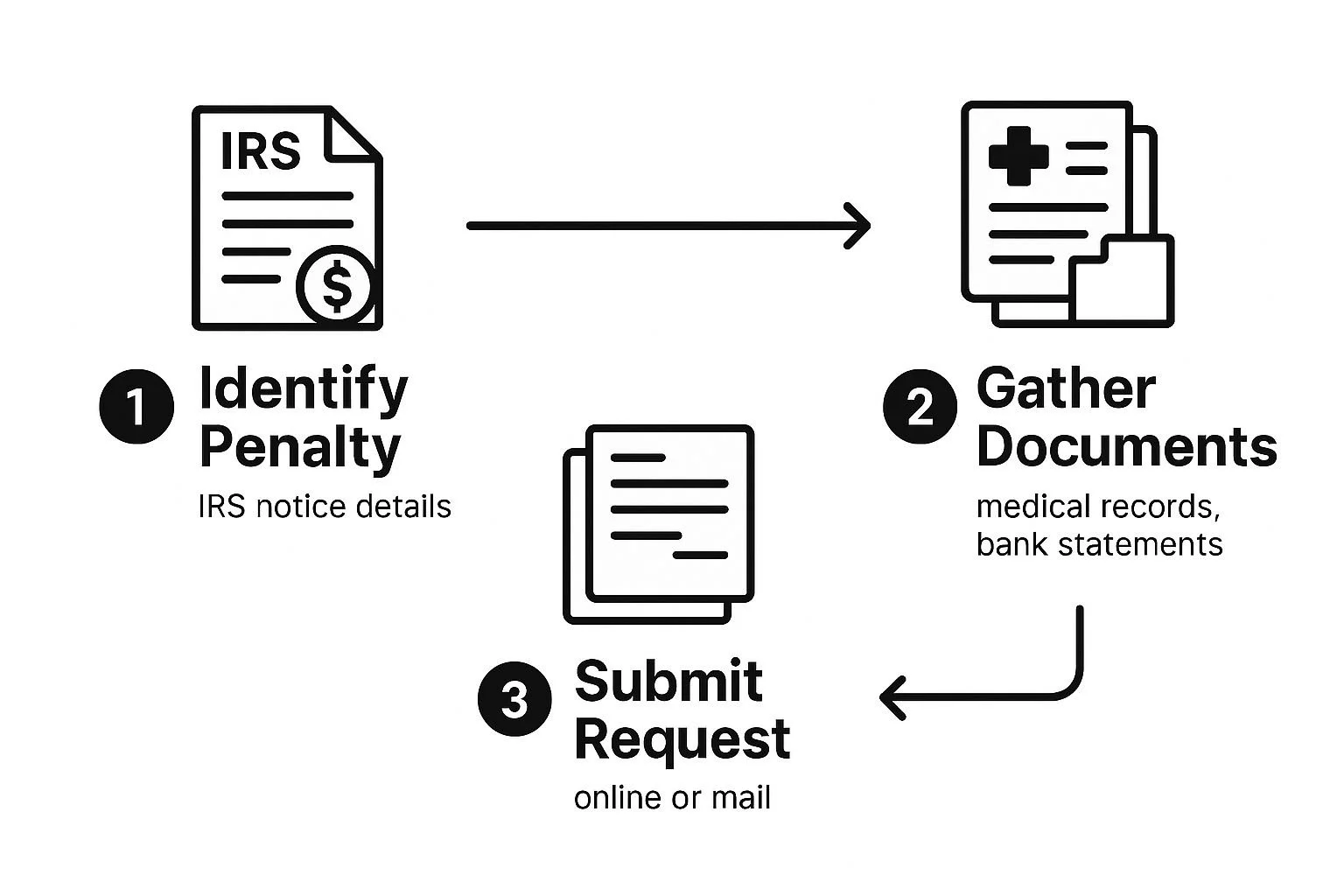
As you can see, a successful submission is the culmination of careful, deliberate preparation.
Managing Expectations: The IRS Timeline
Once you’ve mailed your package, the waiting begins. And you will be waiting. It’s crucial to have realistic expectations here. The IRS is a massive organization, and it’s not unusual for a penalty abatement case to take 90 to 120 days—sometimes even longer—to get a final decision.
My best advice? Be patient. Calling the IRS repeatedly before that 120-day window closes probably won’t speed things up. It will, however, almost certainly increase your frustration. Just file your certified mail receipt somewhere safe and wait for their official letter.
Understanding the Possible Outcomes
Eventually, a letter from the IRS will arrive with their decision. In my experience, it generally falls into one of three categories. Knowing what they are ahead of time helps you prepare for what’s next.
Full Abatement: This is the home run. You'll get a notice, often a Letter 168C, confirming the IRS has accepted your argument and is wiping out the penalties.
Partial Abatement: Sometimes the IRS will agree with part of your case. For instance, they might waive the Failure to File penalty because you had a great reason for the delay, but uphold the Failure to Pay penalty if you couldn't explain why the tax wasn't paid on time.
Full Denial: The letter will state your request was denied. It’s a disappointing outcome, but it's not the end of the road. That denial letter is required to explain your appeal rights.
Remember, even the IRS's internal processes are under scrutiny. A recent government audit confirmed that reasonable cause hinges on whether a taxpayer showed "ordinary business care and prudence" under all the circumstances. If your penalties are just one piece of a bigger tax problem, exploring all your options for IRS debt forgiveness can provide a more complete strategy. No matter what the letter says, being prepared allows you to act quickly and decisively.
What to Do When Your Request Is Denied
It’s incredibly frustrating to get that denial letter from the IRS after you’ve put so much work into your penalty abatement request. It can feel like you’ve hit a brick wall, but I can tell you from experience, this is often just part of the process.
Think of it this way: the U.S. tax system is designed with multiple layers of review for a reason. Your initial request was likely denied by a busy agent at an IRS service center who is juggling a huge caseload. The goal now is to get your penalty abatement reasonable cause argument in front of a fresh set of eyes—and you have a legal right to do just that.
Understanding Your Appeal Rights
That rejection letter, as disappointing as it is, holds the key to your next move. The IRS is legally required to tell you about your appeal rights. Pay close attention to the deadlines; you usually have only 30 days from the date on the letter to file your appeal. You need to act fast.
Filing an appeal doesn't send your case back to the same person. It elevates it to the IRS Independent Office of Appeals, a completely separate division. This office is staffed with highly trained Appeals Officers whose entire job is to be impartial and settle tax disputes to avoid expensive court battles.
Expert Insight: Appeals Officers are trained to evaluate the "hazards of litigation." They look at the facts and weigh the chances of the IRS winning if your case went to Tax Court. If you have a solid, well-documented reasonable cause, they are far more likely to compromise than the agent who first reviewed your case.
Requesting an Appeals Conference
To kick things off, you'll need to submit a formal written protest. This isn't just a quick note saying you disagree; it's a carefully drafted document that rebuilds your case and explains precisely why you believe the initial denial was a mistake.
Your formal protest must include:
A clear statement that you are appealing the decision.
Your name, address, and Social Security Number or Taxpayer ID.
The tax years in question and the exact penalties you're fighting.
A compelling summary of the facts, along with the laws or regulations supporting your reasonable cause argument.
A professional, well-organized protest makes a world of difference. If you're feeling overwhelmed, our guide on how to appeal an IRS decision breaks down the specific steps for handling this critical stage.
Considering Other Strategic Options
A direct appeal is the most common route, but it’s not the only one. Depending on your situation, especially if the IRS starts taking collection actions, other doors might open.
It’s smart to be aware of two other powerful options:
Filing Form 843 (Claim for Refund and Request for Abatement): If you've already paid the penalty, this form is the official way to ask for your money back. It provides a structured format to formally present your case for abatement.
Requesting a Collection Due Process (CDP) Hearing: This is a big one. If the IRS files a Notice of Federal Tax Lien or sends a Notice of Intent to Levy, you have the right to request a CDP hearing. This hearing is also handled by the Independent Office of Appeals and gives you a fantastic opportunity to bring up your penalty abatement argument as an alternative to forced collection.
Don't give up. Persistence is your biggest ally here. The IRS reverses initial penalty denials all the time when taxpayers present a strong, well-supported reasonable cause argument. Your first denial isn't the final word—it's your cue to take the fight to the next level.
Common Questions on Penalty Abatement
When you're trying to get penalty relief from the IRS, it's easy to get bogged down in the details. Even with a solid plan, specific situations can leave you wondering if you're making the right move. I hear the same questions time and time again from clients, so let's tackle the most common ones right here.
This is your quick-fire guide to the tricky spots. We'll get straight to the point with answers that help you navigate the process with more confidence.
Can I Get Penalties Waived for Lack of Funds?
This is probably the most frequent question I get, and the answer is almost always a hard no. The IRS is crystal clear on this: simply not having enough money to pay your taxes on time isn't considered a valid reason to waive a Failure to Pay penalty.
From the IRS's perspective, managing your finances to meet your tax obligations is just part of exercising "ordinary business care and prudence."
Now, there are a few very narrow exceptions. If your inability to pay was caused by a sudden, catastrophic event—think a fire that destroyed your business or a sudden illness that drained your life savings—you might have a shot. The key is you have to prove the lack of funds was a direct result of something completely unforeseen, not just a tight month or poor cash flow management.
How Does First Time Penalty Abatement Work?
The First Time Abatement (FTA) program is a fantastic tool, but it's crucial to understand it's entirely separate from a reasonable cause argument. You can qualify for FTA if you check three boxes:
A Clean Slate: You have no penalties for the three tax years before the one you're being penalized for.
You're All Caught Up: You've filed all your required tax returns or have a valid extension in place.
The Tax is Handled: You've either paid the tax due or have set up an arrangement (like an installment agreement) to pay it.
FTA is a "get out of jail free" card because you don't even need to give a reason. If you meet the criteria, the IRS will often grant it without a fight. But here’s the catch: you can only use it once every few years. Don't burn your FTA if you have a legitimate penalty abatement reasonable cause argument. You might need it more a few years down the line when you don't have a good excuse.
Strategic Tip: Always check if you have a strong reasonable cause case first. If you do, use it. Save your First Time Abatement eligibility for a rainy day—it’s too valuable a tool to use unnecessarily.
What if the IRS Gave Me Bad Advice?
Yes, this is one of the rare instances where the IRS will waive a penalty based on a statutory exception. If you relied on erroneous written advice from the IRS, any resulting penalty can be abated.
But be warned: the burden of proof is incredibly high. You must have a copy of your specific, written request for advice and the incorrect written response from the IRS. Verbal advice you got over the phone is almost impossible to prove. While it's always smart to keep detailed notes of any call—agent name, ID number, date, what was said—it just doesn't carry the same weight as black-and-white proof.
Do International Penalties Have Different Rules?
Absolutely. Penalties for late-filed international information returns (IIRs), like Form 3520 for foreign gifts or trusts, are notoriously brutal and often assessed automatically. For years, the system was broken. Taxpayers who voluntarily came forward to file late were slapped with massive penalties before anyone at the IRS even looked at their reasonable cause statement.
Thankfully, after a lot of pressure from the National Taxpayer Advocate, things are changing for the better. The IRS has stopped the automatic assessment of penalties for late-filed Form 3520s (related to foreign gifts) and will now review reasonable cause statements for foreign trust forms before sending a penalty notice. This is a huge win for taxpayers.
The data shows just how broken the old system was. Between 2018 and 2021, the IRS abated 67 percent of these penalties and 78 percent of the dollar amounts for foreign gift reporting. It just goes to show how essential it is to submit a rock-solid reasonable cause argument if you're in this boat.
Will the IRS Also Waive the Interest I Owe?
This is a major point of confusion for many people. If the IRS grants your penalty abatement, they will automatically remove any interest that was charged on that specific penalty.
However, they will not waive the interest charged on the underlying tax you failed to pay. Interest on your unpaid tax balance is required by law and keeps ticking up until the tax is paid in full. There is no "reasonable cause" for interest. The only way to get interest abated is to prove the IRS made an unreasonable error or caused a delay, which is a completely separate process that usually requires filing Form 843, Claim for Refund and Request for Abatement.
When facing tax issues, getting clear, professional advice is the most important step you can take. At Attorney Stephen A Weisberg, we start with a FREE Tax Debt Analysis to understand your unique situation and determine the best path forward before you ever pay a fee. If you're struggling with IRS penalties or other tax problems, let us help you find the best possible outcome.
➥ Contact Attorney Stephen A. Weisberg for a free Tax Debt Analysis.
Contact Me Here: https://www.weisberg.tax/contact-1
Email: s.weisberg@weisberg.tax
Phone/Text: (248) 971-0885
Address: 300 Galleria Officentre, Suite 402, Southfield, MI 48034
