Mastering Self Employed Quarterly Taxes
When you go out on your own, you're not just the CEO, designer, or consultant—you’re also the payroll department. This means you're now in charge of sending your own tax payments to the IRS throughout the year. It's a system called self employed quarterly taxes, and it's a big shift from the traditional W-2 world.
Instead of having taxes neatly taken out of each paycheck, you have to estimate what you'll owe for the year and pay it in four chunks.
Why Quarterly Taxes Are Your New Reality
If you’re new to the freelance game or just launched your business, paying taxes four times a year can feel a little overwhelming. For regular employees, taxes are mostly an out-of-sight, out-of-mind deal handled by their employer.
But as a business owner, you're both the employee and the employer. Managing your own tax payments isn't just a good idea; it’s a fundamental part of running your business.
This isn’t optional. The U.S. has a "pay-as-you-go" tax system, which means the government expects to get its cut as you earn money, not all at once next April. If you ignore these payments, you can get hit with underpayment penalties—even if you pay the full amount when you file your annual return.
The Two Pillars of Your Tax Payments
Your quarterly payments are actually funding two different tax obligations. It's crucial to understand both.
Income Tax: This is the standard federal tax on your business profits. Just like anyone else, the rate depends on your tax bracket, which is determined by your total taxable income.
Self-Employment Tax: This is the entrepreneur's version of Social Security and Medicare taxes (you might know them as FICA taxes from old pay stubs). For 2024, this is a flat 15.3% on your net business earnings.
This one-two punch often catches new business owners by surprise. You absolutely have to account for both taxes when you're setting money aside from every check that comes in.
The Cost of Waiting Until April
Let’s walk through a common scenario. Imagine you're a freelance web developer who had a fantastic first year and netted $80,000. You were so buried in client work that you blew off your taxes, thinking you'd deal with it all in April. Big mistake.
When you finally sit down with your tax forms, reality hits you like a ton of bricks.
A sudden tax bill of over $15,000 (combining self-employment and income taxes) can be financially devastating if you haven't been saving. This is the exact scenario that self employed quarterly taxes are designed to prevent.
Without that tax savings account, you're now facing a massive debt. This can kick off a cycle of serious financial stress, forcing you to drain personal savings, take out a loan, or get on a payment plan with the IRS—all while penalties and interest pile up. This isn't just a hypothetical; it's a trap many new entrepreneurs fall into.
In fact, quarterly estimated tax payments are a core requirement for the roughly 10 million taxpayers who file them each year. You can actually dig into some of the IRS data on self-employment tax trends to see just how common this is.
Paying your taxes quarterly transforms a potential financial crisis into a predictable, manageable business expense. Think of it as just another cost of doing business, like your software subscriptions or internet bill.
Calculating Your Estimated Tax Payments
Alright, let's move from theory to actually getting this done. This is where you take real control over your finances by figuring out exactly how to calculate your self employed quarterly taxes.
Forget abstract math—this is a concrete process you can master each quarter to make sure you're setting aside the right amount. We'll use the official IRS roadmap, Form 1040-ES, Estimated Tax for Individuals, to guide us.
Let's imagine a freelance graphic designer whose income tends to be a bit unpredictable. The first, and honestly, the trickiest step is to estimate their total expected income for the year.
The best way to tackle this is by looking at what you earned last year and what contracts you have lined up now. It’s not a perfect science, but it gives you a solid starting point.
Next up: business expenses. This is where being a meticulous record-keeper really pays off. You'll subtract every legitimate business cost from your income. We're not just talking about big-ticket items; it's the small, recurring costs that truly add up.
Think about things like:
Software Subscriptions: All those tools you use daily, like Adobe Creative Cloud, project management software, or cloud storage.
Home Office Costs: A percentage of your rent, utilities, and internet that corresponds to the portion of your home used exclusively for business.
Marketing and Advertising: Costs for your portfolio website, email marketing services, or any ads you run.
Professional Development: Any courses, workshops, or industry events you attend to sharpen your skills.
This workflow shows how a freelancer can go from estimating income to calculating their final payment.
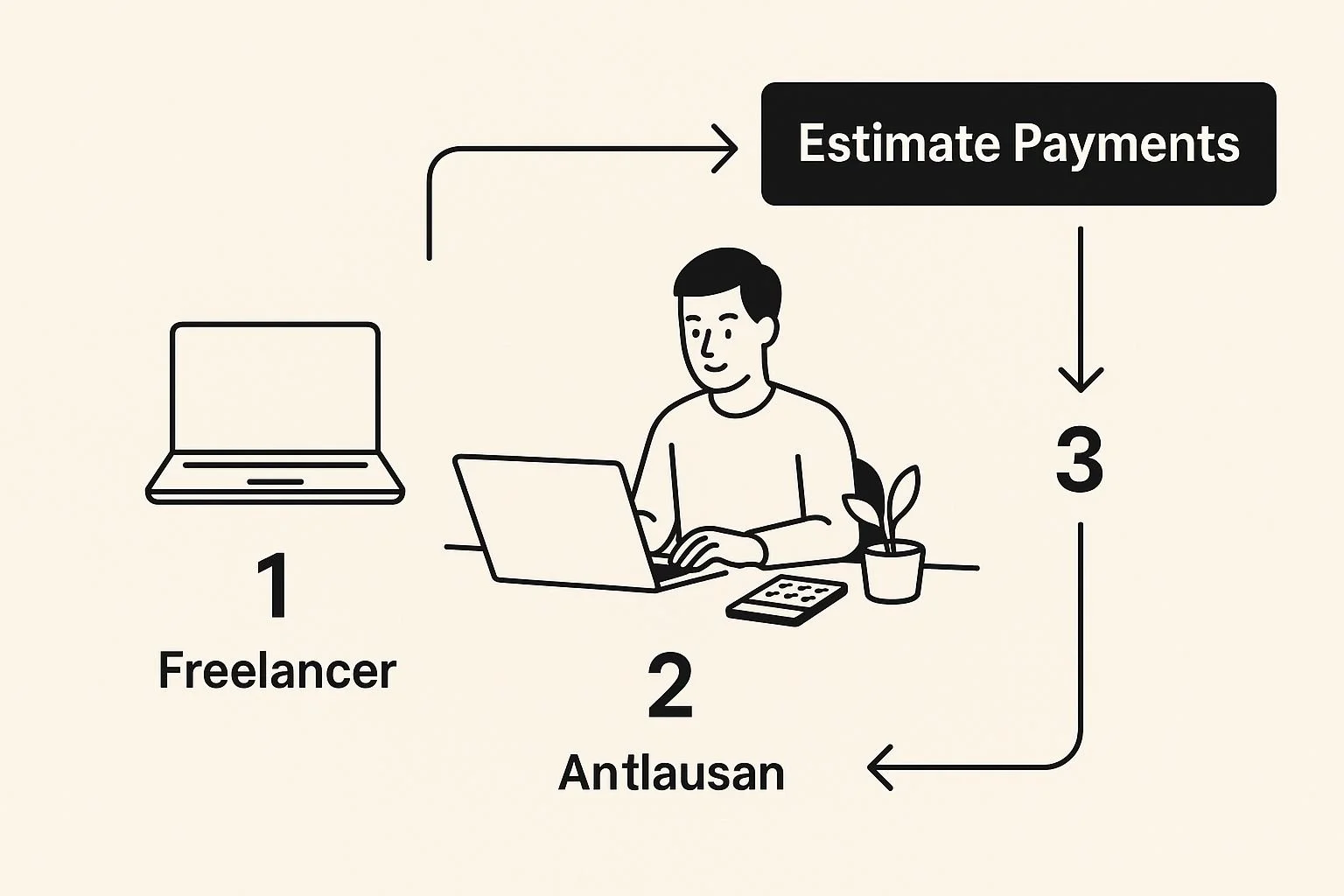
As you can see, it’s a multi-step journey that begins with your gross income and narrows down to a specific quarterly figure.
The Core Calculation
Once you have your estimated net profit (that's your income minus all those expenses), you can calculate the two main taxes you'll owe. First, there's the self-employment tax, which is a flat 15.3% on 92.35% of your net earnings. After that, you'll calculate your federal income tax based on which tax bracket you fall into.
My Favorite Pro Tip: Open a separate, high-yield savings account just for taxes. Every time a client pays you, immediately transfer 25-35% of that payment into the tax account. This one habit makes saving automatic and keeps you from accidentally spending the money you owe the IRS.
It might feel like a uniquely American headache, but this system is common worldwide. Self-employment is a huge economic force, averaging around 14% across OECD member nations.
This is precisely why governments rely on systems like quarterly tax payments—millions of people are earning money without an employer to handle withholding for them. It helps to remember that what feels like a personal burden is actually part of a much larger economic structure.
Choosing Your Estimation Method
The good news is the IRS gives you a couple of ways to figure out your payments. Picking the right one for your business can make a huge difference to your cash flow.
1. The Regular Installment Method
This is the most straightforward option. You simply estimate your total tax bill for the year and divide it by four. You pay that same amount on each of the four quarterly due dates.
Who it’s for: This works best for freelancers and business owners who have pretty stable and predictable income. If your revenue doesn't have dramatic peaks and valleys, this method is simple and easy to manage.
2. The Annualized Income Installment Method
For anyone with a seasonal or "lumpy" income stream, this method is a game-changer. Think of a wedding photographer who makes most of their money between May and October. Instead of four equal payments, you calculate your tax based on what you actually earned during that specific quarter.
Who it’s for: This is perfect for anyone with inconsistent income. It saves you from the stress of a big tax bill landing during a slow month. It does require a bit more number-crunching for each deadline, but it aligns your tax payments perfectly with your actual cash flow. You can get a better feel for the deadlines by reviewing the estimated tax payment schedule.
Let’s go back to our graphic designer. In Q1, they land a huge project and earn $30,000. But in Q2, things are quiet, and they only bring in $10,000.
With the annualized income method, their Q1 tax payment would be much larger than their Q2 payment, directly reflecting their bank account.
If they had used the regular method based on a high annual estimate, that second quarterly payment could have been a real financial strain.
Uncovering Your Best Business Deductions
The secret to lowering your estimated tax payments isn't some magic trick you pull out of a hat when Form 1040-ES is due. It’s a habit. It’s the year-round, borderline-obsessive practice of tracking every single legitimate business expense.
For anyone who’s self-employed, deductions are your single most powerful weapon against a high tax bill. They directly slash your net profit, which means you pay less in both self-employment tax and income tax.
Think about it this way: every dollar you legally deduct is a dollar that completely escapes that nasty 15.3% self-employment tax, not to mention your own income tax bracket. This is a fundamental mindset shift—expenses aren't just costs; they are tax-saving opportunities waiting to be claimed.
Real-World Deductions in Action
Reading a generic list of deductions is one thing. Seeing how they actually apply to a real person's business is where the lightbulb goes on. It's not about what you can deduct, but how it fits into the work you do every day.
Take a freelance podcaster, for example. That new $500 microphone and $300 audio interface aren't just fun new toys. They're ordinary and necessary expenses for producing a professional-sounding show. Bam. Fully deductible.
Or consider a real estate agent whose car is basically their office. They have two ways to handle vehicle expenses.
While you can track every drop of gas, every oil change, and every insurance payment (the actual expense method), most find the standard mileage rate far simpler.
If that agent drives 15,000 business miles in a year, they just multiply that by the IRS rate. The result is a massive deduction, often adding up to thousands of dollars.
The Home Office Deduction Demystified
Ah, the home office deduction. It's one of the best write-offs available, yet so many freelancers are scared to take it, fearing it’s an automatic audit flag. Let me be clear: if you meet the requirements, you should claim it. Period.
You've got two options for calculating it:
The Simplified Method: This is the no-fuss approach. You deduct $5 per square foot for your home office space, capped at 300 square feet. That gives you a straightforward deduction of up to $1,500. It's fast and the record-keeping is minimal.
The Actual Expense Method: This one takes more math but can lead to a much bigger tax break. First, you figure out what percentage of your home is used for business (e.g., a 150-square-foot office in a 1,500-square-foot apartment is 10%). Then, you can deduct that percentage of your actual home costs—rent, utilities, internet, renter's insurance, the works.
If you’re just getting started or value simplicity, the simplified method is a great choice. But if you live in a high-rent area or have a larger dedicated workspace, doing the math for the actual expense method is almost always worth your time.
Don't Overlook the Qualified Business Income Deduction
One of the biggest game-changers for the self-employed is the Qualified Business Income (QBI) deduction. The rules can get a little thorny, but the basic idea is pretty simple.
The QBI deduction lets many sole proprietors, partners, and S-corp owners deduct up to 20% of their qualified business income. It's a "below-the-line" deduction, which means it lowers your taxable income but doesn't reduce what you owe for self-employment tax.
Let's say a consultant has $100,000 in qualified business income. They could potentially slice $20,000 right off their income before the tax is even calculated.
That's a huge saving that directly lowers the final check you write to the IRS. Yes, there are income limits and specific rules depending on your profession, but you absolutely have to check if you qualify.
Trying to keep all these potential savings straight can feel overwhelming. That’s why a solid system isn't just a good idea; it's non-negotiable.
Whether it's accounting software or a detailed spreadsheet, consistency is what matters. For a much deeper look into the nitty-gritty of write-offs, our complete guide to small business tax deductions has you covered.
When you make expense tracking a daily habit, tax time stops being a frantic scramble. It becomes a strategic review of a year's worth of smart financial moves.
How to Actually Pay Your Quarterly Taxes
You’ve done the hard work of calculating your estimated taxes. Now for the final step: actually sending the money to the IRS. It might feel like the most stressful part, but the government has made it surprisingly easy to pay your self employed quarterly taxes.
The key is simply picking the method that works best for you and getting it done by the deadline. For most of us, paying online is the fastest and safest bet. It cuts out the risk of a check getting lost in the mail and gives you an instant confirmation for your records.
Digital Payment Options
Let's be honest, digital payments are just easier. They’re quick, you get a receipt immediately, and it's simple to track. The IRS gives you a couple of solid, free options.
IRS Direct Pay: This is my go-to recommendation for straightforward, one-off payments. You can pay directly from a checking or savings account with no fees and, best of all, no need to create an account. It’s secure, fast, and you get immediate confirmation that the IRS received your payment.
Electronic Federal Tax Payment System (EFTPS): Think of EFTPS as the heavy-duty version of Direct Pay. You do have to enroll and create an account, but it’s a free government service with a lot more power. You can schedule payments up to 365 days in advance, see your entire payment history, and handle all kinds of federal taxes, not just your estimated payments.
If your income is pretty steady throughout the year, EFTPS is a game-changer. You can literally log in once, schedule all four quarterly payments for the year, and forget about it. It’s the ultimate "set it and forget it" tool for avoiding missed deadlines.
Paying by Card or Mailing a Check
Sometimes life happens, and you might need the flexibility of paying with a credit or debit card to manage cash flow. The IRS allows this through a few approved third-party payment processors. Just be aware that these services tack on a processing fee, which is usually a percentage of your payment or a small flat rate.
And yes, you can still go old-school. Mailing a check or money order along with a payment voucher from Form 1040-ES is perfectly acceptable. If you go this route, make absolutely sure it’s postmarked by the due date. Also, double-check the IRS mailing address for your specific state—it’s not the same for everyone.
Choosing Your Quarterly Tax Payment Method
To make it easier, here’s a quick breakdown of the most common ways to pay your estimated taxes. This table can help you decide which one fits your needs based on speed, convenience, and any potential costs.
| Payment Method | Best For | Processing Time | Associated Fees |
|---|---|---|---|
| IRS Direct Pay | Quick, one-time payments without account setup. | Instant | None |
| EFTPS | Scheduling future payments and tracking history. | Instant | None |
| Debit/Credit Card | When you need payment flexibility or to earn rewards. | Instant | Processor fees apply |
| Mail (Check) | Those who prefer a traditional paper trail. | Days to weeks | Postage only |
Ultimately, choosing the right method comes down to what makes you most comfortable and what ensures the IRS gets its money on time.
Don't Forget About State Taxes
One final, critical reminder: federal taxes are only half the battle. The vast majority of states have their own income tax and, you guessed it, their own system for quarterly estimated payments.
The deadlines, rules, and payment methods for your state can be completely different from the IRS. It's on you to visit your state's tax agency website and figure out your obligations. Ignoring state taxes can trigger a whole separate set of penalties and interest, and that’s a headache nobody wants.
If you find yourself falling behind and dealing with mounting tax debt, don't panic. You have options. We break down the steps you can take in our smart guide for tax relief success.
Avoiding Underpayment Penalties and Common Mistakes
Making your self employed quarterly tax payments consistently isn't just about good financial hygiene; it's about protecting your hard-earned money. Nothing stings quite like thinking you're all paid up, only to have the IRS hit you with an underpayment penalty for miscalculating or paying late.
Think of this penalty as interest the IRS charges when you haven't paid enough tax throughout the year. The good news? It's almost entirely avoidable. The IRS isn’t trying to trick you, especially if your income bounces around. They’ve set up clear guidelines to help you stay on track.
Your Shield Against Penalties: The Safe Harbor Rules
I always tell my clients to think of the "safe harbor" rules as their get-out-of-jail-free card for estimated tax penalties. As long as you meet one of these simple thresholds, you generally won't owe a penalty, even if you have a balance due when you file your annual return.
To avoid the underpayment penalty, you just need to make sure your total payments for the year equal at least:
90% of the tax you owe for the current year, OR
100% of the tax you owed for the previous tax year.
That second rule is a total lifesaver for most freelancers and small business owners because it gives you a solid, predictable target. Just pull out last year's tax return (your 2023 Form 1040), find your total tax on line 24, and divide that number by four. That's your quarterly payment. Simple.
Important Caveat: There's a small catch for higher earners. If your Adjusted Gross Income (AGI) last year was over $150,000 (or $75,000 if you're married filing separately), the bar is raised. You need to pay at least 110% of last year's tax to qualify for the safe harbor.
Even with that adjustment, using the prior-year rule gives you a clear number to hit, which is a massive help when your income is growing.
When Your Income Suddenly Changes
Let's walk through a real-world scenario. A freelance graphic designer had a good year, earning $80,000. She’s diligently paying quarterly estimates based on that 100% prior-year rule. But in July, she lands a huge six-month contract that will effectively double her income for the year.
This is a classic penalty trap. If she keeps making those smaller payments based on last year's numbers, she'll blow past the safe harbor and will almost certainly fall short of the 90% current-year requirement.
The key is to adjust. As soon as that contract is signed and the income is a sure thing, she needs to recalculate her total estimated tax for the year. Her payments for the third and fourth quarters will need to be much larger to cover the shortfall from the first two quarters.
Being proactive here is what saves you from a nasty surprise next April. For a deeper dive, you can avoid tax penalties in our playbook for compliance which covers more of these complex situations.
Other Common Pitfalls to Sidestep
Beyond the safe harbor rules, a few other common missteps can land self-employed folks in hot water. Knowing what they are is half the battle.
1. Forgetting State Estimated Taxes The IRS isn't the only game in town. Almost every state with an income tax requires its own quarterly estimated payments, complete with separate rules, forms, and deadlines. It's easy to forget, but ignoring your state obligations will earn you a completely separate set of penalties.
2. Miscategorizing Expenses Getting too creative or aggressive with your business deductions can backfire. If an IRS audit disallows a big chunk of your claimed expenses, your taxable income shoots up. This recalculation can easily push you below the penalty thresholds on the newly corrected tax amount.
3. Poor Record-Keeping Honestly, this is the root cause of most tax headaches. Without clear, organized records of every dollar in and every dollar out, making an accurate estimate is just guesswork. Bad bookkeeping can lead you to overpay (giving the government an interest-free loan) or, far worse, underpay and get hit with penalties and interest.
Answering Your Quarterly Tax Questions
Even once you get the hang of calculating and paying your self-employed quarterly taxes, real life has a way of throwing curveballs. It’s one thing to plug numbers into a formula, but it's something else entirely to figure out what to do when your situation doesn't fit the mold.
This is where we tackle some of the most common questions I hear from freelancers and business owners. Getting these right can be the difference between tax-season stress and quiet confidence.
What if This Is My First Year in Business?
This is the classic chicken-and-egg problem. The "safe harbor" rule relies on your prior year's tax return, but what if you don't have one? The IRS doesn't expect you to have a crystal ball.
Your only move here is to make a reasonable, good-faith estimate of your income and expenses for the entire year. Don't just pull a number out of thin air. Break it down.
Project your income: Look at the contracts you've already signed. What's in your sales pipeline? What has your monthly revenue been so far? Use that data to project out for the full 12 months.
Estimate your expenses: Add up your recurring costs like software subscriptions or rent. Then, factor in any planned one-time purchases, like that new laptop or desk you've been eyeing.
Calculate and pay: Use these projections to figure out your quarterly payments. The most important part is to document your thought process. Keep a record of how you arrived at your numbers. If you end up earning more than you guessed (a great problem to have!), you can simply increase your later quarterly payments to make up for it.
What if I Have a Business Loss?
It happens. Expenses can easily outrun revenue, especially when you're just starting out or hitting a slow patch. If you have a net loss for a specific quarter, you won't owe any income or self-employment tax for that period. Simple as that.
But hold on. A loss in one quarter doesn't give you a free pass for the rest of the year. If you expect to turn a profit in the later quarters, you still need to make payments to cover the taxes on that future income.
Remember, the goal is to pay tax on your annual profit. If you project a net loss for the entire year, you likely won't need to make any quarterly tax payments. Just be absolutely sure your projection is grounded in reality.
Can I Just Pay Everything in the Fourth Quarter?
I see people ask this all the time, and it's a risky move. The U.S. tax system is designed as "pay-as-you-go." This means the IRS expects you to pay tax on your income as you earn it throughout the year.
Waiting until the final January deadline to send in one big check for the whole year can land you an underpayment penalty.
Even if you pay every single dollar you owe for the year by that final deadline, you can still get penalized for not paying it evenly across the four quarters.
The penalty is calculated based on how much you underpaid for each specific payment period. It's always, always safer to make four separate, on-time payments.
Navigating the complexities of self-employment taxes, especially when dealing with IRS issues, requires expertise. Attorney Stephen A Weisberg offers a FREE Tax Debt Analysis to assess your situation and determine the best path forward, ensuring you only pay for services that genuinely help resolve your tax problems.
➥ Contact Attorney Stephen A. Weisberg for a free Tax Debt Analysis.
Contact Me Here: https://www.weisberg.tax/contact-1
Email: s.weisberg@weisberg.tax
Phone/Text: (248) 971-0885
Address: 300 Galleria Officentre, Suite 402, Southfield, MI 48034
