What Does It Mean to Get Audited? Discover the Facts Now
That letter from the IRS in your mailbox is enough to make anyone’s heart skip a beat. But before you panic, let's unpack what it really means to get audited. An audit is simply the IRS's way of reviewing your tax return to make sure everything lines up. It's more of a fact-checking mission than an accusation.
The Core Purpose of a Tax Audit

At its heart, an audit is just a double-check. Think of it like a quality control inspection at a factory—the goal is to ensure the final product (your tax return) is accurate and follows the rules. The IRS or a state tax agency is simply taking a closer look at the income, deductions, and credits you claimed.
The whole point is to verify that the tax you reported is the tax you actually owe. It's a key part of how the government keeps the tax system fair for everyone. Contrary to what you see in movies, getting an audit notice doesn't automatically mean you're in trouble. Many returns are flagged by a computer algorithm or are even chosen completely at random.
Why Audits Happen
So, what triggers an audit? It could be any number of things, but the end goal is always the same: verification. The IRS can't possibly look at every single one of the millions of returns filed each year, so it uses sophisticated systems to flag returns that seem unusual or have potential red flags. This keeps everyone honest. Knowing there's a chance your return could be reviewed encourages all of us to be more careful and accurate.
This isn't just a U.S. phenomenon, either. Governments worldwide are ramping up audits to ensure they're collecting the revenue they're owed. For example, a recent report on tax dispute trends from PwC noted that in one year, Ukraine conducted over 13,000 tax audits, leading to additional tax assessments of more than 38 billion UAH—nearly triple the amount from 2019.
Before we dive deeper, here's a quick cheat sheet to demystify the core concepts of a tax audit.
Audit at a Glance Key Takeaways
| Concept | What It Really Means |
|---|---|
| Audit Notice | It's a formal request for more information, not a guilty verdict. |
| Purpose | To verify the accuracy of your tax return, not to punish you. |
| Selection | Often triggered by computer algorithms or random chance, not just suspicion. |
| Outcome | Can result in no change, a refund, or a bill for additional tax owed. |
This table helps put the process into perspective. An audit is a structured review, and understanding its basic framework is the first step toward navigating it successfully.
Understanding Common IRS Audit Triggers
Let’s get one thing straight: the IRS isn't just picking names out of a hat. When a tax return gets flagged for an audit, it’s almost always because something in the return stood out to its automated systems. Think of it like your credit card company flagging an unusual purchase—it’s not an accusation, it's just a "Hey, can you confirm this?"
So, how does the IRS decide which returns to look at? They use a sophisticated computer program called the Discriminant Information Function (DIF). In simple terms, this system compares your return to a baseline of what's "normal" for someone in your financial situation. A high DIF score just means your return has certain traits that, statistically, often correlate with misreported taxes.
It's important to remember that a high score doesn't mean you did anything wrong. It just means your return is different enough to warrant a second look from a real person.
Beyond Simple Math Errors
Sure, simple mistakes like mixing up numbers or a math error can trigger an automated notice from the IRS. But the red flags that lead to a full-blown audit are usually more significant. These are the kinds of issues that make your return a real outlier.
The infographic below shows some of the key areas that can raise your audit risk, from small mistakes to major reporting discrepancies.
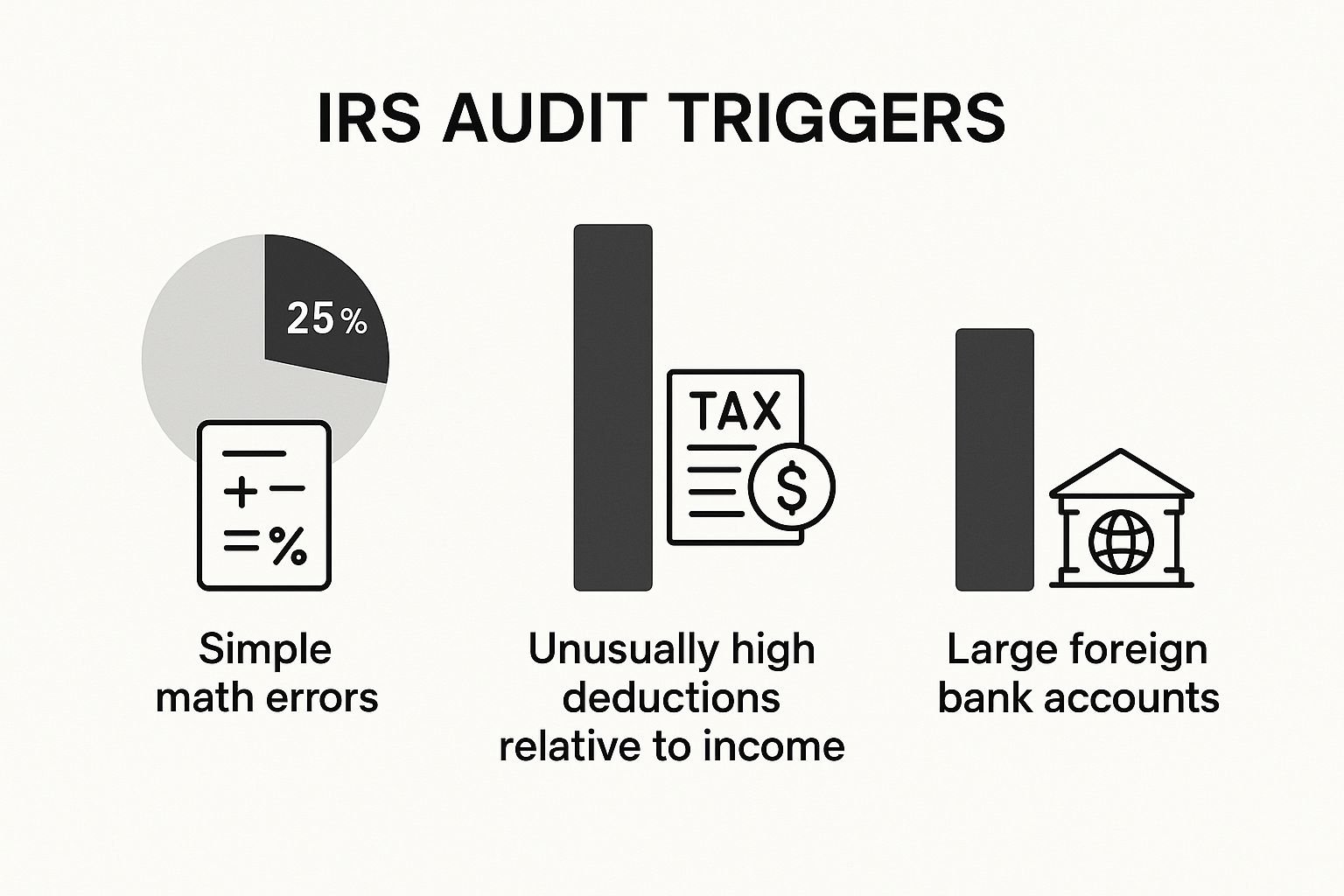
As you can see, while basic errors can get you a letter, things like unusually high deductions or complex international finances are what really get the IRS’s attention.
Common Red Flags to Watch For
Let's dig into a few of the most common scenarios that leave taxpayers wondering what an audit really means. These triggers often pop up when deductions or credits seem way out of line with your reported income.
Unusually High Deductions: This is a big one. Claiming deductions that are way above the average for your income bracket is a surefire way to get flagged. For instance, if you report $60,000 in income but claim $30,000 in charitable donations, you can bet the IRS computers are going to notice.
Claiming 100% Business Use of a Vehicle: This is a classic audit trigger. The IRS is well aware that it's nearly impossible for a vehicle to be used only for business, with absolutely no personal trips. Unless you have pristine, detailed mileage logs to back it up, this claim is practically an invitation for scrutiny.
Aggressive Home Office Deductions: The rules for the home office deduction are strict. The space must be used regularly and exclusively for your business. If you claim a huge chunk of your home as an office, especially if it seems out of proportion to your business income, it can easily trigger a review.
At its core, an audit is simply a request for proof. The IRS isn't accusing you of anything; they're just saying, "Show us your records." This is why having organized documentation is the single best defense you can have.
Another major area of focus is foreign bank accounts. If you have a combined total of $10,000 or more in foreign accounts at any point during the year, you’re required to file a Report of Foreign Bank and Financial Accounts (FBAR). Forgetting to file this is a serious red flag. Getting ahead of these issues is the best strategy.
The Different Types of IRS Audits Explained

When most people hear the word "audit," their mind immediately jumps to a stuffy room with an IRS agent grilling them under a bare lightbulb. The reality is that this scenario is the exception, not the rule.
IRS audits come in a few different flavors, each with its own level of intensity. Knowing which one you're facing is the first and most important step in figuring out how to respond. It sets the stage for what to expect, from the documents you'll need to gather to how you'll communicate with the agency.
Correspondence Audits: A Simple Request by Mail
By far the most common type of audit is the correspondence audit. This is handled entirely through the mail, so you'll never actually speak to or meet an agent.
Think of it as the IRS sending a quick note asking for clarification on one or two items. They might request a receipt for a large charitable donation or proof of a specific medical expense you claimed. You simply gather the requested documents, mail them back, and if everything checks out, that’s usually the end of it. These are narrowly focused and the least intimidating of the bunch.
Office Audits: An In-Person Meeting
An office audit is a step up from a mail-in request. As the name implies, this one requires you to visit a local IRS office and meet an auditor in person.
Don't panic—this still isn't a deep dive into every corner of your financial life. The auditor will be looking at specific items on your tax return that raised a flag. You'll need to bring all your supporting documents for the issues in question, like business expense logs or records for rental property income.
The scale of tax noncompliance is significant. For the 2022 tax year, the IRS estimated a gross tax gap of $696 billion, with $539 billion stemming from income underreporting alone. Audits are a primary tool the agency uses to close this gap. You can explore more about these IRS tax gap projections to understand the full scope of the issue.
Field Audits: The Comprehensive Review
The field audit is the one that most closely matches the Hollywood stereotype. This is the most serious and comprehensive type of examination, where an IRS agent comes directly to you—at your home, business, or accountant's office.
Field audits are typically reserved for more complex tax situations, like those involving large businesses or individuals with intricate financials. The agent will conduct a thorough review of your books and records, often looking at multiple aspects of your return. Because of their in-depth nature, these audits demand significant preparation, and having professional representation is almost always a good idea.
Comparison of IRS Audit Types
To make it easier to see the differences at a glance, here’s a simple breakdown of the three main audit types.
| Feature | Correspondence Audit (Mail) | Office Audit | Field Audit |
|---|---|---|---|
| Location | Through the mail | At an IRS office | At your home, business, or accountant's office |
| Scope | Narrowly focused on 1-2 specific items | Focused on specific issues, but more detailed | Broad and comprehensive; can cover the entire return |
| Common Issues | Simple deductions, credits, exemptions | Business expenses, rental income, itemized deductions | Complex business returns, high net-worth individuals |
| Interaction Level | Low (letters only) | Medium (in-person meeting with an auditor) | High (direct, in-depth examination with an agent on-site) |
| Time Commitment | Minimal; just need to mail documents | Moderate; requires preparing for and attending a meeting | Significant; can take days or weeks of review and meetings |
Understanding these distinctions helps demystify the process. No matter which notice you receive, the key is to stay calm, read the instructions carefully, and provide exactly what is requested.
How to Navigate the Audit Process Step by Step

Getting that letter in the mail is enough to make anyone's heart skip a beat. But after the initial shock, it's crucial to approach the situation calmly and methodically. An audit isn't an accusation; it's a formal request for verification. Your job is simply to provide clear, organized proof for the numbers you reported.
Think of it less like a courtroom drama and more like a very detailed fact-checking exercise. This guide will give you a step-by-step framework to follow, turning a nerve-wracking event into a series of manageable actions.
The process always starts with a formal letter from the IRS, often a CP2000 notice or something similar. This letter is your road map. It will tell you exactly which tax year is under review, what specific items are being questioned, and how the audit will be conducted—whether by mail (correspondence), at an IRS office, or at your place of business (field).
Your first move? Read that letter from top to bottom. Don't toss it on a pile to deal with later. The notice will include a strict response deadline, and you absolutely cannot miss it. Ignoring the letter won't make it go away; it just means the IRS will likely make a final decision without your input, and that rarely works out in a taxpayer's favor.
Step 1: Assemble Your Documentation
Once you know what the IRS is looking for, it's time to gather your records. This is the moment where good record-keeping really proves its worth. Essentially, the auditor is asking you to "show your work" for the figures on your return.
Organize everything logically based on what's being questioned. For instance, if the audit is about business expenses, you'll want to pull together:
Receipts and Invoices: The direct evidence of what you spent.
Bank and Credit Card Statements: Use these to back up your receipts, highlighting the corresponding transactions.
Mileage Logs: If you claimed vehicle expenses, a detailed, contemporaneous log is non-negotiable.
Walking in with a neat, organized file makes the auditor's job easier and signals that you're cooperative and on top of your finances. A shoebox full of crumpled receipts sends a very different message.
Step 2: Communicate Professionally
How you talk to the auditor is just as important as the documents you provide. Whether it's over the phone, through the mail, or in person, keep it professional and to the point. Stick to the facts and answer only the questions you are asked.
It’s easy to get defensive or feel the need to over-explain. Don't. Volunteering extra information can sometimes open up entirely new areas of inquiry that weren't on the auditor's radar. If you’re not sure how to answer a question, it is perfectly fine to say, "I'll need to check my records and get back to you," or to ask for time to consult a tax professional.
Navigating an audit is about precision and proof. Your goal is to provide exactly what is requested—nothing more, nothing less. Treat every interaction as a formal part of the record, because it is.
Step 3: Present Your Case and Await the Outcome
After you’ve submitted your documents and answered the auditor's questions, they will review everything and issue a final report. This report will lay out one of three possible outcomes:
No Change: The best-case scenario. The auditor accepts your return as filed, and the audit is closed.
Agreed: The auditor proposes changes to your tax liability, and you agree with them. You’ll sign a form and pay any additional tax, penalties, and interest.
Disagreed: The auditor proposes changes, but you don't believe they are correct. This is not the end of the road; you have the right to appeal the decision.
If you find yourself in the "disagreed" category, this is usually the point where professional help becomes essential. An experienced tax attorney can navigate the next steps, represent you, and make sure your rights are fully protected.
Knowing Your Rights as a Taxpayer
Getting that audit notice can make your stomach drop. It’s easy to feel like you’re on the defensive, but remember, this isn’t a one-sided interrogation. The IRS has a formal Taxpayer Bill of Rights, which is your rulebook for the entire process. It’s there to make sure everything is handled fairly.
This isn’t just some pamphlet; it’s a framework that gives you the power to be an active participant. You have the right to get clear answers, receive professional treatment, and, most importantly, question the IRS’s conclusions. Knowing these rights from the get-go is your single best defense.
The Foundation of a Fair Audit
The Taxpayer Bill of Rights isn't just a list of polite suggestions. It lays out ten core principles that every single IRS employee is required to follow when they deal with you. These rights are your guarantee that you’ll be treated with respect and that your audit won't drag on forever.
Here are a few of the most important protections you should be aware of:
The Right to Be Informed: The IRS can't operate in secret. They have to tell you exactly what they're looking for and why they need it. You should never feel confused about what’s happening.
The Right to Representation: You absolutely do not have to go through this alone. You are fully entitled to hire a professional, like a CPA or a tax attorney, to represent you and speak for you.
The Right to Appeal: If you don't agree with the audit results, it’s not the end of the road. You have the right to take your case to the IRS Office of Appeals for an independent, impartial review.
Think of it as a system of checks and balances. Even though the government is examining your finances, you have a protected and well-defined way to make your case.
Your Obligations in the Process
Of course, with rights come responsibilities. The audit process is a two-way street, and it works best when there's cooperation. Your main job is to provide the records and documentation that back up the numbers on your tax return.
At its core, an audit is a request for proof. Your job is to supply clear, organized information. The IRS’s job is to review it fairly and stick to the law.
Being organized and cooperative is how you hold up your end of the deal. That means getting them the documents they ask for on time, answering questions truthfully, and keeping things professional. When you meet your obligations, it not only speeds things up but also shows the auditor you’re acting in good faith.
This whole process of tax verification has created a huge global industry. In fact, the market for tax audit services was pegged at around $11.1 billion back in 2021 and is expected to keep growing as tax laws get more complicated. You can find more details about this growing market on Cognitive Market Research. This just goes to show how established this process is. Knowing your rights is how you navigate it with confidence.
Common Questions About Getting Audited
Even with a good grasp of the basics, the idea of an audit brings up a lot of specific, often anxious, questions. When you're staring down that official-looking envelope, fear and uncertainty can take over. Let's cut through the noise and answer some of the most common "what ifs" that pop up when facing the IRS.
How Long Does an IRS Audit Usually Take?
There’s no simple answer here, because the timeline really depends on the type and complexity of the audit. Think of it like a car repair: fixing a flat tire is a quick job, but rebuilding the engine is a whole different project.
A simple correspondence audit, where you just mail in a few documents, can be over and done within a few months. An office audit, which means you have to go to an IRS office, will likely take longer—anywhere from several months to a year, depending on scheduling and how much information they need. The most in-depth review, a field audit, where an agent comes to you, can easily stretch out for a year or even more, especially if it involves a business with complicated books.
A few key things will speed up or slow down the process:
The complexity of your return: A simple W-2 return is faster to review than a business with international transactions.
The availability of your records: If your documents are organized and ready to go, things move much faster. Digging for receipts will cause delays.
Your level of cooperation: Responding promptly and clearly to the auditor's requests helps keep everything on track.
Can I Handle an Audit Myself or Do I Need a Professional?
This is a huge decision point. If you get a letter for a basic correspondence audit asking for one specific document—say, a 1099 form you forgot to include—and you have it on hand, you can probably handle that yourself. It's not much different from a bank asking you to verify a transaction.
But the minute the audit gets more complicated, like an office or field audit, it's almost always a smart move to bring in a professional. When you're dealing with complex tax laws or potentially large amounts of money, you need an expert in your corner. A Certified Public Accountant (CPA) or a tax attorney speaks the IRS’s language. They know the procedures, can negotiate for you, and most importantly, they will make sure your rights are protected every step of the way.
What Happens If I Disagree with the Audit Findings?
You absolutely do not have to just accept the auditor's decision if you think it's wrong. You have a right to appeal, and the IRS has a formal process for it.
First, you can usually ask for a meeting with the auditor's manager to see if you can resolve the disagreement there. If that doesn't work, you can file a formal appeal with the IRS Independent Office of Appeals. This is a separate division within the IRS designed to give your case a fresh, impartial look.
If you're still not satisfied after the appeals process, you might have the option to take your case to U.S. Tax Court. The most important thing is to watch the deadlines listed in your audit report—miss one, and you could lose your right to appeal.
An audit is a review, not a final judgment. If the IRS proposes changes you believe are wrong, you have established pathways to challenge them. The key is to act within the specified timeframes.
Does Getting Audited Mean I Will Owe More Taxes?
Not necessarily. It’s easy to assume an audit automatically means you're going to get a bill, but that's not always the case. An audit is simply a review to check for accuracy. It can end in one of three ways:
No Change: The IRS looks over your return and agrees with it as filed. You're all set.
Refund: The review uncovers that you actually overpaid your taxes. Believe it or not, the IRS will send you money back.
Assessment: The IRS finds that you owe additional tax. This outcome often includes penalties and interest on top of the tax.
The final result comes down to the facts—how accurate your tax return was and how well your records back it up.
Navigating an audit can feel overwhelming, but you don't have to face it alone. Attorney Stephen A Weisberg offers a FREE Tax Debt Analysis to determine if and how he can help you resolve your IRS issues before you ever pay a fee. Visit us online today to learn more and get the expert guidance you need.
Want to understand your options before you call anyone?
Download my free book — Freedom From Tax Debt — a plain-language guide to how the IRS collections process actually works and what resolution really looks like.
➥ Contact Attorney Stephen A. Weisberg for a free Tax Debt Analysis.
Contact Me Here: https://www.weisberg.tax/contact-1
Email: s.weisberg@weisberg.tax
Phone/Text: (248) 971-0885
Address: 300 Galleria Officentre, Suite 402, Southfield, MI 48034
