Tax Audit Representation Your Guide to IRS Audits
Let's be honest—nothing makes your stomach drop quite like an official notice from the IRS. When they decide to examine your tax returns, it’s called an audit, and it's a serious matter. Tax audit representation is when a qualified professional steps in to handle that entire process for you.
Think of it this way: you wouldn't go to court without a lawyer. A tax audit is no different. A specialist—like a Tax Attorney, CPA, or Enrolled Agent—becomes your advocate, managing every interaction with the government so you don't have to face them alone. It’s your strategic defense.
Understanding Your Shield Against The IRS

That audit letter sparks immediate anxiety and a thousand questions. This is precisely where tax audit representation proves its worth.
Your representative acts as a seasoned interpreter, translating complex tax law and audit procedures while standing between you and the auditor.
They build a solid case to defend your tax return, managing all communication along the way.
So instead of you fielding tricky questions from an IRS agent—and potentially saying something that complicates your case or even widens the audit's scope—your representative takes the lead.
At its core, representation is about protecting your rights and fighting for the best possible outcome based on the facts and the law.
And this isn't just a service for massive corporations. With tax codes getting more complex every year, we see individuals, small business owners, and freelancers all benefit from having an expert in their corner. It simply levels the playing field.
Why You Should Never Face An Audit Alone
Going into an audit by yourself is a huge gamble. The IRS auditor is a trained professional whose entire job is to find mistakes and collect more tax revenue. It’s an uneven fight from the start.
A professional representative knows the rulebook, understands what auditors are trained to look for, and can skillfully argue the legal points behind your deductions and reported income.
If you're curious about what might have caught the IRS's attention in the first place, you can learn more by reading about the most common factors that can trigger a tax audit in our guide.
This professional buffer transforms a potentially terrifying interrogation into a structured, less emotional review of facts and documents. The demand for these services reflects this reality.
The global Tax Audit Services market is projected to jump from about $13.76 billion in 2025 to over $21.11 billion by 2033, a surge driven by increasingly complicated tax regulations.
Self-Representation vs. Professional Tax Audit Representation
Deciding whether to hire a professional is the first critical choice you'll make after receiving an audit notice. While you have the right to represent yourself, the risks are substantial. This table breaks down what you can expect on each path.
| Aspect | Handling It Yourself (Self-Representation) | Hiring a Professional Representative |
|---|---|---|
| Communication | Direct, high-stress communication with the IRS. It's easy to make costly misstatements under pressure. | All communication is handled by your representative, who acts as a professional, strategic filter. |
| Knowledge Gap | You're forced to become a tax law expert overnight while the clock is ticking. | You leverage your representative’s deep expertise in tax law and internal IRS procedures. |
| Emotional Stress | The anxiety can be overwhelming, impacting your work, family, and decision-making. | Stress and fear are dramatically reduced, letting you focus on your life and business. |
| Time Commitment | Expect to spend countless hours gathering documents, researching, and attending meetings. | Your representative manages the entire process, freeing up your valuable time. |
| Outcome Potential | Higher risk of an unfavorable result, added taxes, and significant penalties due to inexperience. | A much better chance of a “no-change” audit or a more favorable, negotiated outcome. |
Ultimately, having an expert on your side isn't just about convenience—it's about protecting your financial future and ensuring you get a fair shake. An experienced representative knows how to navigate the system to achieve the best result possible.
Who Can Legally Represent You Before The IRS

When you get that dreaded notice from the IRS, you can’t just send your cousin who’s “good with numbers” to handle it. The IRS is very particular about who is qualified to practice before them. In fact, many tax preparers don't have the legal authority to represent you in an audit.
Only a select group of federally authorized professionals have what the IRS calls unlimited representation rights. This is a big deal. It means they can represent any taxpayer, for any tax issue, in front of any IRS office.
They are the only people who can truly stand in for you, from the first meeting with an agent all the way through the appeals process.
The Big Three Authorized Representatives
So who are these professionals? There are three main types who hold these powerful practice rights. Each one brings a different set of skills to the table, and picking the right one often comes down to the details of your situation.
Enrolled Agents (EAs)
Certified Public Accountants (CPAs)
Tax Attorneys
Getting to know what makes each of them a potential ally is your first step in protecting your interests. Let's break down what each credential really means.
Enrolled Agents (EAs)
Think of Enrolled Agents as the ultimate tax nerds—and I mean that as a high compliment. While CPAs and attorneys often have wider practices, an EA’s expertise is laser-focused on one thing: taxation.
They earn their credential in one of two ways: by passing a grueling three-part IRS exam on every aspect of the tax code or through significant experience working directly for the IRS.
Because they're licensed by the U.S. Department of the Treasury itself, their authority is federal, not state-based. This makes an EA a fantastic choice for complex tax returns with tricky deductions, credits, or niche industry rules.
It’s worth remembering that many qualified tax preparation professionals are also authorized to provide this level of representation.
Certified Public Accountants (CPAs)
CPAs are state-licensed professionals known for their broad financial acumen. While many are tax specialists, their knowledge also covers accounting, business consulting, and financial planning. This 30,000-foot view can be incredibly useful, especially in business audits where your financial statements are just as important as the tax return itself.
Becoming a CPA involves passing a tough four-part exam and meeting demanding education and experience requirements. A good CPA can analyze your entire financial story, providing crucial context that can make or break your defense with an auditor.
Tax Attorneys
A Tax Attorney is a lawyer who lives and breathes tax law. They have a law degree (Juris Doctor) and often a specialized advanced degree in tax (LL.M.). Their superpower is their legal training.
While EAs and CPAs are masters of tax and accounting rules, only an attorney can provide the protection of attorney-client privilege. This is a legal shield that keeps the communications between you and your lawyer confidential. It's absolutely essential if your audit could potentially uncover evidence of criminal activity.
If the stakes are high or your case seems destined for U.S. Tax Court, a Tax Attorney isn't just a smart choice—they are a necessity. They are the only representative who can actually defend you in a court of law. The key is to match their unique strengths to your audit's specific needs and risks.
Your Step-by-Step Tax Audit Representation Journey
Getting that audit notice from the IRS can feel like your world just tilted on its axis. Suddenly, you're facing a process that seems complicated, invasive, and incredibly stressful. But it doesn't have to be. With an experienced professional on your side, the journey from that first letter to a final resolution follows a clear, predictable path.
Think of it less as a battle and more as a structured process. Knowing the steps involved helps take the fear out of the equation and puts you back in control. Let's walk through what that process looks like.
Step 1: Engaging Your Representative and Granting Authority
It all starts with your decision to hire a professional. After an initial chat where you lay out your situation, you’ll make it official by signing an engagement letter. This document simply details what your representative will do for you and how the fees work.
The most important piece of paper you'll sign at this stage is IRS Form 2848, Power of Attorney and Declaration of Representative. This is the key that formally hands the reins to your tax pro.
By signing Form 2848, you're giving your representative the legal authority to act on your behalf. They can talk to the IRS, get copies of your notices, review your confidential tax files, and handle all meetings for you. It's what puts a professional shield between you and the auditor.
Once the IRS processes this form, they’ll direct all future communications about your audit straight to your representative. From that point on, you won't have to speak to the auditor directly again.
Step 2: The Deep Dive and Strategy Development
With the legal authority secured, your representative gets down to business. This is the investigation phase—a deep dive into your financial records, the tax return under scrutiny, and all your supporting documents. It’s like your legal team building its case from the ground up.
Your rep will go through everything with a fine-tooth comb to pinpoint the strengths and weaknesses of your position. They’re not just looking at what's there; they're anticipating the auditor's every move and preparing for questions before they're even asked.
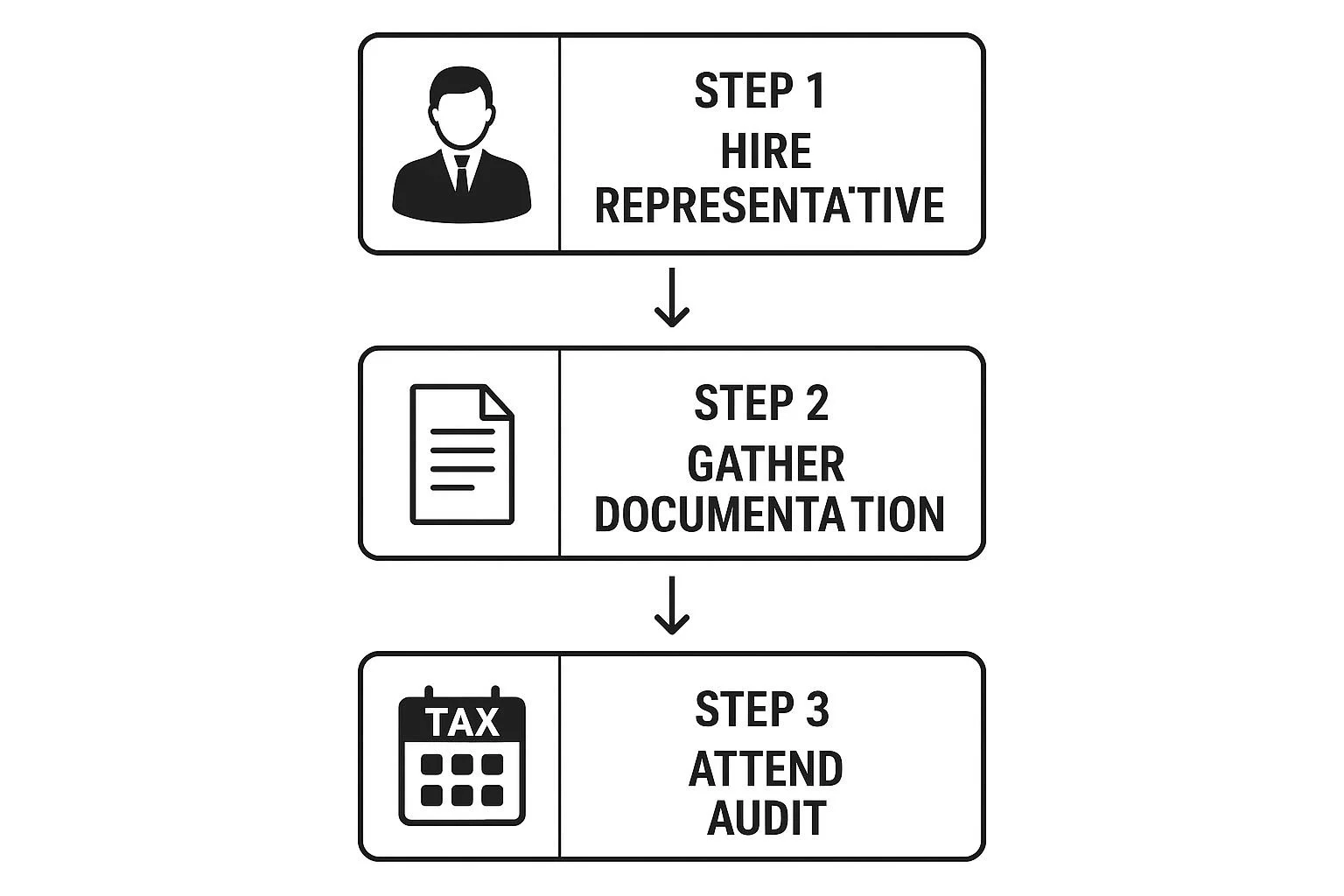
Based on this forensic analysis, your representative will map out a specific defense strategy. This plan dictates how to present your case, what information to share, and how to counter any arguments the IRS might throw your way.
Step 3: Navigating the Audit Examination
This is where having a pro really pays off. Your representative takes the lead on the entire audit examination, fielding every phone call, responding to every letter, and attending every meeting. You get to focus on your life and your business while they manage the headache.
The audit itself can happen in a few different ways:
Correspondence Audit: This is an audit handled entirely by mail. Your representative will submit all the necessary documents and written arguments for you.
Office Audit: If a face-to-face meeting is required, your rep goes to the local IRS office to present your case and answer the agent's questions. You typically don’t even need to be there.
Field Audit: In more complex cases, an agent might need to visit your business. Your representative will be there every step of the way to manage the interaction and keep it professional and on-topic.
Throughout this entire stage, your representative’s primary job is to keep the audit laser-focused on the original issues, provide only the information that is absolutely required, and defend the legal grounds for your tax positions.
Step 4: Reaching a Resolution and Exploring Options
Once the examination is over, the auditor will present their findings. This can go one of three ways:
No Change: The best possible outcome. The auditor agrees with your return as filed, and the case is closed. You owe nothing more.
Agreed: The auditor proposes changes, and your representative agrees they are fair and accurate. You’ll sign an agreement, pay any resulting tax, penalties, and interest, and the case is closed.
Disagreed: Your representative does not agree with the auditor's conclusions. This is where their negotiation skills are truly put to the test.
If you disagree with the result, the fight isn't over. Your representative can file a formal protest and take your case to the IRS Office of Appeals—an independent body within the IRS. This gives you a fresh set of eyes and a chance to negotiate a settlement in a less formal setting.
And what if the final amount owed is more than you can possibly pay? Sometimes exploring other options is the right move. If you find yourself in this boat, you might want to read our complete guide to the IRS Offer in Compromise, a program that can help you settle your tax debt for less than you owe.
From beginning to end, the representation process is built to shield you from stress and secure the best possible financial outcome.
Why High-Stakes Audits Demand Specialized Representation

Let’s be honest, any audit feels like a big deal. For an individual, it's personal and stressful. But when that notice lands on the desk of a business or a multinational corporation, the stakes aren't just higher—they're on a completely different level.
This isn't just about double-checking a few deductions. It's a fundamental challenge to your company's entire financial strategy.
These high-stakes audits are a different beast. They quickly move past simple income verification and dive deep into the weeds of global tax law, complex financial instruments, and multi-jurisdictional rules.
The potential fallout isn't a few thousand dollars; it can be millions, putting the company’s bottom line, and even shareholder value, at risk. This is precisely why generic tax audit representation just won't cut it. You need a specialist.
The Corporate Audit Gauntlet
Business audits, especially for companies with a footprint across state or international lines, open up a labyrinth of complex issues. These demand a profound and specialized understanding of tax law that goes far beyond the norm.
The IRS agent handling a typical individual's return is likely a pro at that, but they may not have the specific training to properly scrutinize the advanced topics that define a corporate audit.
This is why your representative must have deep corporate and international tax expertise. They need to speak the same technical language as the specialized auditors the IRS assigns to these complex cases.
Some of the most common battlegrounds include:
Transfer Pricing: This is all about how you price goods and services exchanged between related arms of your multinational corporation. The IRS is laser-focused on this, making sure you aren't artificially shifting profits to low-tax havens. Defending your pricing strategy requires sophisticated economic analysis, not just basic accounting.
Nexus and Apportionment: For any business operating in multiple states, "nexus" is the concept that determines where you have a big enough presence to owe state taxes. How you then apportion your income among those states is a constant source of disagreement and a major audit trigger.
International Tax Treaties: These agreements are meant to prevent double taxation between countries, but they are incredibly dense and nuanced. Your representative absolutely has to have a firm grasp on treaty provisions to defend your tax position on foreign-sourced income.
A high-stakes audit is like a game of chess where every move has significant financial consequences. Your representative isn’t just playing defense; they are a grandmaster who understands the entire board, anticipates the opponent’s strategy, and protects your king—your company’s financial stability.
The Specialist as a Strategic Counselor
A specialist's role in tax audit representation goes so much further than just fighting over a past tax return. A true expert becomes a strategic counselor, offering invaluable guidance to head off future risks. While navigating the audit, they get an intimate, under-the-hood look at your business operations and financial reporting.
This unique insight allows them to spot potential weak points in your current tax strategy. They can advise you on shoring up your transfer pricing documentation, re-evaluating your nexus footprint, or even restructuring transactions to stay ahead of changing tax laws. It's this proactive counsel that helps protect the company from the next audit.
And the need for this level of expertise is only growing. A recent Deloitte survey found that 90% of the large multinational firms they surveyed are grappling with increasingly complex global tax rules, particularly around transparency and digitalization.
As the rules evolve, you need robust audit readiness. You can get a better sense of these challenges by reading the full 2025 Global Tax Policy Survey.
This forward-looking approach is essential for your company's long-term financial health. By turning the audit into a learning opportunity, a specialized representative helps fortify your defenses.
You're not just closing the book on one audit; you're getting better prepared for whatever the regulatory landscape throws at you tomorrow. This is the strategic partnership that separates basic representation from true financial advocacy.
How To Choose The Right Tax Audit Representative
Picking the right professional to represent you in an IRS audit is, without a doubt, the most important decision you'll make in this entire process. This person isn’t just a consultant. They’re your shield, your negotiator, and your strategic guide through what can be a very intimidating ordeal.
Getting this choice right can mean the difference between a stressful, expensive nightmare and a resolution that you can live with. Think of it like hiring a surgeon—you wouldn’t just pick one from a flashy ad. You’d dig into their credentials, their specific experience, and their track record. The same level of care is non-negotiable here. Your financial health is on the line.
Verifying Credentials And Experience
First things first, you have to confirm that anyone you consider has the legal right to practice before the IRS. This isn't a "nice to have," it's a must. They need to be a Certified Public Accountant (CPA), an Enrolled Agent (EA), or a Tax Attorney. If they don't hold one of those three titles, you should end the conversation right there.
But that’s just the ticket to entry. The real value is found in their direct, hands-on experience. An audit digging into cryptocurrency gains is a completely different animal from one questioning a small business's Schedule C deductions.
You need to ask sharp, specific questions to see if they actually know your world:
Case Experience: "How many audits like mine have you handled in the last 12 months?"
Specific Issues: "What’s your experience with [name your specific issue here, like unreported income, hobby loss rules, or innocent spouse relief]?"
Success Stories: "Can you walk me through a non-confidential example of a complicated case you were able to resolve?"
A seasoned pro will have no problem answering these. Vague or evasive responses are a major red flag. If your audit involves a current or former spouse, it's also crucial to see if they understand the unique rules at play. You can learn more by reading our guide on IRS Innocent Spouse Relief.
Understanding The Fee Structure
Let's talk about money. Cost is obviously a huge factor, and you should demand total transparency. Before you sign anything or any work starts, you must get a clear engagement letter that spells out the fee structure. Usually, you’ll run into one of these three models.
| Fee Structure | How It Works | Best For |
|---|---|---|
| Flat Fee | A single, all-in price for the entire audit representation. | Predictable budgeting, especially for simpler correspondence audits. |
| Hourly Rate | You pay for the actual time the professional puts into your case. | Complicated or unpredictable audits where the scope isn't clear upfront. |
| Retainer | An upfront deposit that the professional bills their hourly time against. | Long-term or ongoing audit defense that could stretch over several months. |
When you're comparing different professionals, knowing how to read their proposals is key. Getting a handle on best practices for evaluating consulting service proposals can help you see the true value beyond just the sticker price.
Spotting The Red Flags
Knowing what to look for is only half the battle; you also need to know what to run from. The tax resolution industry, unfortunately, attracts some shady operators who prey on people's fear and anxiety. The demand for true experts is why half of U.S. firms plan to focus more on high-value services like audit representation, according to the 2025 State of Tax Professionals Report.
Be extremely cautious of any representative who makes grand promises. Ethical professionals deal in strategy and diligence, not guarantees.
Keep an eye out for these massive warning signs:
Guaranteed Outcomes: Nobody—and I mean nobody—can promise you a specific outcome, like slashing your tax debt by a guaranteed percentage. That’s a fantasy.
High-Pressure Sales Tactics: A trustworthy advisor gives you the space and information you need to make a good decision. They don’t rush you.
Lack of Direct Access: If you can't get on the phone with the actual CPA, EA, or attorney who will be handling your case, that’s a deal-breaker. You need to know who you’re working with.
Putting in the time to choose your representative carefully is one of the best investments you can make for your peace of mind. By checking credentials, digging into their experience, getting clarity on costs, and watching for red flags, you can hire a competent, trustworthy advocate with confidence.
Common Questions About Tax Audit Representation
Even after you get the big picture, a lot of questions tend to pop up. For most people, facing the IRS is a whole new world, full of confusing jargon and high stakes. It’s completely normal to have concerns.
Getting direct answers is the best way to turn that knot in your stomach into a clear plan of action. So, let's dive into some of the most common questions we hear from clients to help you get a handle on what to expect.
How Much Does Tax Audit Representation Cost?
This is usually the first thing on everyone's mind, and the honest answer is: it really depends. The price tag for professional help is shaped by a few key things—how complex your tax situation is, the type of pro you hire (CPA, Enrolled Agent, or Tax Attorney), their level of experience, and even where they're located.
Generally, you'll see a few different ways fees are structured:
Flat Fee: A one-time, all-inclusive price for handling the entire audit from start to finish. This can run anywhere from $2,500 to over $10,000, depending on how deep the IRS wants to dig.
Hourly Rate: You’re billed for the exact time your representative puts into your case. Rates often fall between $150 to $500+ per hour.
Retainer: Think of this as a down payment. You pay a lump sum upfront, and your representative bills their hourly fees against it as they work on your case.
A straightforward mail audit will always be on the lower end of that scale. On the flip side, if you're a business owner facing a detailed field audit with years of complex records, you can expect the cost to be much higher. No matter what, you should always get a formal engagement letter that clearly spells out the fees before anyone starts working.
Do I Have To Attend The Audit With My Representative?
Usually, no. And frankly, that's one of the biggest reasons to hire a professional in the first place. When you grant someone Power of Attorney with Form 2848, you're authorizing them to handle all the meetings and communications with the IRS for you.
Your presence isn't just unnecessary—it can actually backfire. It's easy to get flustered and accidentally say something that complicates your case or gives the auditor a reason to expand their review.
Your representative's job is to keep the audit focused strictly on the facts and the law. By letting them take the lead, you remove the emotion and stress from the situation and ensure the process stays professional.
Let them manage the face-to-face interactions. You can get back to focusing on your work and your life without the anxiety of squaring off with an auditor.
What's The Difference Between An Audit And A Notice?
While both can cause a spike in blood pressure, an IRS notice and an audit aren't the same thing. A notice is almost always a computer-generated letter about a single, specific issue. A classic example is the CP2000 notice, which points out a mismatch between the income on your tax return and the W-2s or 1099s the IRS got from your employer. Often, you can clear these up right through the mail.
An audit, however, is a much more formal and in-depth review of your entire financial situation to confirm your tax return was accurate. Audits are more comprehensive and come in a few flavors:
By mail (correspondence audit)
At an IRS office (office audit)
At your home or place of business (field audit)
Because an audit is a much deeper dive with higher stakes, having solid tax audit representation is far more critical. It also pays to be proactive. To get a better sense of what triggers IRS scrutiny, you can read our detailed article on how to avoid an IRS audit.
Can A Representative Guarantee A Specific Outcome?
Absolutely not. If you ever hear a tax professional make a promise like that, you should run in the other direction. Ethical representatives will never guarantee a specific result, like slashing your tax bill by a certain percentage. The outcome of an audit is decided by the facts, your records, and how tax law applies to them—period.
What a good representative will promise is to build the strongest defense possible, protect your rights at every turn, and fight to get you the best outcome the law allows. A guarantee, however, is a huge red flag.
Navigating an IRS audit is a serious challenge, but you don't have to face it alone. At Attorney Stephen A Weisberg, we believe in providing clarity and expert guidance from the very beginning. Instead of demanding a large retainer upfront, we start with a FREE Tax Debt Analysis to determine exactly how we can help. Schedule your free consultation today and get a clear, honest assessment of your situation.
➥ Contact Attorney Stephen A. Weisberg for a free Tax Debt Analysis.
Contact Me Here: https://www.weisberg.tax/contact-1
Email: s.weisberg@weisberg.tax
Phone/Text: (248) 971-0885
Address: 300 Galleria Officentre, Suite 402, Southfield, MI 48034
