What Is Tax Liability and How Does It Work?
Let's cut through the jargon. At its core, your tax liability is the total amount of tax you legally owe to a government body like the IRS. It's the bottom-line number, your final bill after you've taken advantage of all the deductions and credits you're entitled to.
This isn't just about the tax on your gross salary. It's a comprehensive figure reflecting the government's share of your entire financial picture for the year.
Demystifying Your Annual Tax Bill

The term "tax liability" can sound intimidating, but the concept is actually pretty simple if you break it down. Think about it like you're shopping at a department store.
Your total income for the year is the full sticker price on an item you want. It’s the starting point, but it's rarely what you actually end up paying.
First, you apply some discounts. In the tax world, these are your tax deductions. They shrink the amount of your income that can actually be taxed. Just like a 20% off coupon lowers the price of that item, deductions lower your taxable income, giving you a smaller base for the final calculation.
Now you head to the register with your discounted item. Here, you pull out something even better: a $10 gift card. This is your tax credit.
A credit is a direct, dollar-for-dollar reduction of your final tax bill. They are incredibly powerful because they slash the actual tax you owe, not just the income it's based on.
To help visualize this, let's break down the core pieces that determine your tax liability.
Key Components of Tax Liability at a Glance
This table provides a quick summary of the fundamental elements that constitute and influence your final tax liability.
| Component | Brief Explanation | Example |
|---|---|---|
| Gross Income | All the money you earned from all sources before any taxes or deductions are taken out. | Wages, freelance income, investment gains, rental income. |
| Deductions | Expenses you can subtract from your gross income to lower your taxable income. | Student loan interest, IRA contributions, standard deduction. |
| Taxable Income | The portion of your income that is actually subject to tax after all deductions. | Gross Income - Deductions = Taxable Income. |
| Tax Credits | A dollar-for-dollar reduction of the actual income tax you owe. | Child Tax Credit, Electric Vehicle Credit, education credits. |
Understanding how these parts fit together is the key to getting a handle on your taxes.
Why This Number Matters
Getting a firm grasp on your tax liability is step one toward smart financial management. It’s your true obligation to the government, a figure that reflects a year of hard work and, hopefully, some strategic planning.
This whole concept was formally cemented in the U.S. with the 16th Amendment back in 1913, which paved the way for our modern income tax system.
Today, the U.S. operates on a progressive system with federal tax rates ranging from 10% to 37%, all depending on your income level. For a closer look, you can explore a deeper dive into current tax rates and see how they play out for businesses.
Your tax liability is not a punishment for earning money; it is a calculated obligation that you have the power to influence through informed financial decisions throughout the year.
Knowing this final number is empowering. It helps you:
Budget Accurately: No more April surprises. You can estimate what you'll owe and prepare for it.
Plan Strategically: Make smarter choices about investments, retirement savings, and charitable giving to actively lower your bill.
Ensure Compliance: Stay on the right side of the law and avoid the stress of costly penalties and interest.
Ultimately, your tax liability is the end result of your financial year. Mastering this concept puts you in the driver's seat, allowing you to take control of your finances instead of letting them control you.
The Step-by-Step Journey to Your Final Tax Bill
Figuring out your tax liability isn't a single, confusing calculation. It's more like a journey with a few clear stops along the way. Think of it as systematically whittling down a big number (your total earnings) into a much smaller, more specific one (what you actually owe).
To make this real, let’s walk through the process with "Alex," a freelance graphic designer. His example will show exactly how each step gets you closer to your true tax bill.
This infographic lays out the core roadmap, showing how your income gets refined at each stage to pinpoint your final tax obligation.
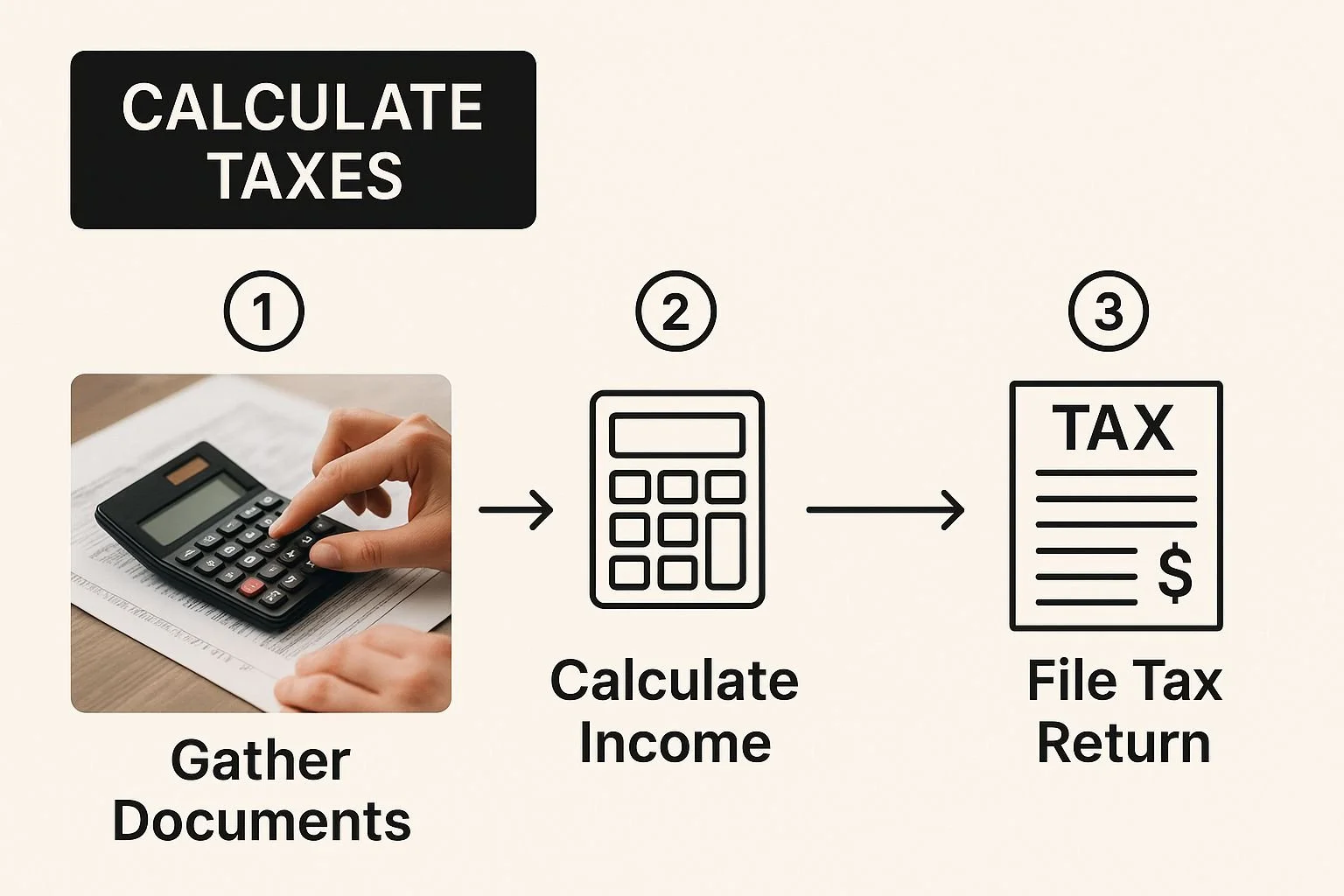
As you can see, the path from your total income to your final tax bill involves several key subtractions—adjustments, deductions, and credits. Each one has a specific job to do in lowering what you owe.
Step 1: Start with Your Gross Income
First things first, you need a starting point. That’s your Gross Income—every single dollar you earned throughout the year, before a penny is taken out for anything.
For Alex, this bucket includes all the payments he received from clients for his design work, which came to $80,000 for the year. But it doesn't stop there; he also needs to add any interest his savings account earned or any cash from a small side gig.
Step 2: Calculate Your Adjusted Gross Income (AGI)
Next up, we find your Adjusted Gross Income (AGI). This is a massively important number on your tax return. To get it, you subtract certain "above-the-line" deductions from your Gross Income. The great thing about these is that you can take them even if you don't itemize.
What kind of things count?
Contributions you made to a traditional IRA.
Interest you paid on student loans.
One-half of the self-employment taxes you paid.
Money you put into a Health Savings Account (HSA).
Alex put $6,000 into his IRA and paid $4,000 in self-employment taxes (he gets to deduct half of that, so $2,000). His total adjustments are $8,000. So, his AGI is now $72,000 ($80,000 - $8,000).
Your AGI isn't just a random number; it's a gatekeeper. It determines whether you qualify for a whole range of other tax deductions and credits. A lower AGI can open the door to bigger savings.
Step 3: Subtract Deductions to Find Taxable Income
Now you've hit a fork in the road. You can either take the standard deduction or you can itemize deductions. Your goal is simple: pick whichever one is bigger, because a bigger deduction means less taxable income.
The Standard Deduction is a flat amount set by the IRS. It depends on your filing status, age, and whether you're blind. No math required.
Itemized Deductions involve adding up specific eligible expenses, like mortgage interest, charitable donations, and state and local taxes (capped at $10,000).
Alex is single, and when he looks at his potential itemized deductions, they don't add up to much. The standard deduction is way higher for him. By taking it, he shrinks his income down even further. This new, smaller number is his Taxable Income—the actual amount of his money the government will tax.
Step 4: Apply Tax Brackets and Subtract Credits
With your taxable income locked in, it’s time to apply the federal income tax brackets. The U.S. has a progressive system, which just means different chunks of your income get taxed at different rates—you don't pay your top rate on all your money.
After you calculate this initial tax, you get to the best part: subtracting tax credits. This is where you can make the biggest dent in your tax bill.
Deductions vs Credits: Which Lowers Your Bill More?
People often mix up deductions and credits, but they work very differently. Understanding the distinction is key to seeing how your tax bill is really calculated. One reduces the income you pay tax on, while the other directly slashes the tax itself.
| Feature | Tax Deductions | Tax Credits |
|---|---|---|
| How It Works | Reduces your taxable income. | Reduces your final tax bill dollar-for-dollar. |
| Value | The value depends on your tax bracket. | The value is the same for everyone who qualifies. |
| Example | A $1,000 deduction might save you $220 in the 22% bracket. | A $1,000 tax credit saves you exactly $1,000. |
As you can see, a credit is almost always more powerful than a deduction of the same amount.
It turns out Alex qualifies for a $500 credit for making some energy-efficient upgrades to his home. That $500 comes straight off the tax he calculated, not his income. The final number he's left with is his true tax liability.
This whole process, from gross earnings to the final payment, can feel complex. This is where tools for automating financial reporting can become a huge help, ensuring everything is tracked accurately. By following these steps, you demystify the process and stay in control of your finances.
Exploring the Different Forms of Tax Liability

Your tax liability isn’t some single, monolithic number that just shows up every April. It’s actually a collection of different obligations that pop up throughout your financial life—from the moment you earn a paycheck to when you decide to sell an investment.
Getting a handle on these distinct forms is the only way to see the complete picture of what you owe.
Think of it like this: your financial life is a house with several rooms. Each room—your job, your business, your home, your investments—can generate its own unique tax bill. Let's take a walk through the most common "rooms" and see what kind of taxes live there.
Personal and Corporate Income Tax
This is the one most of us know best: personal income tax. It's the tax liability triggered by the money you make from your job, a freelance gig, or any other personal venture.
The federal government and most states levy this tax on your taxable income—the amount left after you’ve taken all your allowed adjustments and deductions.
For businesses, the parallel is corporate income tax. When a C Corporation turns a profit, it calculates its taxable income and pays tax directly on those earnings. This creates a tax bill for the business itself, completely separate from the personal liabilities of its owners or staff.
The big takeaway here is that how you earn your money matters. The government treats wages from a 9-to-5 job differently than profits from a corporation, even though both are just money in the bank.
Sales Tax for Business Owners
If you own a business that sells goods or services, you’ll get to know sales tax very well. This is what's known as a consumption tax. While the customer is the one who ultimately pays it, the business owner is legally on the hook for collecting that money and sending it to the right state and local governments.
Who is responsible? The business owner.
What triggers it? Selling a taxable product or service.
How it works: Let's say you sell a t-shirt for $25 from your online shop. If the local sales tax is 7%, you have to collect an extra $1.75 from your customer. That $1.75 was never your money—it’s a liability you owe to the government.
Messing up sales tax collection can lead to some seriously painful penalties, making it a non-negotiable part of running a business.
Property Tax for Homeowners
For anyone who owns a home or other real estate, property tax is an unavoidable part of the deal. Local governments, like your city or county, charge this tax based on the assessed value of your property. That money goes on to fund essential public services like schools, fire departments, and road repairs.
This liability is tied directly to ownership. It doesn't matter if you have a mortgage; as the owner, you are responsible for making sure the tax gets paid. It's a perfect example of how your tax obligations go far beyond just what you earn.
Capital Gains Tax for Investors
Last but not least, we have capital gains tax. This one comes into play for anyone investing in assets like stocks, bonds, or real estate. The tax liability is only triggered when you sell an asset for more than you originally paid for it, creating what's called a "capital gain."
There are two main flavors:
Short-Term Capital Gains: This applies to assets you've owned for one year or less. The gains get taxed at your regular income tax rate, which can be steep.
Long-Term Capital Gains: This is for assets held for more than one year. These are taxed at much friendlier rates, typically 0%, 15%, or 20% for most people.
For example, if you bought a stock for $1,000 and sold it two years later for $3,000, you’ve got a $2,000 long-term capital gain. That profit creates its own specific tax liability, completely separate from your income tax. Each of these tax types contributes to your total financial obligation, showing why you can't just focus on one and ignore the others.
Actionable Strategies to Reduce Your Tax Liability
Alright, now that you have a handle on what tax liability is, it's time to shift from knowing to doing. The goal isn't to find some secret, magic loophole to slash what you owe. It’s about smart, consistent, year-round planning using totally legal and established strategies.
Too many people only start thinking about their tax bill when April is looming, but the biggest moves are made months, or even a year, in advance. When you’re proactive with your finances, you have a surprising amount of control over that final number. Let's walk through some of the most effective methods out there.
Maximize Your Retirement Contributions
One of the most powerful and accessible tools for shrinking your taxable income is funding your tax-advantaged retirement accounts. Think of every dollar you put into a traditional 401(k) or IRA as a dollar you’re shielding from the IRS right now.
These contributions are "pre-tax," which means the money comes out of your paycheck before the government calculates what you owe. For 2024, you can contribute up to $23,000 to a 401(k). If you're age 50 or over, you can add another $7,500 as a catch-up contribution.
This directly lowers your Adjusted Gross Income (AGI), which can have a ripple effect, potentially dropping you into a lower tax bracket or making you eligible for other tax breaks.
How it works: The cash you put in lowers your taxable income for the year. Then, it gets to grow tax-deferred until you pull it out in retirement.
Who it’s best for: This is a no-brainer for just about anyone with earned income. It's a straightforward, long-term plan that helps you save for the future while cutting your taxes today.
Thinking ahead is the name of the game here. For federal employees, for instance, the process of maximizing your FERS retirement benefits runs on the same principle of forward-thinking financial and tax planning.
Leverage a Health Savings Account (HSA)
A Health Savings Account (HSA) is often called the ultimate retirement tool, and for good reason—it packs a rare triple tax advantage. To open one, you just need to be enrolled in a high-deductible health plan (HDHP).
The benefits are pretty much unbeatable:
Tax-Deductible Contributions: The money you put in is deductible, which immediately lowers your taxable income for the year.
Tax-Free Growth: Your investments inside the HSA grow completely tax-free. No capital gains tax, ever.
Tax-Free Withdrawals: You can take money out tax-free for any qualified medical expense, anytime.
Unlike a Flexible Spending Account (FSA), your HSA funds roll over every single year. That money is yours to keep, forever. It's a savings account for healthcare that secretly moonlights as a powerful investment vehicle. For 2024, individuals can contribute up to $4,150, while families can put in up to $8,300.
An HSA is so much more than a healthcare fund. It’s a strategic financial tool that directly reduces your tax liability while preparing you for future medical costs and even supplementing your retirement savings.
Use Tax-Loss Harvesting
If you have a brokerage account, tax-loss harvesting is a brilliant strategy for offsetting your investment gains. It sounds complicated, but the concept is simple: you sell investments that have lost value to "realize" that loss on paper.
You then use that "harvested" loss to cancel out capital gains you've made somewhere else in your portfolio.
Let's say you sold Stock A for a $4,000 profit. But you're also holding Stock B, which is down $3,000. You can sell Stock B to lock in that loss.
Now, the $3,000 loss directly offsets your gain, meaning you only pay capital gains tax on $1,000 of profit instead of the full $4,000. And if your losses are bigger than your gains? You can use up to $3,000 a year to reduce your regular income.
These are just a few of the ways you can start taking control. For a deeper dive, our guide on how to reduce tax liability explores even more powerful strategies. By putting these tactics into play, you can actively manage your finances and work your way toward a smaller tax bill.
What Happens When Tax Liabilities Go Unpaid
It’s one thing to understand your tax liability, but it's another thing entirely to know what happens if you can't—or don't—pay it.
Let’s be clear: ignoring a tax bill is one of the worst things you can do. The problem doesn’t just go away; it kicks off a very predictable, and increasingly aggressive, series of actions from the IRS.
And this isn’t some rare occurrence. The gap between what taxpayers owe and what the IRS actually receives is staggering. For the 2022 tax year alone, the IRS estimated the gross tax gap was a whopping $696 billion.
A huge chunk of that, $514 billion, came from individual income tax shortfalls. That means about 15% of the total true tax liability went unpaid that year, showing just how common this issue is. You can discover the full breakdown of the U.S. tax gap on the IRS website if you want to dig into the numbers.
When a tax bill goes unpaid, a specific chain of events gets set in motion.
The Initial Consequences: Penalties and Interest
The second the tax deadline passes, any unpaid balance starts to grow. The IRS doesn’t wait around; it immediately tacks on penalties and interest that can cause your debt to balloon surprisingly fast.
Failure-to-Pay Penalty: This penalty kicks in for not paying the tax you reported on your return by the due date. The charge is typically 0.5% of your unpaid taxes for every month (or part of a month) they remain unpaid. It keeps adding up until it hits a cap of 25% of your total bill.
Interest: As if the penalty wasn't enough, the IRS also charges interest on your entire underpayment. The real kicker? This interest is compounded daily. That means you're paying interest not just on the original tax debt, but on the accumulating penalties and interest, too.
These two charges work in tandem, creating a snowball effect that makes the debt harder and harder to tackle the longer you wait.
Escalating IRS Enforcement Actions
If the mounting penalties and interest don't prompt you to pay, the IRS shifts gears and starts its more serious collection efforts. These actions aren't just letters in the mail; they are designed to have a direct, and often disruptive, impact on your financial life by freezing your assets and taking your money.
An unpaid tax liability is more than just a debt; it's a legal obligation that grants the government powerful tools to collect what is owed. Proactive communication is always better than waiting for enforcement.
The two most powerful weapons in the IRS's arsenal are liens and levies.
Federal Tax Lien: This is a legal claim the government files against all of your property—your house, your car, your bank accounts, everything. A lien is a public record, essentially telling the world (and all other creditors) that the IRS has first dibs on your assets. It can absolutely trash your credit score and make it almost impossible to sell property or get a loan.
IRS Levy: A levy is the next step up from a lien. It’s not just a claim; it’s the actual seizure of your property to pay off your tax debt. The IRS can take money directly from your bank accounts, garnish your wages right from your paycheck, or even seize and sell your physical assets like your home or car.
Finding yourself in this situation can feel like you’re drowning, but there are ways out. Exploring professional tax debt solutions can open up pathways like an installment agreement or an Offer in Compromise, which can help you resolve the debt and stop these harsh collection actions in their tracks.
How Global Tax Policies Shape Your Financial Future
Your tax liability isn't some fixed number carved in stone. It's constantly in motion, a figure that governments actively tweak to guide their economies, address public needs, and balance the national budget.
Think of tax policy as a control panel with a bunch of levers—each one can be pulled by finance ministers, and each pull directly affects the tax bill for millions of people like you.
These aren't just abstract economic theories playing out in a textbook. They have a very real, very tangible impact on your wallet.
One year, a government might slash tax rates to leave more cash in people's pockets, hoping to spark consumer spending and kickstart the economy.
The next, they might raise taxes to fund massive infrastructure projects or shore up social programs. Grasping this connection is absolutely critical for any kind of long-term financial planning.
Why Tax Laws Are Always Changing
Governments see tax liability as one of their primary tools for managing the economy. When inflation is running hot, they might adjust the tax brackets so a simple cost-of-living raise doesn't unfairly bump you into a higher tax rate.
If unemployment is creeping up, they might roll out tax credits for businesses that hire new employees. Every single change is a calculated move designed to achieve a specific outcome.
This constant state of flux means that staying informed isn’t just a good idea—it’s essential. A new law passed today could completely change how much you need to set aside for taxes next year.
Your personal financial plan doesn't exist in a vacuum. It is directly connected to the broader economic policies enacted by governments, both at home and around the world. Being aware of these shifts allows you to adapt your strategy accordingly.
Global Examples of Tax Policy in Action
You don’t have to look far to see how governments use tax policy to tackle economic hurdles. Take 2025, for instance. Several countries made major moves that changed what their citizens owe.
Argentina, battling runaway inflation, adjusted its tax brackets to give taxpayers some breathing room. Cuba went in the complete opposite direction, hiking its top income tax rate from a modest 20% to a steep 50% to drum up more government revenue.
Meanwhile, India's latest budget focused on lightening the load for low-income earners by boosting tax rebates. These examples are perfect illustrations of how tax rules are always being refined to meet national priorities. You can learn more about recent global tax rate changes to see just how widespread these adjustments are.
Trying to keep up with these changes, especially if you’re already struggling with a tax issue, can feel overwhelming. It’s exactly why programs designed to help taxpayers get back on solid ground, like the IRS Fresh Start Program, are so vital. They offer a clear path forward when you're facing financial trouble.
Ultimately, understanding that your tax liability is tied to these larger economic currents empowers you to be a more proactive and prepared financial citizen.
Got Questions? We've Got Answers
Even after breaking down the basics, tax liability can still feel a bit confusing. A few questions always seem to pop up, and getting them sorted is the key to feeling confident about your finances. Let's tackle some of the most common ones.
Taxable Income vs. Tax Liability: What's the Real Difference?
It’s easy to mix these two up, but they represent two very different steps in the tax process. Think of it like a recipe.
Your taxable income is the bowl of ingredients—it's the slice of your total earnings that the IRS actually gets to tax after you've subtracted all your eligible deductions. It's not your final bill, but it's the number that bill is based on.
Your tax liability is the finished dish—the actual dollar amount you owe the government. You only get to this number after you've applied the tax rates to your taxable income and then subtracted any tax credits you qualify for.
So, one is the amount being taxed, and the other is the actual tax you have to pay.
Can My Tax Liability Actually Be a Negative Number?
Absolutely, and when it happens, it's a good day. A negative tax liability is just a fancy way of saying you’re getting a refund because the government owes you money.
This situation arises when your refundable tax credits are worth more than the tax you owed in the first place.
Let's say your tax calculation shows you owe $900. But, you also qualify for $1,500 in refundable credits (like the Earned Income Tax Credit). Those credits first wipe out the $900 you owe, and then there's $600 leftover. That leftover amount comes back to you as a refund. Your tax liability is effectively -$600, meaning you get a check from the IRS.
A negative tax liability isn’t a mistake. It’s the tax code working as intended, putting money back into the pockets of taxpayers who qualify for certain support programs.
How Much Does My Filing Status Really Affect My Tax Bill?
It's a huge deal. Your filing status (Single, Married Filing Jointly, Head of Household, etc.) is one of the most powerful factors determining your tax liability. It directly impacts two critical parts of your tax return:
Your Standard Deduction: Each filing status gets a different standard deduction amount. A married couple filing jointly gets a deduction that’s double the amount for a single person. That immediately lowers their taxable income by a much larger chunk.
Your Tax Brackets: The income levels for each tax bracket change based on your filing status. The brackets for a Head of Household are wider and more forgiving than for a Single filer, allowing them to earn more before getting bumped into a higher tax rate.
Picking the right filing status is foundational. It ensures the whole calculation is based correctly on your life situation and can save you from paying more than you need to.
If you're wrestling with tax liability issues, you don't have to figure it out on your own. Attorney Stephen A Weisberg offers a FREE Tax Debt Analysis to see how he can help you resolve problems with the IRS or state, all before you ever pay a fee.
➥ Contact Attorney Stephen A. Weisberg for a free Tax Debt Analysis.
Contact Me Here: https://www.weisberg.tax/contact-1
Email: s.weisberg@weisberg.tax
Phone/Text: (248) 971-0885
Address: 300 Galleria Officentre, Suite 402, Southfield, MI 48034
