It's Thursday afternoon, payroll is due tomorrow, and a notice in the mail says the IRS intends to levy your business bank account. You also owe income tax from two years ago, and you haven't filed last year's return yet. Which problem do you handle first? That ordering question, not which balance is biggest, is what priority tax relief is really about.
What Priority Tax Relief Means in Collections
Say a shop owner owes an older income tax balance, has a payroll deposit due this week, and just received a levy warning. The older balance may be the largest number in the file, but it's not the most urgent problem. In collections, priority means urgency. It asks which debt can create a new personal assessment, take money now, or freeze a sale, loan, divorce, or court date if it waits.
Think of it as traffic. A levy is a car already in the intersection, because funds can be pulled before you finish negotiating. A payroll deposit is a red light you can't run, because missing it creates a new and more dangerous kind of debt. An older income tax balance is traffic still a block away. It's real, it's coming, but it doesn't outrank the car in front of you.
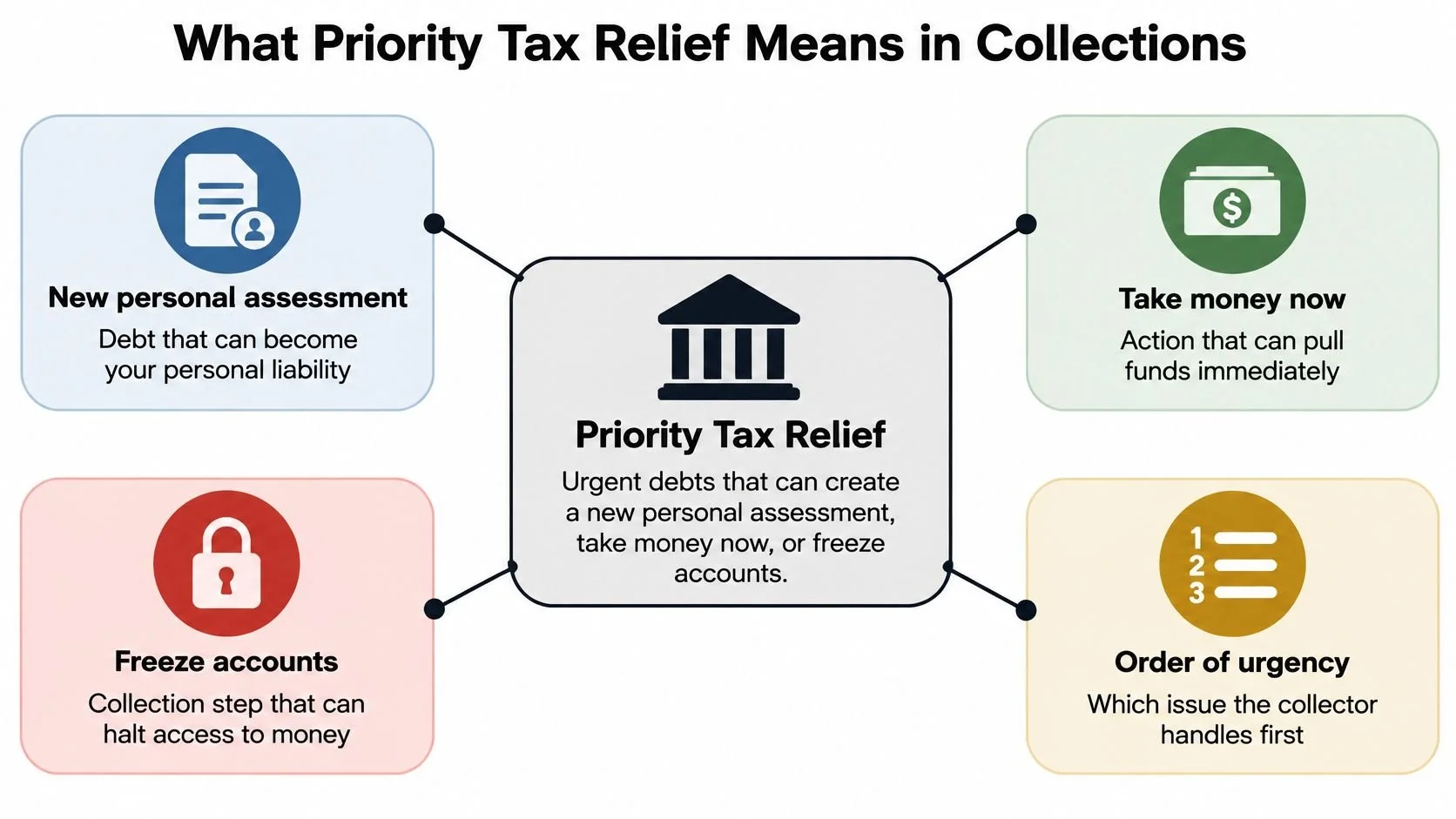
Two Different Meanings of Priority
There's a second, narrower meaning you'll see in bankruptcy. There, priority is a statutory payment rank that decides which claims get paid ahead of others. It's not forgiveness, and that ranking gets separate treatment later in this article. In day to day IRS and state collections, stick with the urgency meaning, because that's the one that decides what you do this week.
States add another layer. A state runs its own liens, levies, and payment programs on its own deadlines. A federal hold or payment plan doesn't automatically pause a state warrant, so a state balance needs its own place in your order even when the IRS is your main concern.
Reading the Notice in Front of You
Before you rank anything, read each notice for its type and date. A notice of intent to levy means the next collection step is close. A balance due notice is a payment request, serious but earlier in the sequence. Match each notice to a row in the triage table that follows, because the notice type tells you how much time you have.
One line test: If waiting creates personal exposure, empties an account, or blocks another deal, it's priority, even when a bigger bill is sitting in the file.
The decision the rest of this article supports is simple to state. Stay current, stop any seizure that's already moving, get required filings in, then match a program to what your household or business can pay. Skipping to the last step is where most relief efforts break down.
Which Tax Debts to Handle First
A business owner gets a bank levy notice on Thursday. Friday payroll is still unfunded, and an older income tax balance is already sitting in a proposed installment agreement. The instinct is to protect the installment agreement because that balance is biggest. The rule is the opposite. Priority tax relief is triage by the kind of liability and the harm it can do this month, not by which balance is largest.
What to Handle Before You Negotiate Older Tax Debt
| Priority item | Why it cannot wait | First move |
|---|---|---|
| Current payroll and federal tax deposits | A missed deposit creates new trust fund debt and possible personal exposure | Deposit on time before negotiating older balances |
| Trust Fund Recovery Penalty risk | Assessment can equal unpaid withholdings plus interest for a responsible person | Identify who had authority and keep those records |
| Active levy, garnishment, or seizure | Operating cash or wages can be taken before a plan is approved | Seek a collection hold while a resolution is documented |
| Unfiled required returns | Most agreements, hardship status, and offers stall without them | File the missing returns first |
| Federal tax lien | Public claim that can block a sale, refinance, or loan | Address the lien before a closing date |
| Older personal or business income tax | Interest and penalties grow, but usually behind payroll and live levies | Model a plan only after current compliance |
| Separate state tax balance | A different agency with its own deadlines and liens | Do not assume an IRS plan covers the state |
Read the table from the top. Current payroll and federal tax deposits come first. Money withheld from employees' wages isn't the business's money to borrow for rent or inventory. When it isn't paid over, the debt changes character and can follow individuals, not just the company.
That's the second row. The IRS explains in its guidance on the Trust Fund Recovery Penalty that it can assess that penalty personally against responsible individuals who willfully fail to collect, account for, or pay over withheld employment taxes, and the assessment can equal the full unpaid trust fund amount plus interest.
So cash flow relief that ignores current deposits can increase personal exposure while you're still negotiating older income tax. If this risk is in your file, our detailed breakdown of how trust fund penalties are assessed against responsible persons explains who the IRS targets and why authority records matter.
Why a Live Levy Outranks a Larger Balance
An active levy, wage garnishment, or seizure comes next because the cash can disappear before any agreement is approved. A payment plan that would've worked next month doesn't help if the operating account is emptied this week. The first move is getting collection paused while you document a resolution, not finishing the resolution itself.
Unfiled returns come before program shopping for a practical reason. Installment agreements, hardship status, and offers generally don't move until required returns exist, because the IRS won't settle a total it can't yet see. Filing doesn't mean you must pay in full with the return. It means the door to every other option is now open.
Next is a federal tax lien, the government's public claim against your property. It may not take cash today, but it can stall a sale, refinance, or loan at the worst moment, so it has to be sequenced ahead of any closing date. Only after those items do older personal or business income tax modules get their turn, followed by state balances that a federal plan doesn't erase.
Before you treat any program as a plan, lay every notice, balance, and upcoming deposit beside the matching row. If a higher row is unresolved, that's your work, whatever the biggest number says.
Relief Options Matched to Your Cash Position
IRS programs aren't interchangeable lanes to the same place. Each one fits a different cash position, and each one leaves something running while it's in effect. The right question isn't which program erases the most, but which program matches what you can pay each month without falling behind again. Start with the comparison, then read the trade offs row by row.
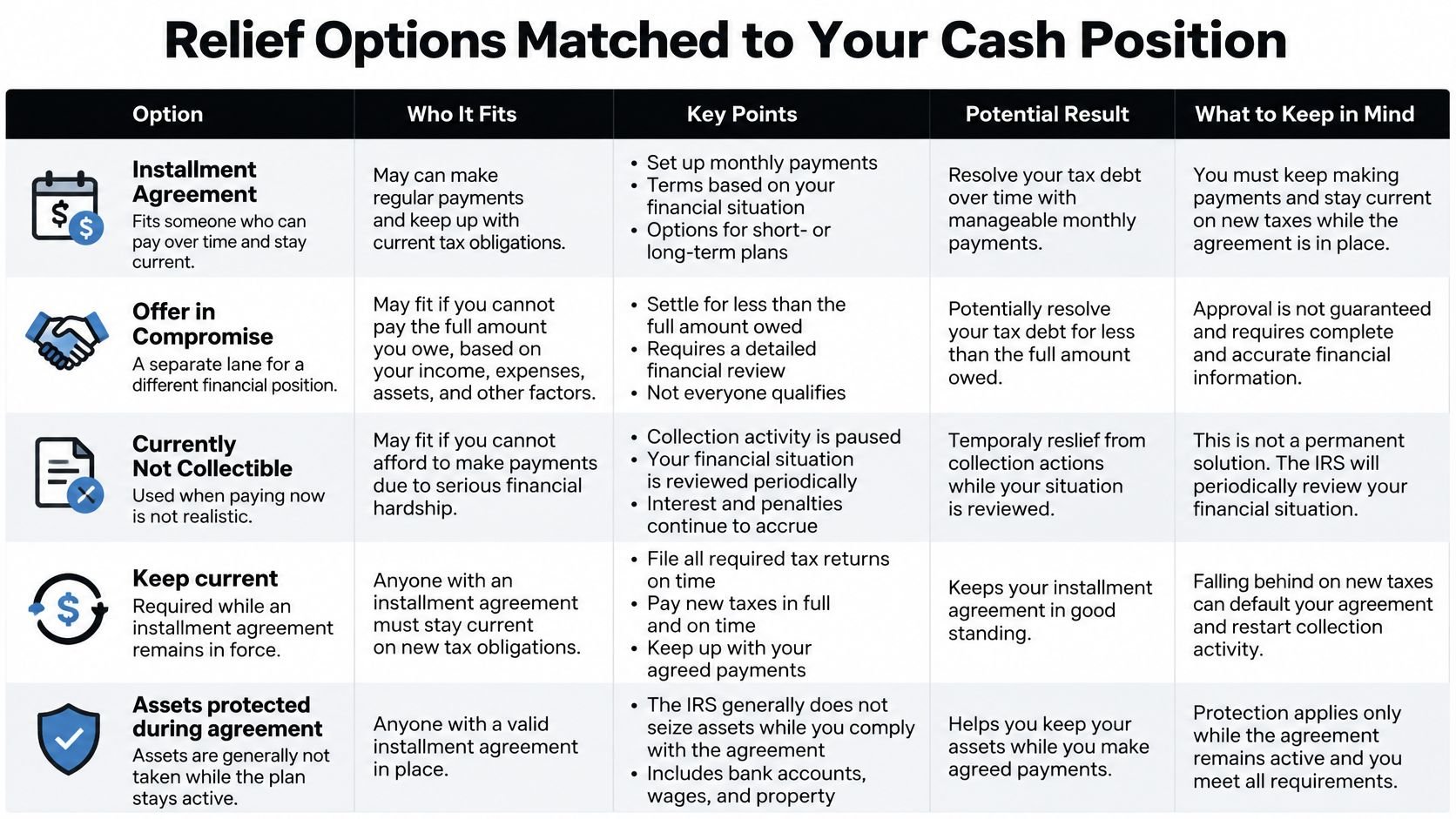
Which Relief Fits the Cash and Compliance You Actually Have
| Relief | Best fit | What still happens | What it is not |
|---|---|---|---|
| Installment agreement | Can pay over time and remain current | Interest, penalties, and fees continue; levies generally held while the agreement is active | A reduction of the tax |
| Currently not collectible | Paying would cause serious hardship and income and assets are very limited | Collection pauses but penalties and interest continue | A settlement or permanent waiver |
| Offer in compromise | Full payment through a plan or equity is unlikely and the offer meets collection potential | Requires filing compliance, estimates, and employer deposits; most offers are not accepted | An automatic hardship discount |
| Penalty abatement | Reasonable cause such as illness or bad professional advice, or other IRS penalty relief | Underlying tax, and often interest on the tax, remains | Forgiveness of the balance |
| Innocent spouse relief | Joint return error the spouse did not know about | Must be requested within two years of the first collection attempt | A payment plan for both spouses |
| Temporary collection delay | Cannot pay right now but may pay later | Penalties and interest keep accruing during the pause | A final resolution |
An installment agreement works like refinancing the balance into monthly payments. It fits someone who can pay over time and stay current on new obligations. While it remains in force, assets are generally protected from new levies, which buys stability.
The cost is that interest, penalties, and fees keep running, so a long plan pays more than the original balance. If your income can't pay the balance in full within the collection period, the monthly payment shrinks but so does the total you clear. Compare that math carefully using our guide to choosing between a partial payment plan and an offer in compromise.
Currently not collectible status, also called hardship status, pauses active collection when paying would cause serious hardship and income and assets are very limited.
It protects the account without reducing what you owe, and accruals continue while you wait. A temporary collection delay works similarly for someone who can't pay right now but may pay later. Both buy time. Neither resolves the debt, so treat either one as breathing room to fix the underlying cash problem.
An offer in compromise belongs in this table for one narrow group: people whose reasonable collection potential shows the IRS can't collect the full balance. The qualification test is strict enough that most filers don't pass it, which is why it gets its own discussion after the case examples. Don't pick it from this table alone.
A pause is not a settlement. If a program stops collection but lets interest and penalties run, you're buying time, and time has a price.
Penalty abatement can reduce or remove penalties when there's reasonable cause, such as illness or incorrect professional advice. The tax itself stays, so it works best layered onto a payment arrangement instead of replacing one.
Innocent spouse relief addresses tax from a joint return error that one spouse didn't know about. The application must be filed within two years of the IRS's first attempt to collect, so that deadline can jump the queue even when the balance looks smaller than other items.
While you weigh these rows, the IRS isn't standing still. It actively pursues unpaid balances through levies, liens, and wage garnishments, so waiting without a plan carries real risk no matter which option you eventually land on.
Before any application, check three gates. Required returns are filed. Required estimated payments are made. If you're an employer, federal tax deposits are current. An application that fails a gate usually stalls no matter how well the rest is prepared.
How the Order Changes in Real Cases
The table gives you a default order. Real files rearrange it based on one constraint that dominates everything else. These short cases stop at the correct first move, because getting that move right is most of the work.

The S Corporation Owner Who Wants a Settlement
Say an S corporation owner owes about $40,000 of older income tax and wants to file an offer right away. This week's payroll, though, is short. The right sequence is to fund the deposit first and identify who had check signing authority, before anyone calculates a settlement. A personal trust fund assessment can outlive the company debt, so creating a new one while negotiating the old balance trades a manageable problem for a worse one.
The Sole Proprietor With a Levy and Missing Returns
Say a sole proprietor's business account is under levy and the last two returns are unfiled. Settlement math feels urgent because the balance is unknown and growing. It isn't the first move. Dealing with the levy and filing those returns comes first, because an empty account closes the business faster than interest does, and no agreement moves forward without the missing filings anyway.
The Couple With a Closing Date
Say a married couple has a joint balance, income one spouse didn't know about, and a house closing in 60 days. A generic payment plan sounds tidy, but it solves neither live problem. The lien has to be addressed before the closing date or the sale stalls, and the spouse issue has its own deadline and its own analysis. Sequence those two first, then decide how any remaining joint balance gets paid.
The 1099 Earner With Swinging Income
A shorter snapshot. Say a 1099 earner earns well in busy months and very little in slow ones. A long fixed monthly payment looks fine on annual income and then fails in the first slow stretch, which can default the whole arrangement. Hardship status during the lean period or a partial payment structure that reflects real cash flow can be more realistic than chasing a settlement the financials won't support.
Find the case that shares your constraint, whether that's payroll, a live levy, a closing date, or uneven income. Then go back to the first table and start from that row. Your biggest balance rarely tells you where to begin. Your tightest constraint does.
Why an Offer in Compromise Is Often the Wrong First Move
Many taxpayers arrive expecting a deep discount. The numbers say otherwise. The IRS reports in its Data Book publication for fiscal year 2025 that taxpayers submitted 38,797 Offers in Compromise in fiscal year 2025 and the IRS accepted only 5,464, approximately 14.1% of submissions.
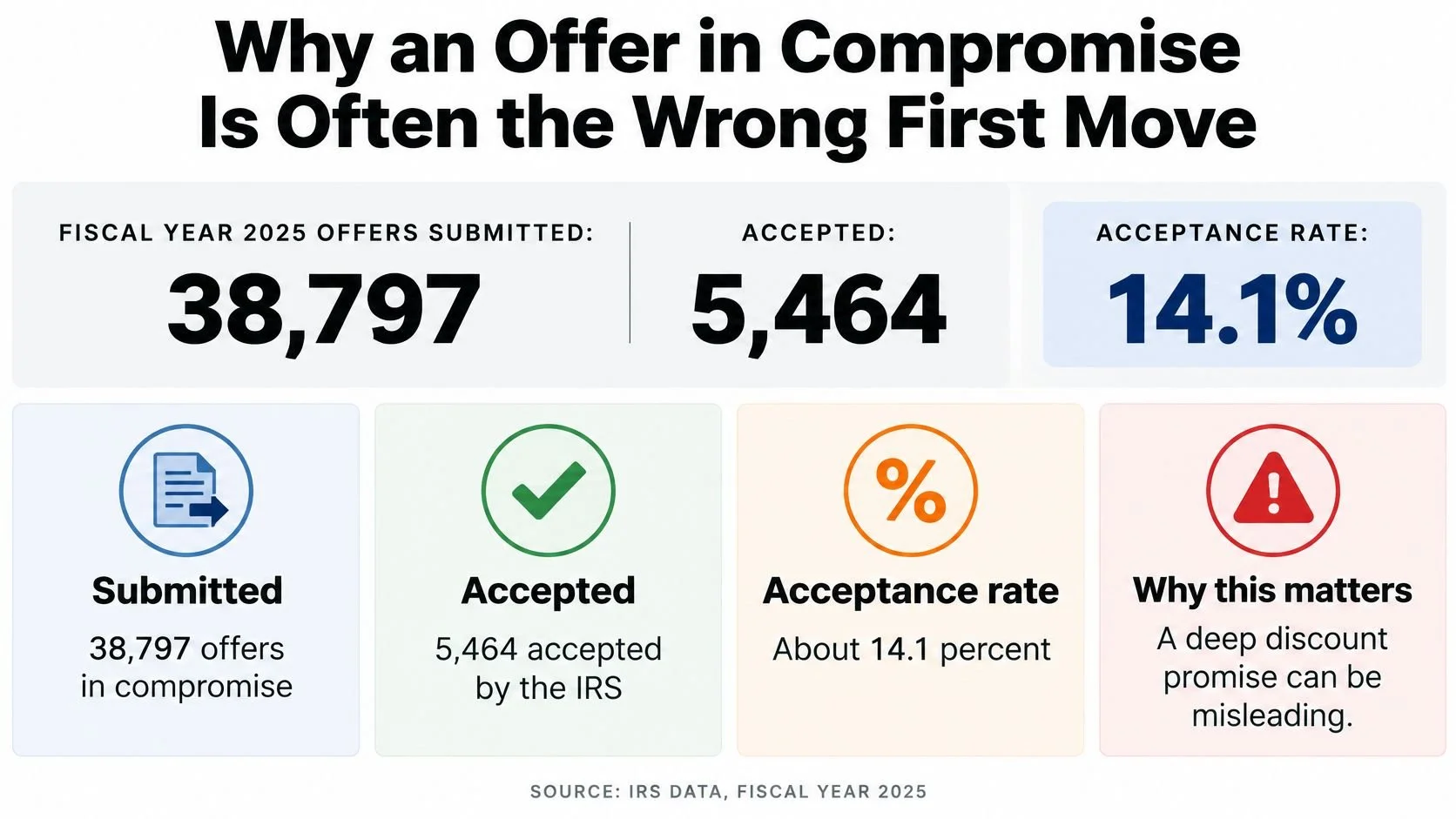
The Math Behind the Low Acceptance Rate
An offer isn't a hardship coupon. It's an actuarial collection analysis. The IRS explains in its topic guidance on offers in compromise that the offered amount generally must equal or exceed reasonable collection potential, calculated from realizable asset equity plus expected future income after allowable basic living expenses.
That math decides most cases before negotiation starts. If your home or account equity alone exceeds what you're offering, the offer fails on paper.
Unreported equity, unsupported expenses, or understated earning capacity lead to rejection because the IRS measures your offer against what it could collect, not against what you'd prefer to pay. An offer generally won't be accepted when an installment agreement or available equity would full pay the debt.
The paperwork reflects that scrutiny. Individuals and self employed filers typically submit Form 656 with Form 433-A (OIC), while businesses generally use Form 433-B (OIC). Thin records don't lower your collection potential. They give the examiner reason to use less favorable figures.
Be skeptical of urgency in advertising. Claims of an expiring deadline for the IRS Fresh Start Program can be misleading, and pressure to file fast usually serves the advertiser, not your financial statement.
An offer is still worth pursuing when full payment is unlikely and your financials support a lower collection potential. For readers weighing that narrow path, a plain explanation of settling IRS debt for less can help you see what qualification requires before you spend time on forms. Use the IRS OIC Pre-Qualifier as a screen, not a verdict. If the math doesn't fit, a payment plan, temporary delay, or penalty relief will usually get you protected sooner and at lower cost.
How Bankruptcy Ranks Priority Tax Claims
A business owner files for bankruptcy expecting the tax debt to disappear along with the credit card balances. Sometimes older tax years do get discharged. Often they do not, because bankruptcy law sorts every claim into a payment order, and the IRS frequently stands near the front of that line. Priority here is a payment rank, not a forgiveness program. It works like the order a court empties a limited pot of money: the highest ranked claims are paid before general creditors see anything.
Bankruptcy Priority Ranks for Common Tax Claims
| Priority rank | Which tax | Why the rank matters | Typical plan treatment |
|---|---|---|---|
| Second | Post-petition taxes of the bankruptcy estate | Paid ahead of many general unsecured claims | Estate obligation, not forgiven by the rank |
| Eighth | Certain pre-petition income taxes | Return due within three years before the petition, assessed within 240 days, or still assessable | Chapter 13 generally three years, or five with court approval |
| Eighth | Unpaid employment taxes, including the withheld employee share and the employer share | Both portions of the payroll liability generally share one rank | Chapter 11 plans may pay over five years |
The IRS confirms in Publication 908 on bankruptcy tax rules that post-petition taxes incurred by a bankruptcy estate receive second priority under 11 U.S.C. § 507, while pre-petition income taxes generally receive eighth priority when the return was due within the three years before the petition, the tax was assessed within 240 days before filing, or the tax remained unassessed but still assessable before the petition date.
Employment taxes are simpler than many owners expect. Unpaid employment taxes, covering both the employee share withheld from paychecks and the employer share, generally fall in eighth priority under 11 U.S.C. § 507(a)(8).
One rank covers the whole payroll liability.
That single rank is the point: the withheld portion does not jump ahead of the employer portion in the payment order, so the same payroll period produces one priority claim rather than competing slices.
The rank has real consequences. Priority claims are paid ahead of many general unsecured claims, like credit card balances, and they may be difficult or impossible to discharge. In Chapter 13, qualifying priority taxes are generally paid through a plan lasting three years, or five years with court approval.
Chapter 11 plans may provide payment over five years. If you're weighing whether a filing helps your specific tax years, our analysis of whether tax debt can be discharged in bankruptcy walks through the timing tests in plain terms.
Bankruptcy can turn an immediately enforceable bill into a court supervised repayment. It does not erase priority tax by relabeling it.
Two cautions apply. Payroll taxes that come due after filing sit outside the old claim entirely and become a fresh liability. And if a sale, loan, or divorce can't close until someone knows whether the tax claim outranks the other side of the deal, get the rank mapped before you sign anything.
When to Call a Tax Attorney Before You File or Settle
You don't need a lawyer to read a notice or set up a simple payment plan you can afford. You do need one when the wrong first move creates a problem you can't undo. Use this hire test.
Triggers That Justify a Call
A levy or wage garnishment is already running, because cash is leaving while you decide.
A trust fund penalty interview or assessment is possible, because what you say about authority and willfulness shapes personal liability.
A lien threatens a closing or refinance, because the deal has a date and the lien doesn't care.
An offer has been rejected, or innocent spouse or appeal deadlines are running, because missed dates close doors.
A bankruptcy, divorce, or lender can't finish until the tax claim is mapped, because that professional may not practice IRS controversy work.
Your CPA or enrolled agent who prepares returns can stay involved, and often should. Controversy work, meaning representation in collection, appeals, and penalty disputes, is a different task from preparation. Our guide on deciding when to hire a tax attorney lays out that dividing line in more detail.
Stephen A. Weisberg, lead attorney of The W Tax Group, represents individuals, owners, and businesses before the IRS and state taxing authorities. He also coordinates with tax professionals, lenders, bankruptcy lawyers, and family lawyers when tax debt blocks another deal from closing.
The practical next step is an ordered review, not a promise of settlement. The Tax Resolution Plan includes Power of Attorney submission, a complete review of IRS transcripts, an attorney led analysis of financials, and a personalized step by step plan of action.
Prospective clients can click a button to receive a Tax Debt Resolution Plan, and the free book Freedom From Tax Debt is available at no cost and with no obligation if you want background first. Bring every notice, balance, and upcoming deposit so the triage can be applied to your actual file.
If a levy, payroll shortfall, or lien is forcing your hand, get the order right before you file, pay, or settle anything. Tax Attorney Stephen A Weisberg will review your transcripts, rank each liability by live collection risk, and give you a written step by step sequence matched to what you can pay. Visit Tax Attorney Stephen A Weisberg to request that review and bring every notice you have.
Want to understand your options before you call anyone?
Download my free book — Freedom From Tax Debt — a plain-language guide to how the IRS collections process actually works and what resolution really looks like.
➥ Contact Attorney Stephen A. Weisberg for a free Tax Debt Analysis.
Contact Me Here: https://www.weisberg.tax/contact-1
Email: s.weisberg@weisberg.tax
Phone/Text: (248) 971-0885
Address: 300 Galleria Officentre, Suite 402, Southfield, MI 48034
