The IRS generally has three years to assess the trust fund recovery penalty and then ten years from that assessment date to collect it. Neither number is a fixed calendar countdown, because notices, waivers, protests, and collection pauses can change both dates.
You're probably asking because an old payroll quarter suddenly feels personal. A business closed, a revenue officer called, or a notice arrived with your name on it, and someone told you the quarter is too old to matter. That advice skips the only question that counts. Was the penalty assessed on time against you, and how much collection time is left?
The Two Deadlines That Control a TFRP
Say a former officer hears that a 2019 payroll quarter is stale and can't hurt her. Then she learns the IRS assessed a personal penalty years later, after a protest and an Appeals review. The quarter's age didn't answer anything. The trust fund recovery penalty statute of limitations has two separate clocks, and the second one starts only when the first one ends in an assessment.
Assessment first, collection second
The assessment statute, often called the ASED, is the IRS deadline to create your personal liability. It's generally three years, and for withholding and FICA it runs from the later of the Form 941 filing date or the succeeding April 15. The collection statute, or CSED, generally runs ten years from the date the penalty is assessed against you under IRC §6502, not from the payroll quarter.
The penalty itself, under IRC §6672, equals 100 percent of the unpaid trust fund portion. That's the income tax and employee FICA withheld from wages but not paid over. It doesn't include the employer share. If you want the background on who counts as responsible and willful, start with what the trust fund recovery penalty is, then use the table below for timing.
TFRP statute clocks and what changes them
| Clock | Starts | Normal length | What changes it |
|---|---|---|---|
| Assessment (ASED) | Later of Form 941 filing or the succeeding April 15 | 3 years | Form 2750 waiver; Letter 1153 while the period is open; timely Appeals protest |
| Collection (CSED) | Date the TFRP is assessed against that person | 10 years | Installment agreement, offer in compromise, bankruptcy, CDP hearing, time outside the United States, and other periods when levy or suit is barred |
| Letter 1153 window | Personal delivery or mailing while the ASED is still open | At least 90 days, or 75 days if mailed outside the United States | Timely protest keeps the period open until 30 days after Appeals issues a final determination |
| No assessment limit | Unfiled return, fraudulent return, or willful attempt to evade tax | No ASED | IRS may assess whenever; the 10-year collection clock still starts only at assessment |
Walk the rows in order. The first row asks whether the IRS can still assess you. The second asks how long it can collect after it does. The third row explains why a notice near the deadline can keep the first clock alive, and the fourth covers cases where the first clock never started at all.
Write down four dates now
Before you read further, list what you know and leave blanks for what you don't.
Return date: When was each Form 941 filed, or when was it due if it wasn't filed?
Letter 1153 date: When was the proposed penalty notice mailed or hand-delivered to you?
Assessment date: When did the IRS record the penalty against you personally?
Waiver date: Did you sign Form 2750, and what new date does it state?
Practical rule: Don't ask how old the payroll quarter is. Ask whether the ASED was open on the assessment date, and what CSED is printed on your own transcript.
How the Three-Year Assessment Period Is Counted
Many taxpayers miscount because they start at the end of the quarter. The quarter ends, the Form 941 is due a month later, and three years from that due date feels like the obvious answer. It isn't.
For income tax withholding and FICA taxes, Internal Revenue Code §6672 imposes a penalty equal to 100% of the unpaid trust-fund tax on a person responsible for collecting, accounting for, or paying it over who willfully fails to do so, and IRS guidance measures the assessment period as generally three years from the succeeding April 15 or the filing date, whichever is later.
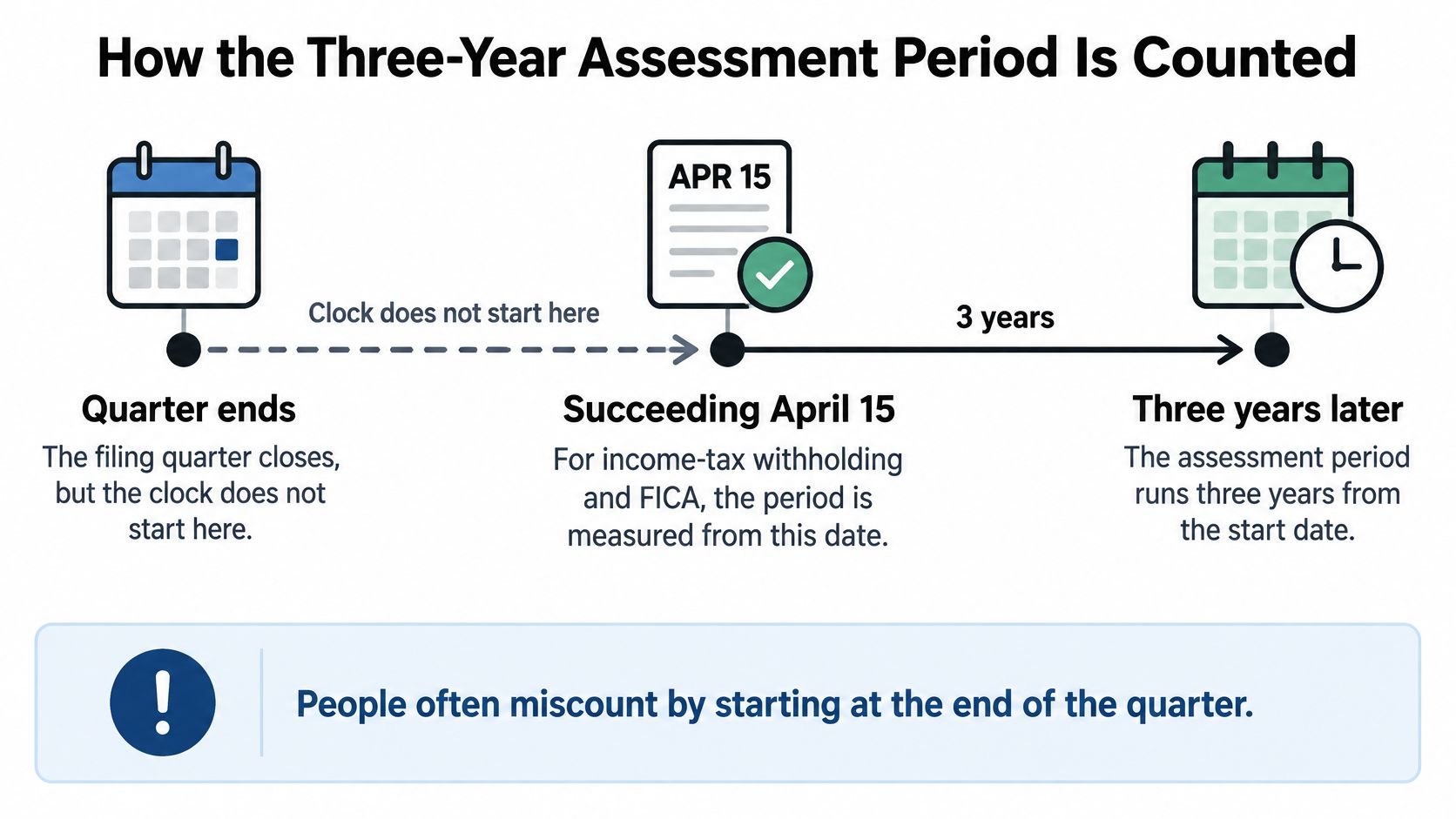
One quarter, counted correctly
Take a second-quarter Form 941 for the period ending June 30, 2022, filed on time by July 31, 2022. The clock is generally measured from April 15, 2023, the succeeding April 15. Three years from there lands on April 15, 2026, not July 31, 2025. That gap surprises people who counted from the filing date.
Change one fact and the date moves. If that same return was filed late, on September 1, 2023, the later filing date controls. Three years run from September 1, 2023. A late return doesn't shorten the IRS window. It pushes the start date out.
Each quarter and each account stands alone
Every quarter has its own Form 941 and its own ASED. An expired first quarter doesn't expire the second or third. You have to test each period separately, using that period's filing date and the succeeding April 15 for that calendar year.
Keep the accounts separate too. The employer's unpaid Form 941 account is not your TFRP account. The business balance can still be open, or the company may have already paid part of it, while your personal penalty has its own deadline. Copying a date from the business transcript onto your personal case is a common and costly error.
Think of the trust fund as wages held in a lockbox for the government. The employer took the money out of paychecks and held it briefly before sending it in.
Section 6672 moves that unpaid amount onto a person who was responsible for the lockbox and willfully let other bills get paid instead. Once you know the normal three-year end date for a quarter, the next question is whether anything stopped that count before it ran out.
How Letter 1153 Holds the Assessment Period Open
Letter 1153 is the warning notice, not the bill. Before the IRS assesses the penalty, it must mail or personally deliver notice of the proposed assessment. That delivery date matters as much as the ASED itself.
If the notice goes out while the assessment period is still open, the IRS guidance on trust fund recovery penalty assessment describes Letter 1153 as preserving the period for the 60-day protest period plus an additional 30 days, 90 days total, while its procedures also recognize a 75-day response period for notices mailed outside the United States.
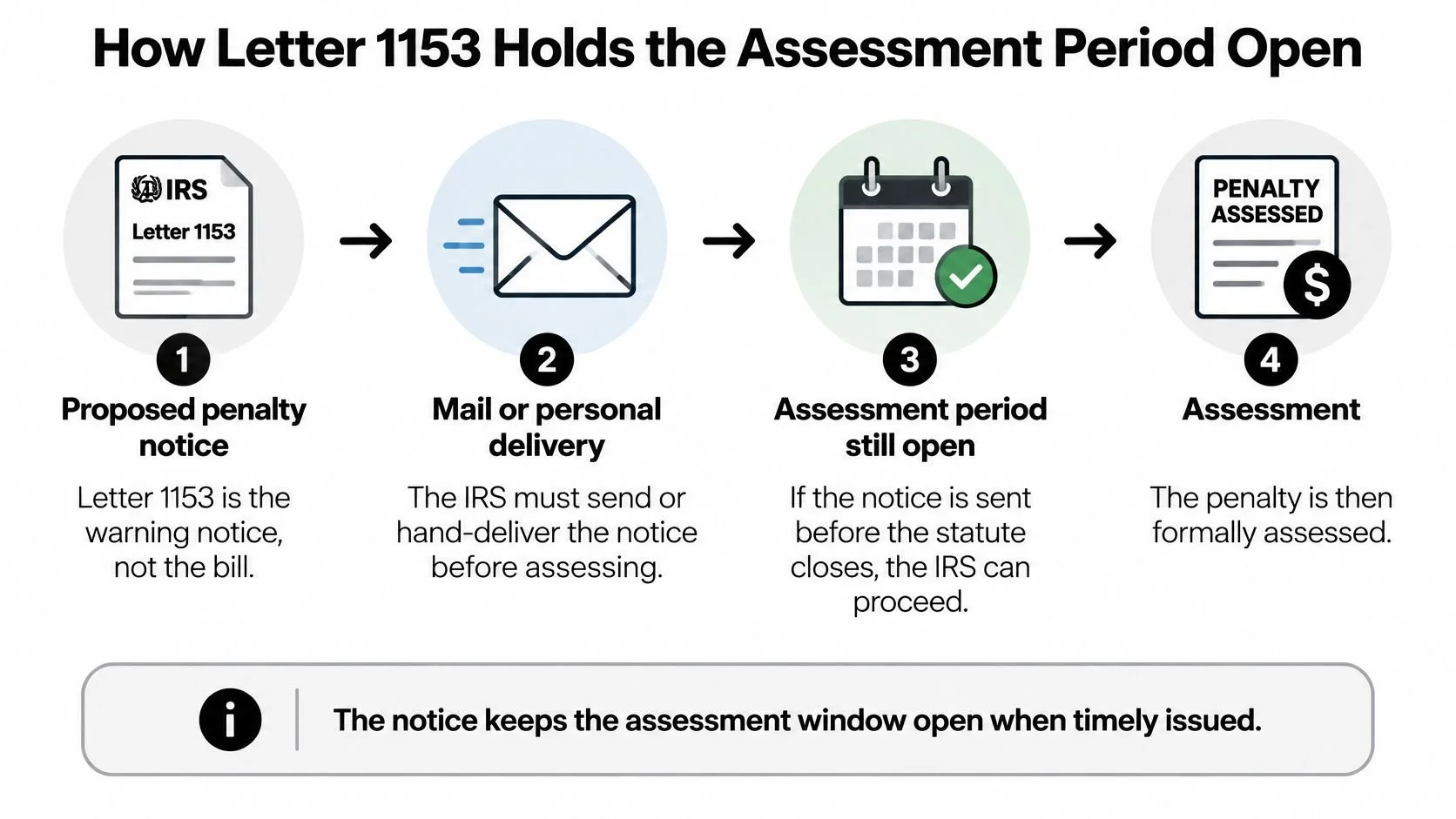
Follow one notice to its end
Use the running example. The normal ASED is April 15, 2026. A revenue officer delivers Letter 1153 on March 1, 2026. Because the statute was open on delivery, it can't expire until at least about May 30, 2026, ninety days later.
If you file a timely protest, on day 60 for instance, the period generally stays open until 30 days after Appeals issues a final administrative determination. That can be many months past the original ASED. A late protest doesn't buy that Appeals extension, so the protest deadline is not a soft target.
The 1153 clock is a fuse only if the statute was open on the day of delivery.
That sentence cuts both ways. If the ASED had already expired before the IRS mailed or delivered the letter, the letter doesn't revive it. Delivery while the period is open is what protects the government.
The protest is your pre-assessment defense
The notice is also your main chance to contest responsibility and willfulness before the penalty exists. Build the protest around documents, not titles. Bank signature cards, board minutes, payment logs, and records showing who signed returns and checks tell Appeals who controlled the money.
Strong defenses are specific to a quarter. Show you had no authority over payroll checks or electronic deposits. Show someone else decided which creditors were paid.
Show you didn't know the taxes were unpaid, or that when you learned, you had no power to fix it. Confirm those facts in writing before the protest deadline, because collection appeals after assessment argue about payment, not about whether you should owe at all.
Waivers and Cases With No Assessment Deadline
The payroll quarter's age alone cannot establish whether the IRS can assess a TFRP. Rebuild the timeline for each quarter: start with the employment return's filing date, then check for a signed waiver and any circumstance that prevents the assessment period from starting.
Form 2750 trades time for time
Form 2750 is a written consent extending the time for the IRS to assess the penalty against a named person for the periods listed. Signing is voluntary. It can give you and the revenue officer more time to gather records or address responsibility. If you do not sign, the officer may move toward a proposed assessment to protect the deadline.
A request for the form is a signal that the assessment deadline may be approaching. The IRS Internal Revenue Manual published in 2025 says examiners ask for Form 2750 as the TFRP assessment deadline nears. The request does not, by itself, tell you the exact assessment date. Check the return date, the IRS's proposed assessment process, and the periods named on any consent.
Read the form closely before signing. The extension lasts only as long as the form specifies and applies only to the periods it identifies. A Form 2750 does not itself extend the later ten-year collection period. That clock begins with assessment, so the assessment date, not the quarter's age, anchors the collection timeline.
When there is no assessment limit at all
Some circumstances leave no assessment limitation period. These include an employment return that was never filed, a fraudulent return, or a willful attempt to evade tax. In these cases, counting three years from the quarter will not establish an end date, because the assessment clock may never have started.
An IRS-prepared substitute for return in an evasion setting also does not serve as a taxpayer-filed return that starts the clock. The collection period still begins only after assessment. As a result, an old unfiled quarter may lead to a newly assessed personal liability with a new collection timeline.
Check each quarter separately:
Filed date: Was Form 941 filed, and when?
Fraud or evasion: Is either alleged?
Form 2750: Did you sign a consent, and which periods does it cover?
Extended date: What date does the consent specify, and has it passed?
These checks turn a broad question about an old payroll quarter into a timeline based on the return, any signed waiver, and the eventual assessment.
What Pauses the Ten-Year Collection Clock
The payroll quarter's age rarely tells you how much collection time remains. First identify the penalty assessment date, then rebuild the collection timeline from that date and any later pauses. The IRS guidance on the Collection Statute Expiration Date explains that the CSED is normally 10 years after assessment. The IRS generally must begin a levy or court proceeding within that period.
Suspended time gets added back
The ten years do not always run continuously. When federal law prevents collection, the clock is suspended, and the paused time is added to the CSED. Some events also add a set period after the suspension ends. For background on how long the IRS can collect back taxes, see the general collection rules, then compare the events with the account transcript.
Events that suspend a TFRP collection statute
| Event | While it lasts | Added after it ends |
|---|---|---|
| Offer in compromise pending | CSED suspended while pending | 30 days after rejection, withdrawal or termination |
| Installment agreement pending, rejected or terminated | CSED suspended while pending or in the protected period | 30 days in usual rejection or termination cases |
| Collection Due Process hearing | Suspended from request until determination | Time until determination is final, including Tax Court review |
| Bankruptcy case | Collection suspended during the case | Six months after the case ends |
| Innocent spouse claim | Suspended while the claim is pending | Case-specific end date shown on transcript |
| Taxpayer outside the United States | Continuous absence of at least six months | Length of the absence period |
These entries extend the existing clock; they do not start a new ten-year period. For example, a pending offer in compromise suspends the CSED, then adds thirty days after rejection, withdrawal, or termination.
A Collection Due Process hearing suspends the clock from the request until the determination becomes final, including any Tax Court review. Time abroad counts when the absence is continuous for at least six months.
What does not restart the clock
A revenue officer's call, a tax lien, or a levy by itself does not restart the ten years. The timing of a court action still matters: a suit filed before the CSED may result in a judgment that lasts beyond the administrative collection period.
Bankruptcy has a specific effect on the timeline. Collection is suspended during the case, with six months added after it ends. It generally does not erase the underlying liability. Many tax debts are not discharged in bankruptcy, especially more recent tax debts or trust fund liabilities like payroll taxes. A taxpayer may therefore leave bankruptcy with the personal penalty still due and a later CSED.
Check the CSED on the account transcript against each suspension event and its dates. The Form 941 quarter can be old while the collection period remains open, or the clock may be closer to expiration than the quarter's age suggests. Reconstruct the timeline from the assessment date, then account for each pause and any added days.
Where the Criminal Statute Fits Beside the Civil Clocks
The civil clocks decide liens, levies, and refund offsets. They don't decide whether a payroll failure can be charged as a crime. Keep those tracks apart, because mixing them leads to bad decisions in both directions.

Two statutes, two different counts
The civil penalty comes from IRC §6672. The related criminal offense for willfully failing to collect, account for, or pay over tax is IRC §7202. Under IRC §6531, the general criminal tax period is three years, but it's six years for several payroll-related offenses, including willful failure to pay a tax and the §7202 offense, a distinction covered in the statute of limitations for tax evasion.
That six-year count is tied to the criminal act. It isn't tied to your civil assessment date or your CSED. A criminal investigation doesn't automatically restart either civil clock, and a civil deadline doesn't switch off criminal exposure.
Neither outcome controls the other
An expired ASED may block a late civil assessment and still leave a timely criminal charge possible. An expired criminal period doesn't cancel a civil penalty that was assessed on time. The two cases ask related questions on different schedules.
An acquittal or a declined prosecution doesn't erase willfulness for the civil penalty either. The civil standard is lower, and the cases are independent. The IRS can lose or never bring a criminal case and still collect a timely assessed penalty from you personally.
Treat certain events as a stop sign. A revenue officer interview that turns toward intent, a summons for records, or any mention of a referral to Criminal Investigation means you shouldn't guess at dates or talk your way through it.
Get counsel before you sign Form 2750, give a statement, or assume the matter is only about collection. Use the civil table for civil collection, and treat any criminal statute question as a separate legal review with its own advice.
Rebuilding One Responsible Person's Dates
Jordan signed checks for an S corporation. That fact can place Jordan under review as a potentially responsible person, but the age of a payroll quarter does not, by itself, tell Jordan when the IRS must assess a trust fund recovery penalty or stop collecting it. The answer comes from rebuilding two timelines: the assessment period, then the collection period.
The IRS guidance on trust fund recovery penalty determinations says that for withholding and FICA taxes, the assessment deadline is generally the later of three years after the succeeding April 15 or three years after the return was filed.
A timely Letter 1153 protest can preserve the assessment period through the later of 90 days after notice or 30 days after Appeals makes a final administrative determination.
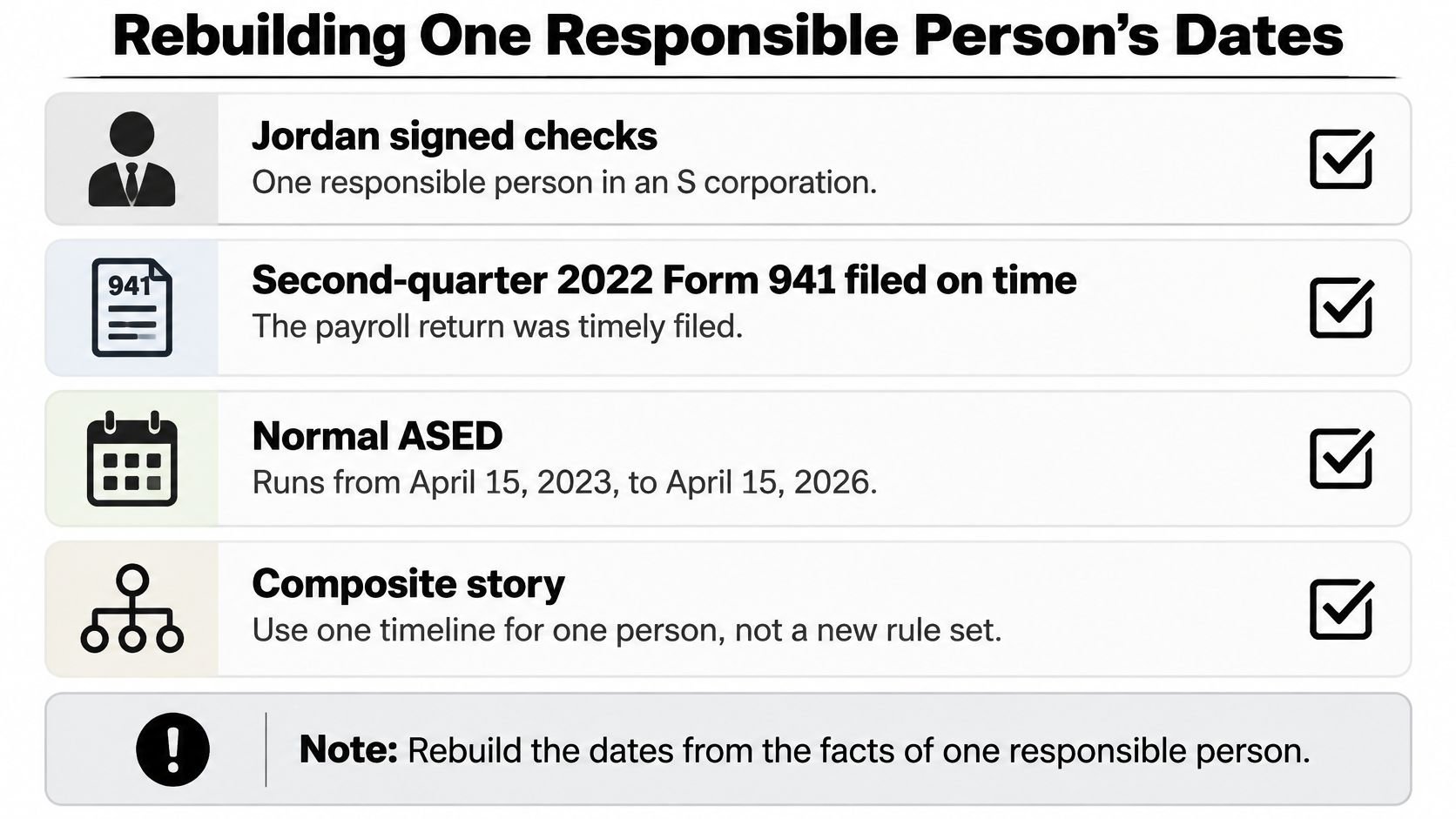
Jordan's timeline, in order
Jordan's second-quarter Form 941 was filed on time. Start by identifying the succeeding April 15 and the actual filing date, then apply the later of the two three-year periods. That gives Jordan's ordinary ASED. The quarter's label is only a starting clue, not the answer.
Next, place Letter 1153 and the protest on the same timeline. In this example, the IRS delivers the letter while the ordinary assessment period remains open, and Jordan protests on day 45. Appeals later makes a final administrative determination.
The period remains open until the later deadline described above, so an assessment made before that extended endpoint can be timely even if it falls after the ordinary ASED.
Once assessed, the penalty has a separate collection clock. Jordan's CSED is generally ten years from the assessment date. A pending installment agreement can suspend that clock for the time it is pending, plus the applicable additional period after rejection.
Bankruptcy can also suspend collection, including for the period of the case and an additional period afterward. The trust fund penalty is not erased because bankruptcy occurs. The actual CSED therefore depends on the assessment date and the recorded tolling history.
Where each date lives
A guide to reading an IRS transcript can help make the entries easier to follow. Check the employment tax module for the business quarter's filing date, the revenue officer file and Appeals record for Letter 1153 and the protest, and the case file for any Form 2750. Then check Jordan's individual civil penalty transcript, often shown as MFT 55, for the assessment date, CSED, and tolling entries.
Keep the business Form 941 transcript separate from Jordan's individual transcript. They may show different collection dates. Finish by checking three things: Was the penalty assessed while the ASED, as extended, remained open? What is the assessment date? Which transcript entries suspend or extend the CSED?
Decide Your Next Move From the Dates
Your next step depends on the dates and where the case stands. If the Letter 1153 protest period is still open, use it to challenge responsibility or willfulness.
Before signing Form 2750, check which assessment deadline it extends and for how long. Keep those deadlines where you can see them, because a missed protest date can't be undone. The same habit can help when managing court dates with Attorney Assistant.
If the penalty has not been assessed and the ASED appears to have expired, gather the return filing date, Letter 1153 delivery date, and any waiver. An expired date matters only if the records support it, so verify the timeline before paying or agreeing to anything. The age of the payroll quarter alone does not settle the issue.
If the IRS has assessed the penalty and the CSED is approaching, compare the individual transcript's codes with the suspension history before concluding that collection has ended. A levy or suit filed within the collection period also matters. Reconstruct the dates from the assessment and tolling entries, rather than relying on the business return's timeline.
When years remain on the collection clock, the statute is not a resolution strategy. Liens, levies, and refund offsets may continue.
An installment agreement, offer in compromise, currently not collectible status, or penalty review may affect the collection timeline, so understand the consequences before choosing a path. Consider legal help if a revenue officer is assigned, assets are at risk, the balance is substantial, or a criminal referral is possible.
A tax attorney can review IRS and state transcripts to trace penalties, payments, and the time remaining before collection ends. Once a Power of Attorney is filed, the IRS directs communications to the attorney rather than the client.
Before deciding whether to protest, pay, or wait, write down the ASED, the assessment date, and the CSED, then check each against the transcript history.
Tax Attorney Stephen A Weisberg can help reconstruct the dates from IRS transcripts and assess whether the records support a protest or another response. Request a review of your trust fund exposure from Tax Attorney Stephen A Weisberg.
Want to understand your options before you call anyone?
Download my free book — Freedom From Tax Debt — a plain-language guide to how the IRS collections process actually works and what resolution really looks like.
➥ Contact Attorney Stephen A. Weisberg for a free Tax Debt Analysis.
Contact Me Here: https://www.weisberg.tax/contact-1
Email: s.weisberg@weisberg.tax
Phone/Text: (248) 971-0885
Address: 300 Galleria Officentre, Suite 402, Southfield, MI 48034
