You've paid the business bills, checked the bank balance, and decided there's enough left to transfer some money to yourself. Then comes the question that makes S corporation payroll taxes confusing: is that transfer salary, a distribution, or something you'll sort out at tax time?
Start with your salary decision, not the transfer. Work out what your services justify, calculate the corporation's cost of that wage, and reserve the payroll taxes before deciding what cash is available for distributions. That order makes the bookkeeping clearer and reduces the chance that an ordinary cash-flow problem becomes a personal tax problem.
Federal Payroll Tax Rates Every S Corporation Pays
Federal payroll tax rates for S corporation owner-employees, 2026
The IRS Employer's Tax Guide (Publication 15) lists the 2026 Social Security wage base of $184,500, Medicare rates, and FUTA rate and credit rules.
| Tax | Rate | Wage limit | Who pays |
|---|---|---|---|
| Social Security, employee share | 6.2% | First $184,500 of wages | Withheld from owner pay |
| Social Security, employer share | 6.2% | First $184,500 of wages | Paid by the corporation |
| Medicare, employee share | 1.45% | No wage cap | Withheld from owner pay |
| Medicare, employer share | 1.45% | No wage cap | Paid by the corporation |
| Additional Medicare | 0.9% | Wages above the applicable statutory threshold | Employee only, collected through withholding when required |
| FUTA | 6.0%, potentially reduced to 0.6% with the maximum credit | First $7,000 per employee | Paid by the corporation |
| Federal income tax withholding | Calculated using Form W-4 and applicable IRS withholding tables | Calculated for each payroll | Withheld from employee pay |
The distinction is withheld versus added. Employee taxes come out of gross wages. Employer taxes are an additional corporate expense, not another deduction from the paycheck.
Federal income tax withholding is separate from Social Security and Medicare. Payroll calculates it using the employee's withholding elections and applicable tables, rather than one flat payroll-tax percentage.
Translate a salary into its actual cost
Consider a hypothetical owner salary of $80,000, entirely below the Social Security wage base. Applying the rates in the table gives this result:
| Hypothetical calculation | Employee withholding | Additional corporation expense |
|---|---|---|
| Social Security | $4,960 | $4,960 |
| Medicare | $1,160 | $1,160 |
| Total regular FICA | $6,120 | $6,120 |
The corporation's salary expense is the gross wage, even though withholding reduces the owner's take-home pay. The corporation must also fund its matching contribution.
In this example, combined employee and employer FICA is $12,240. FUTA adds $420 at the full rate or $42 if the corporation qualifies for the maximum credit, based on the rates and wage limit above.
The hypothetical salary plus employer FICA costs $86,120, before FUTA, state unemployment taxes, benefits, and payroll-service charges. Employee withholding is already included in gross salary, so don't count it again as an employer expense.
Budgeting rule: Gross salary is the employee's wage. Gross salary plus employer taxes is what the corporation must fund.
Leave room for state obligations
State unemployment tax is separate from FUTA. Before assuming the reduced federal rate applies, confirm the corporation's credit eligibility and state unemployment compliance with the person setting up payroll.
The explanation of FICA payroll obligations clarifies how the employee deduction differs from the employer match.
Choose a defensible compensation amount, then check whether the business can fund the entire employer cost. A bank balance that covers intended take-home pay may still fall short of what payroll requires.
Who Counts as an Employee in Your S Corporation
Owning stock and working for the corporation are different roles. A shareholder who handles customers, billing, management, or service delivery generally acts as an employee when performing meaningful services, as the Congressional Research Service explains.
A shareholder who only owns stock and performs no services isn't an employee because of that ownership. Conversely, an owner who runs the business shouldn't assume that a disappointing year turns their work into a nonemployee activity.

Examine the working relationship
For non-owner workers, use these questions to identify classification issues:
Work control: Does the corporation direct how the person performs the work, rather than merely specifying the result?
Financial independence: Does the worker operate an independent business with meaningful expenses and an opportunity for profit or loss?
Relationship: Is this an ongoing staff role, or an independent engagement?
These are screening questions, not a mechanical test. An independent-contractor agreement doesn't settle classification if the actual arrangement looks like employment.
Say your company engages someone to manage billing every working day, using your systems and following your instructions. Calling that person a contractor deserves closer review than hiring an outside firm to complete a defined project independently.
Make a worker inventory: list everyone who performs services, including yourself. Mark each person as an employee or a potential contractor, and record the factual reason for any nonemployee classification before relying on it.
Setting Owner Pay and Avoiding Reclassification
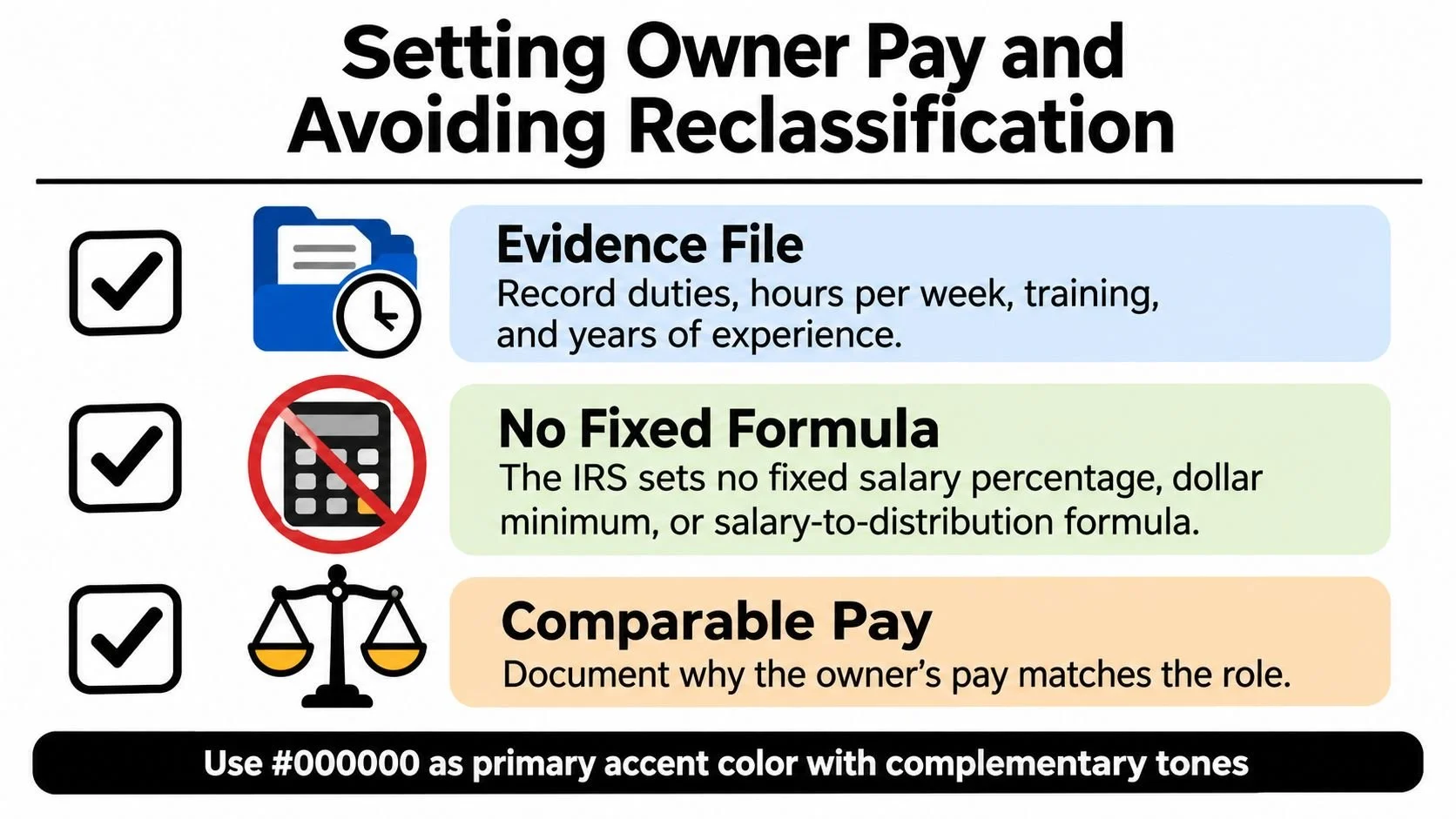
Build an evidence file before choosing a salary. The FreshBooks S corporation payroll guide describes the facts relevant to reasonable compensation, rather than an IRS-approved salary percentage, fixed minimum, or salary-to-distribution formula.
Your file should connect the amount you select to the work you perform.
Responsibilities: Describe revenue-producing work, management, administration, and supervision.
Time and qualifications: Record your workload, training, and relevant experience.
Comparable pay: Save dated compensation comparisons for similar responsibilities and locations.
Business circumstances: Explain cash availability, profitability, and compensation paid to other employees.
Approval: Keep the compensation decision and supporting reasoning with corporate records.
Document a difficult year honestly
Low profit isn't an automatic explanation for no salary, especially if you've taken substantial money out. Distinguish a company that lacks cash to compensate anyone from one that pays its working owner but labels every payment a distribution.
If you perform several jobs, document those roles rather than comparing yourself only with a highly paid executive. If your workload changes, explain how that affected the compensation decision.
The Form 1120-S instructions require payments to officers to be treated as wages to the extent they represent reasonable compensation; officer compensation is reported on line 7, with wage reporting handled through payroll.
A distribution label doesn't determine the tax treatment of a payment for services.
Review compensation before authorizing owner withdrawals and revisit the supporting file when responsibilities or business conditions change. Coordinate the separate personal income-tax obligation through an S corporation estimated-tax plan, rather than treating distributions as tax-free spending money.
How to Run Payroll and Make Federal Deposits
A payroll run isn't complete when the owner's net paycheck arrives. The wage records, withholding, employer taxes, deposits, and returns must all match.
Treat payroll as a controlled process. The person submitting it should know who checks the tax withdrawal, confirms it cleared, and handles a rejected payment.
Follow a repeatable payroll cycle
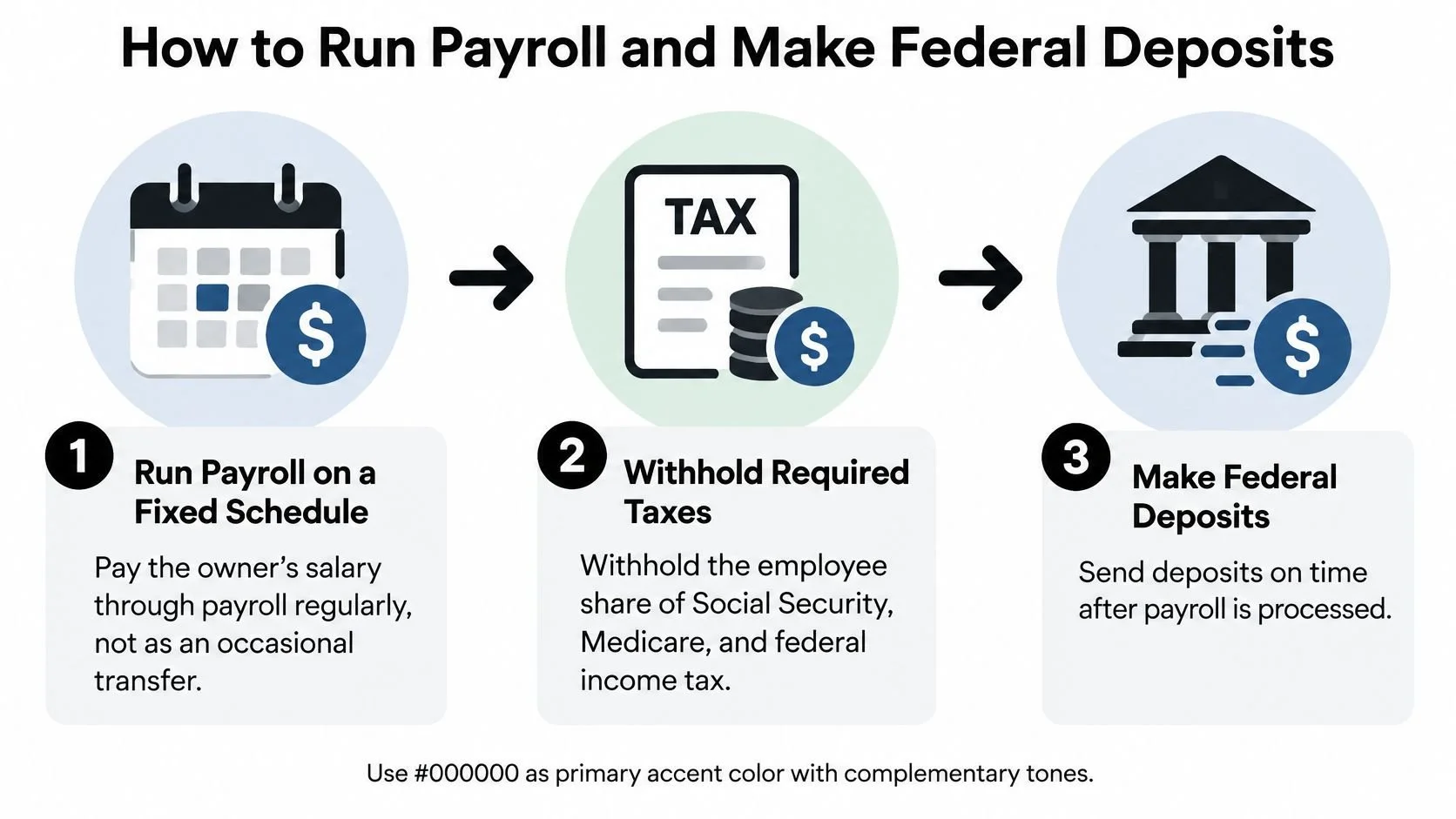
Run the owner's salary through payroll. Use an established pay schedule that fits applicable wage-payment requirements and the compensation arrangement. An occasional transfer does not automatically become wages later.
Calculate employee withholding. Use current payroll software and accurate employee information, including the owner's Form W-4 elections. Review unusual payments before submitting payroll.
Add employer obligations. Confirm that the payroll preview includes the corporation's matching taxes and applicable unemployment taxes. Compare the employer's total cost with the employee's take-home pay.
Make the federal deposit. Arrange payment through the Electronic Federal Tax Payment System or the authorized payroll provider's process. Follow the deposit schedule assigned under federal rules.
Prepare the quarterly employer return. Reconcile wages, withholding, and deposits before filing Form 941. The return reports liability; filing it does not replace a required deposit.
Handle annual unemployment reporting. Prepare Form 940 using payroll records and relevant state unemployment information. Check any FUTA deposit obligation separately.
Complete wage reporting. Issue Forms W-2 and submit the required W-3 information. Check employee identifying information before filing to reduce the chance of a mismatch.
Build a calendar around the actual filing rules
Payroll filing and deposit deadlines
| Filing or deposit | How often | Due-date rule to track |
|---|---|---|
| Form 941, quarterly employer return | Quarterly | Use the applicable quarter's return deadline and filing instructions |
| Form 940, annual FUTA return | Annual | Use the annual return deadline and check FUTA deposit requirements separately |
| Forms W-2 and W-3 | Annual | Use the applicable annual employee-delivery and filing deadlines |
| Monthly deposit schedule | Monthly | Apply the monthly depositor rule to the payroll liability period |
| Semiweekly deposit schedule | Based on payday groups | Apply the Wednesday-or-Friday deposit rule for the relevant payday |
Enter the current due dates and confirmed deposit schedule into a shared calendar. Set reminders early enough to address insufficient funds, missing approvals, or banking problems.
Semiweekly doesn't mean every other week. It describes a tax-deposit schedule tied to payroll timing. Quarterly reporting also does not mean you can wait until the return is due to deposit payroll taxes.
For practical setup considerations, payroll guidance from Kushan Business Solutions can help organize the operating workflow. Configure that workflow around the corporation's actual obligations rather than adopting a generic calendar without checking it.
Check evidence, not just dashboard status
Keep the payroll register, tax-liability report, deposit confirmation, and filed-return acknowledgment together. A dashboard marked complete may refer only to wage processing, so verify that tax payments and filings were completed too.
Reconcile the payroll clearing account against the bank statement. If a scheduled tax debit does not appear, investigate promptly rather than assuming the provider will catch the problem.
Common mistakes include:
Spending reserved taxes: Using cash earmarked for withholding to cover rent or suppliers.
Ignoring a rejected debit: Treating a scheduled payment as proof that the deposit cleared.
Paying outside payroll: Sending the owner money without deciding and recording its proper treatment.
Using the wrong schedule: Following an old arrangement without checking whether it still applies.
The small-business payroll tax guide offers more context on these obligations. Assign someone to verify that each deposit and filing is complete, even when an outside provider processes payroll.
Penalties and Trust Fund Exposure for Unpaid Taxes
Payroll tax penalties and what triggers them
| Penalty | Trigger | Amount or exposure |
|---|---|---|
| Deposit penalty for a short delay | A required deposit arrives late | Determined under the applicable late-deposit tier |
| Deposit penalty for a longer delay | The deposit remains unpaid | A higher late-deposit tier may apply |
| Deposit penalty after extended lateness or notice | Payment remains outstanding as notice rules apply | Determined by lateness and notice timing |
| Deposit penalty after IRS demand | The deposit remains unpaid after the applicable demand | The demand-stage penalty rule may apply |
| Failure to file Form 941 | The required return is filed late | Calculated under the late-filing rules |
| Failure to pay tax | Required tax remains unpaid | Calculated under the late-payment rules |
| Trust Fund Recovery Penalty | A responsible person willfully fails to collect, account for, or pay trust-fund taxes | Full unpaid trust-fund amount, assessed personally, with interest |
The dangerous assumption is that every payroll-tax balance belongs only to the corporation. The IRS Trust Fund Recovery Penalty guidance explains that responsible individuals can face personal assessment for the full unpaid trust-fund amount when the responsibility and willfulness requirements are met.
Understand which money creates personal exposure
The trust-fund portion consists of withheld federal income tax and the employee share of Social Security and Medicare. The corporation holds that money for payment to the government. It isn't ordinary working capital.
The employer's own matching taxes are a separate component of the corporate payroll-tax bill. Don't confuse the entire corporate balance with the amount potentially assessable through the Trust Fund Recovery Penalty.
Say a company has deducted taxes from employee pay but then uses the reserved cash to pay a supplier and an owner distribution. The question isn't merely whether the company will eventually catch up. The IRS may also examine who knew about the unpaid taxes and who decided to pay someone else.

Responsibility depends on actual authority
An officer title matters, but so does what a person could do. Relevant questions include who controlled the bank account, selected creditors for payment, authorized payroll, and had the power to direct tax payments.
Employees with meaningful financial authority may also face scrutiny. On the other hand, handling clerical payroll tasks doesn't automatically establish the same authority as deciding which bills the company pays.
Willfulness is not a synonym for fraud. Knowing that payroll taxes remain unpaid and choosing to pay other creditors can create serious exposure. Don't assume that intending to rescue the business removes the problem.
Corporate limited liability doesn't necessarily protect the people who control the payment of withheld taxes.
Respond before the collection problem grows
A missed deposit can lead to an unpaid balance, IRS notices, and collection activity. Where withheld taxes remain unpaid, the IRS may investigate responsible individuals and propose personal assessments.
Gather bank statements, payroll registers, payment approvals, correspondence, and records showing who controlled financial decisions. Those documents help distinguish the corporation's obligations from each individual's potential exposure.
Our explanation of the Trust Fund Recovery Penalty addresses that distinction. A personal assessment isn't automatic merely because a deposit was late, but it shouldn't be dismissed as an issue that affects only deliberately dishonest businesses.
Closing the company also doesn't reliably end the matter. Many tax debts aren't discharged in bankruptcy, especially more recent tax debts and trust-fund liabilities such as payroll taxes.
If cash is tight, don't make a fresh owner distribution while leaving withheld taxes unresolved. Identify the current liability, preserve the records, and get advice before making payments that could affect the assessment of an individual.
Fixing Missed Payroll Taxes and Deciding on Help
Start by preventing another payroll cycle from creating the same problem. Stop using withheld funds for owners or other creditors, determine what the next payroll costs, and establish a funded process for current deposits.
Bring the records together before negotiating from an incomplete picture.
Confirm the balances: Obtain business IRS transcripts and any relevant owner transcripts, then compare them with payroll records, notices, and payment confirmations.
Identify missing returns: Prepare outstanding employment-tax filings even if the corporation can't yet pay the entire balance.
Separate current compliance from old debt: Keep new obligations funded while developing a resolution for arrears.
Evaluate payment options: Consider an installment arrangement or another appropriate resolution based on income, expenses, assets, and the nature of the liability.
Know when representation becomes important
Hiring a tax attorney is advisable for tax debt over $5,000, criminal investigations, IRS revenue officer involvement, complex finances, foreign-account issues, valuable assets at risk of seizure, or potential liability over $1,000,000. These are reasons to seek help, not safe-harbor thresholds below which personal exposure disappears.
Get legal advice before agreeing to facts about who controlled payments or accepting an arrangement the business can't sustain. An affordable monthly payment won't solve the problem if the next payroll produces another unpaid deposit.
We obtain IRS and state transcripts to review the debt history, payments, penalties, and collection timing. That review helps establish what needs correction before choosing a resolution strategy.
Once the immediate tax problem is being addressed, examine why the process failed. If the company needs a different processing system, Benely's comparison of five payroll providers worth considering offers a starting point for evaluating operational support.
A new provider can improve future processing, but it doesn't erase prior liabilities. Keep a separate checklist for correcting historical filings, resolving balances, and confirming that current payroll stays compliant.
Tax Attorney Stephen A Weisberg offers representation for unpaid payroll taxes, IRS collection problems, and potential personal trust-fund liability. Visit Tax Attorney Stephen A Weisberg to discuss your notices, payroll records, and options for addressing the debt while keeping current obligations on track.
Facing payroll tax debt right now?
Download my free checklist — Behind on Payroll Taxes? What to Do in the Next 48 Hours — and understand exactly what to do before your situation gets any worse.
➥ Contact Attorney Stephen A. Weisberg for a free Tax Debt Analysis.
Contact Me Here: https://www.weisberg.tax/contact-1
Email: s.weisberg@weisberg.tax
Phone/Text: (248) 971-0885
Address: 300 Galleria Officentre, Suite 402, Southfield, MI 48034
