You're sorting mail after work and find an official envelope you weren't expecting. Inside is a notice of garnishment, and your first thought is probably about your next paycheck. How much can they take, when does it start, and can you stop it in time?
Don't panic, and don't set it aside. A notice of garnishment is time sensitive, but it's also a sorting problem first. The sender, the date printed on the notice, and the type of debt tell you which deadline matters and which response can stop the next payroll deduction.
Which Notice You Received and What It Can Take
Start by naming your notice. The sender sets the limit, the rules, and where your reply has to go.
| Notice type | Who sends it | Typical limit on pay | First thing to check |
|---|---|---|---|
| Federal tax levy | Internal Revenue Service | Exempt amount set by filing status and dependents; the rest is withheld | Tax period and notice date |
| Student loan wage garnishment | Department of Education or its contractor | Up to 15% of disposable pay | Whether the loan holder is the Department of Education |
| Child support withholding | State child support agency or court | Up to 50% to 65% of disposable earnings, depending on other dependents and arrears | Case number and court order |
| Private creditor judgment | Creditor through the court | Lesser of 25% of disposable earnings or the amount above 30 times the federal minimum wage per week | Judgment date and court case number |
What Disposable Pay Means
Disposable pay is what's left after legally required deductions, such as income taxes and Social Security. It's not your gross pay, and it's not always the same as your take home pay after voluntary deductions. That distinction matters because most limits are calculated from disposable pay, so using gross pay will give you the wrong estimate.
A federal tax levy works differently. It doesn't use a flat percentage. The IRS protects an exempt amount based on your filing status and dependents, and your employer sends the rest. If you're unsure whether your paper is a levy or another IRS notice, compare it with a plain explanation of what a notice of levy means and how it differs from a lien before you call anyone.
Child support follows its own court or agency order, and the percentage can be much higher than a private creditor's limit. If your notice involves support, it helps to see how child support deductions from your paycheck are ordered and calculated, then match that order to your paystub line by line.
Why Sorting Matters First
This isn't rare, and it isn't only about taxes. Research summarized in the ADP Research Institute wage garnishment white paper reported that approximately 7% of the U.S. workforce had wages garnished, and that the federal government and all 50 states authorize some form of wage garnishment.
Find three things before you do anything else: the sender, the case or tax reference number, and the date printed on the notice.
Write those three items at the top of a clean page. Then match your notice to one row in the table. That one step prevents the most common mistake, which is sending a tax response to a court, a student loan contractor, or a child support agency that can't act on it.
The 30-Day Timeline Before Money Is Taken
For federal tax debt, money isn't usually taken the day a letter arrives. There's a staged process, and the dates in that process control your options.
| Stage | What happens | Timing | Your move |
|---|---|---|---|
| Notice and Demand for Payment | IRS assesses the tax and requests payment | Before any levy notice | Pay, set up a plan or dispute the balance |
| Final Notice of Intent to Levy | Warns of levy and explains your hearing rights | At least 30 days before levy | Request a Collection Due Process hearing or a payment alternative within the window |
| Form 668-W served on employer | Employer receives the wage levy and begins withholding | After the 30-day window closes | Check the next paystub and call the IRS contact on the notice |
| First payroll after service | Employer normally holds at least one full pay period before remitting | About one pay period after service | Confirm the withheld amount matches your exempt figure |
| Ongoing levy | Withholding continues on future pay | Until paid, released or the collection period expires | Resolve the balance or request a release |
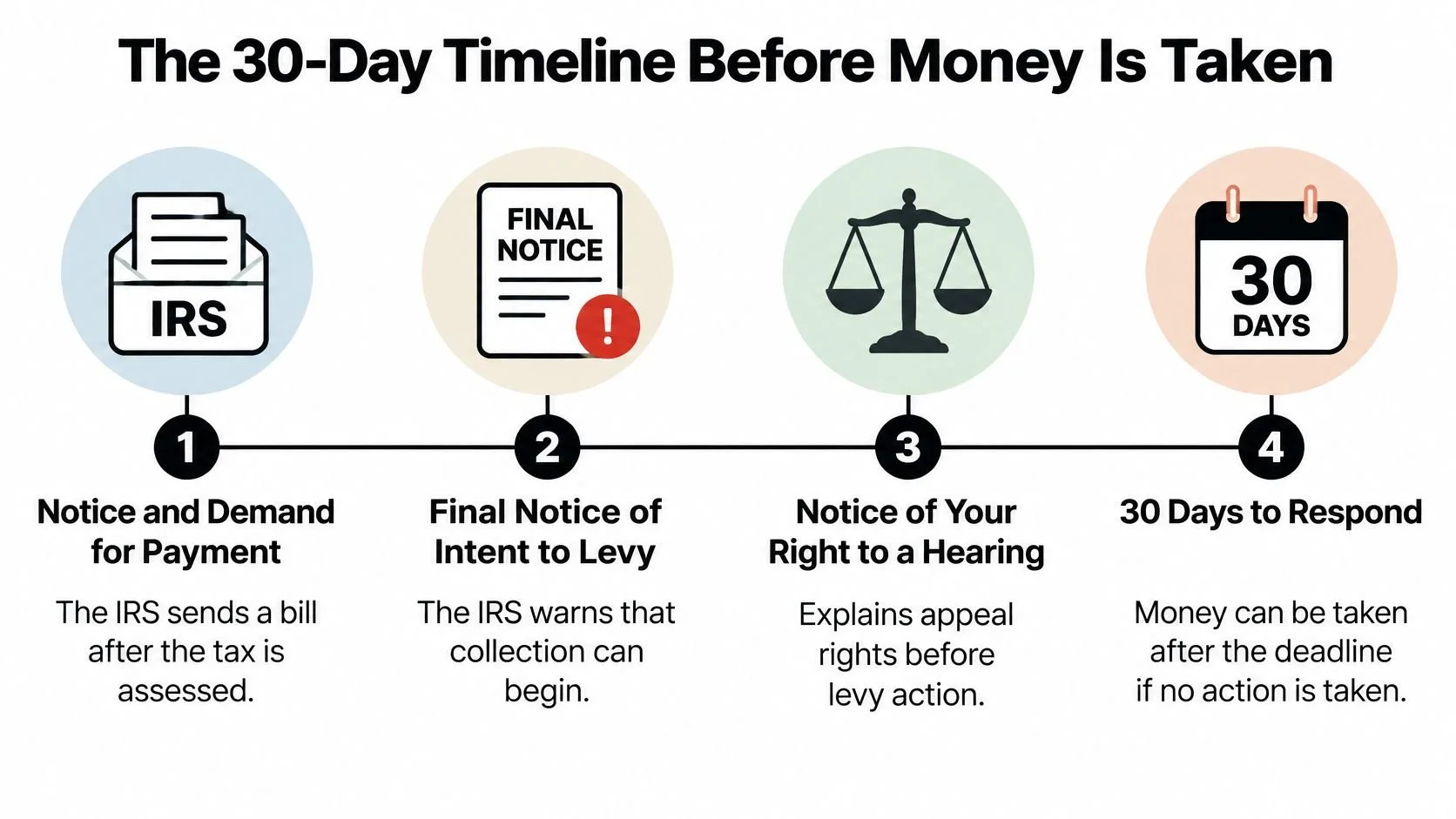
The Sequence in Plain Language
First, the IRS assesses the tax and sends a Notice and Demand for Payment. That's the bill. If it isn't paid or resolved, the IRS can move toward a levy, which is the legal seizure of property or money held by someone else, such as wages held by your employer.
Next comes the Final Notice of Intent to Levy and Notice of Your Right to a Hearing. According to the IRS page explaining what a levy is, the IRS must ordinarily assess the tax, issue a Notice and Demand for Payment, and send that final notice at least 30 days before the levy.
That notice can reach you in ways people miss. It may be delivered personally, left at your home or usual place of business, or sent by certified or registered mail to your last known address. If you've moved and didn't update your address, the clock can start before you ever see the envelope.
What the 30 Days Buy You
The 30-day period is your window to pay, request an installment agreement or another collection alternative, propose an offer in compromise, or request a Collection Due Process hearing. A timely hearing request generally suspends levy activity for the tax periods under review while the case is considered.
If that window closes with no response, the IRS can serve Form 668-W on your employer. Your employer normally has at least one full pay period before remitting money, but that's a short buffer, not a second chance to restart the hearing window.
Count carefully: Count 30 days from the date printed on the notice, not from the day you opened it, then confirm the response date with the IRS.
This deadline can't be recovered once it's missed in the same way. You may still have other ways to ask for relief, but you lose the benefit of a timely hearing request that pauses the levy before payroll is touched. Put the date on your calendar today and treat a few days before it as your real deadline.
Employer Duties and Your Paycheck Math
Your employer doesn't decide whether you owe the money. Payroll receives an order, checks it, calculates an amount, and sends money to the IRS. Understanding that payday routine helps you spot errors before they repeat.

What Payroll Does, Step by Step
Receives Form 668-W: Payroll checks that the notice names the right employee and the right taxpayer identification number.
Calculates the exempt portion: The amount uses your filing status, dependents, and IRS allowances for your pay period.
Withholds the remainder: The levy reaches wages already earned but unpaid, later advances, and wages that become payable after service.
Remits after a buffer: The employer normally has at least one full pay period before sending the withheld amount.
Shows it on your stub: The deduction should appear as a levy or garnishment line you can track each payday.
The IRS Internal Revenue Manual section on levy procedures describes a wage levy as continuous, continuing until the liability is paid, the collection period expires, or the IRS releases it. That's why fixing one paycheck doesn't end the problem. You have to resolve the underlying balance or get a formal release, or the withholding returns on the next payroll.
What Pay Can Be Reached
Don't assume a bonus or contract payment is safe. The IRS levy guidance for employers and taxpayers states that employers must apply the levy to salary, wages, fees, bonuses, commissions, and similar compensation. Being classified as an independent contractor or earning variable pay doesn't automatically prevent collection.
A wage levy is also different from a bank levy. A bank levy generally takes funds available when the bank processes it, a one-time snapshot. A wage levy keeps reaching future payroll. Say your pay is steady but you earn a quarterly commission. The levy calculation applies again when that commission pays out, so one normal looking stub doesn't prove the next one is correct.
If you want to see the arithmetic payroll uses before you question it, review the breakdown of the IRS wage levy formula and exempt amount with your own stub in hand.
Check Your Own Paycheck
Use placeholders from your notice and stub. Don't guess.
Start with gross pay: Write the gross amount for this pay period.
Subtract required deductions: Remove income tax, Social Security, and other legally required deductions to reach disposable pay.
Subtract your exempt amount: Use the exempt figure from the IRS notice or payroll's calculation.
Compare the result: The remainder should match, or be close to, the levy line on your stub.
If the math is off, look for the usual errors. A wrong taxpayer identification number, wrong tax periods, wrong employer, or misclassified compensation can all produce excessive withholding. A change in dependents or filing status that payroll never received can do the same.
Evidence changes outcomes here. Bring payroll records, dependent information, necessary expense data, or proof the balance is incorrect. For example, if payroll used no dependents but your return claims two, documentation can support a corrected exempt amount. If your hours dropped or medical costs rose, that evidence may support modification or release.
Ask payroll this week, in writing, for a copy of the levy and its calculation. Then calculate your expected net pay for the next check before payday. It's much easier to correct the second deduction than to recover money after several pay periods have been sent.
Steps to Take Now
You don't need to solve the whole debt in one day. You do need a file, a date, and one written response started this week.
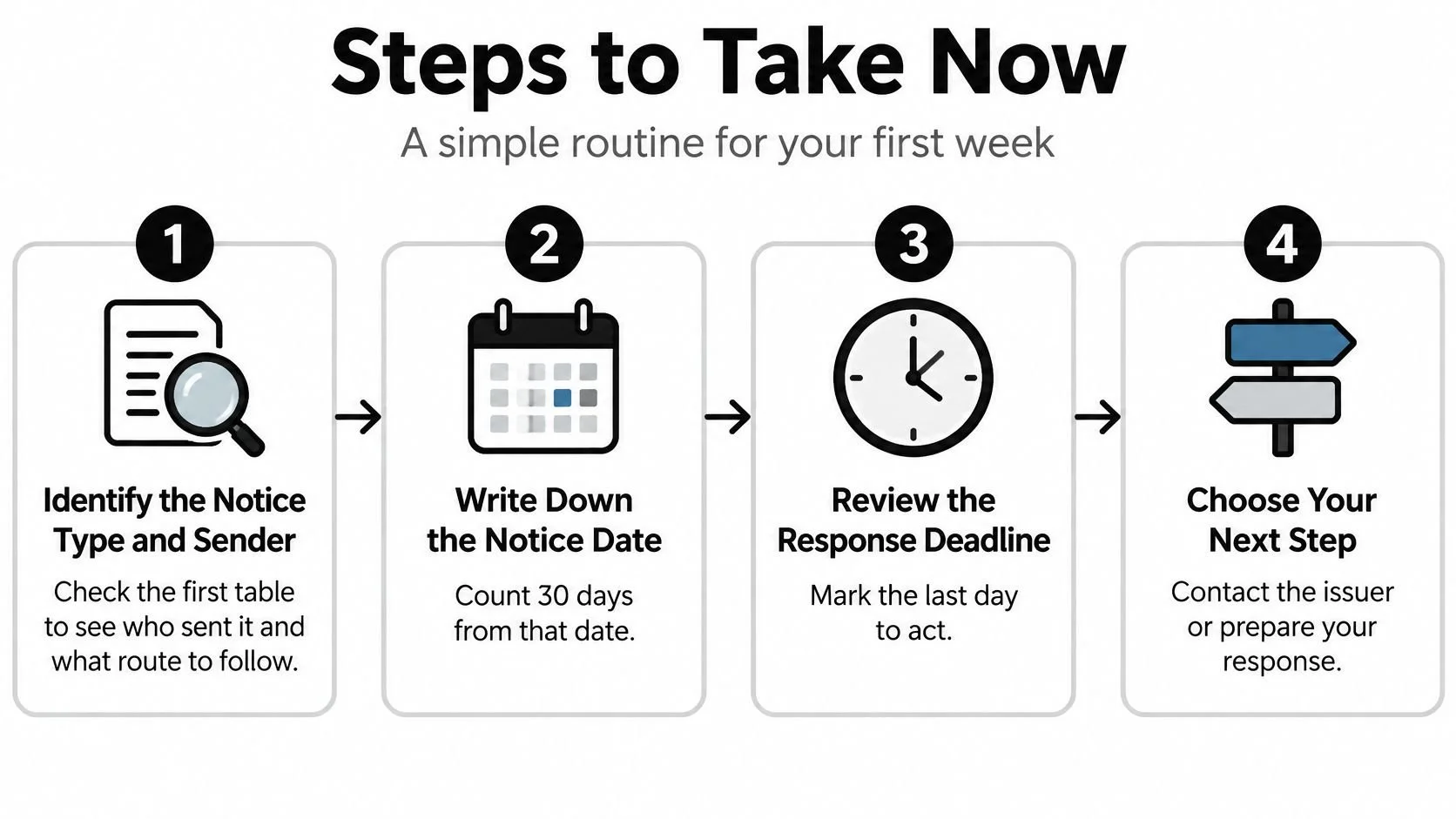
Your First Week Routine
Identify the type and sender. Match your notice of garnishment to the correct row by sender and reference number. The response route depends on that match, and the wrong office can't pause the right deduction.
Write down the notice date and count forward. For an IRS final notice, mark the 30-day response window from the printed date. The common slip is counting from the day the letter arrived, which can waste days you don't have.
Pull your last three paystubs. Note gross pay, deductions, and net pay for each one. You'll need a baseline to measure any change and to check whether an exempt amount was applied correctly.
Call the number printed on the notice. Ask whether a levy is active, which tax periods it covers, what balance is shown, and how to request a Collection Due Process hearing or an installment agreement. Don't rely on a callback from an unverified number that called you first. If you're nervous about wording, review the basics of responding to IRS letters without missing a deadline before you dial.
Gather hardship evidence before the call. Collect rent or mortgage records, utilities, insurance, transportation, childcare, and medical costs, plus records showing irregular self-employment income if that applies. The IRS guidance on levy hardship explains that a levy must be released when it prevents you from meeting reasonable basic living expenses, but a release doesn't erase the debt. The common slip is giving only gross income. Without necessary expenses, the person reviewing your case can't see why the withholding leaves you short.
Choose one response. Pick the route that fits your deadline and balance: pay in full, request an installment agreement, file for a hearing inside the window, or request a hardship release. Choosing one clear route is better than sending vague letters to several places and hoping one of them pauses payroll.
Keep a paper trail. Save copies of every letter you send and receive. Write down the date, time, name, and reference number for every call, even a short one.
A call you can't document is hard to prove later. A dated note with a reference number is evidence you acted.
Success at the end of week one looks concrete. You have a written response on file or ready to send, a confirmed withholding amount to expect, and a calendar date to check your next paystub. That doesn't mean the debt is gone. It means you've taken control of the deadline instead of letting payroll discover the problem for you.
Student Loan, Child Support and Judgment Notices
Not every notice follows IRS rules. If your sender isn't the IRS, don't use the IRS hearing window or IRS phone numbers. Follow the deadline and instructions printed by the sender who can stop or change your deduction.
Student Loan Administrative Wage Garnishment
For defaulted federal student loans, the notice comes from the Department of Education or its contractor. It can reach up to 15% of disposable pay, which means pay after legally required deductions such as taxes and Social Security.
First, confirm whether the Department of Education is the loan holder shown on the notice. Then contact that sender and ask how the amount was calculated, what balance it covers, and what objection or hearing process applies. Send any dispute in writing and keep proof you sent it before the stated response date.
Child Support Income Withholding
A child support order comes from a state child support agency or a court. It can take up to 50% to 65% of disposable earnings, depending on whether you support other dependents and whether arrears are owed.
Check the case number and compare the withheld amount with the underlying court order. If the payroll amount doesn't match the order, or if the order has changed, contact the agency named on the notice and ask it to confirm the current withholding figure in writing. Your employer generally can't reduce it on your word alone.
Private Creditor Judgment
A private creditor normally has to go through the court and obtain a judgment first. The limit is the lesser of 25% of disposable earnings or the amount above 30 times the federal minimum wage per week.
Check the judgment date and court case number, then read the judgment for the correct name, balance, and court. Errors in identity or amount belong in a written response to the court or creditor named on the paperwork, not in a call to the IRS.
Write down the sender, reference number, and response date for whichever notice you hold. The IRS 30-day hearing window does not apply to these three routes, so missing the sender's own deadline can let withholding start or continue even if your objection is valid.
Choosing a Resolution Before Your Deadline
Judge each IRS option by one question: will it stop the next payroll deduction in time? A good long term plan that starts after two more levies may still leave you short this month.
| Option | What it does | Stops wage withholding? | Best when |
|---|---|---|---|
| Full payment | Pays the balance and ends the levy | Yes, a release follows payment | You can clear the full balance quickly |
| Installment agreement | Sets monthly payments over time | Generally yes, while the agreement stays in good standing | The balance is too large to pay at once |
| Collection Due Process hearing | Asks the IRS Independent Office of Appeals to review the proposed levy | Generally suspends levy for the periods under review | The notice arrived and the 30-day window is still open |
| Hardship release | Releases the levy when it prevents basic living expenses | Yes, but the debt remains and the release can be temporary | Withholding leaves you unable to cover necessities |
| Offer in compromise | Settles for less than the full balance | Often, while the offer is under review | You cannot pay the full amount and your finances qualify |
Apply the Decision Rule
If you can clear the balance quickly without missing rent or other essentials, full payment is the cleanest stop. Confirm the payoff amount first, because interest and penalties can change the figure on an older notice.
If the deadline is close and you dispute the notice, use the hearing window while it's open. That's the route designed to pause levy action for the periods under review. Waiting to see what payroll does wastes the protection built into the notice.
If the balance is too large to pay at once, look at an installment agreement or a hardship release. A payment plan spreads the balance over time, and learning how to set up a tax payment plan that stays in good standing can help you avoid a default that brings the levy back.
A hardship release can stop withholding that prevents basic living expenses, but it does not erase what you owe, so you'll still need a longer term arrangement.
An offer in compromise is different. It's a request to settle for less than the full amount, reviewed through detailed financial disclosure. It can be the right fit when you cannot pay in full, but it's not a quick formality and it isn't right for every balance.
Remember that a released levy can be reissued if the agreed resolution breaks down. Missed plan payments, new unpaid balances, or unfiled returns can undo the pause you worked to get.
When Help Is Worth Considering
Hiring a tax attorney is advisable when you're facing tax debt over $5,000, criminal investigations, IRS revenue officer involvement, complex financial situations, foreign account issues, valuable assets at risk of seizure, or large liability exposure over $1,000,000.
An attorney can stop wage garnishment collections within 24 to 48 hours by filing documents that show financial hardship, and once a Power of Attorney is filed, the IRS cannot contact you directly and must direct communications to the attorney.
That help has a clear limit. No attorney can guarantee the IRS outcome or promise an exact stop date. What representation can do is file the right request, document hardship or errors properly, and keep deadlines from being missed while you work.
Write your response date on the calendar, choose one response this week, and keep every reference number in your file. The best option is the one you start before the window closes, not the perfect option you research after another paycheck is reduced.
If your notice of garnishment involves an IRS wage levy, a disputed balance, or a deadline that's already close, we can review the notice, check your transcripts, and identify which resolution can stop the next deduction. Start with a clear analysis of your options before you commit to a plan by visiting Tax Attorney Stephen A Weisberg today.
Want to understand your options before you call anyone?
Download my free book — Freedom From Tax Debt — a plain-language guide to how the IRS collections process actually works and what resolution really looks like.
➥ Contact Attorney Stephen A. Weisberg for a free Tax Debt Analysis.
Contact Me Here: https://www.weisberg.tax/contact-1
Email: s.weisberg@weisberg.tax
Phone/Text: (248) 971-0885
Address: 300 Galleria Officentre, Suite 402, Southfield, MI 48034
