You've painted a room, fixed a leak, and now a buyer is asking what you'll keep after the venta (sale). That's where many first-time sellers get stuck. The sale price is only the starting point.
In venta de casas en New Jersey, the escritura (deed), the cierre (closing) costs, and possible withholding decide your net proceeds, the cash left after payoffs and fees. This guide walks through the order of events and the math, in plain language, so you can price and plan before you sign.
How a New Jersey Home Sale Unfolds, Step by Step
A New Jersey sale runs in five stages, and an attorney normally handles the closing.
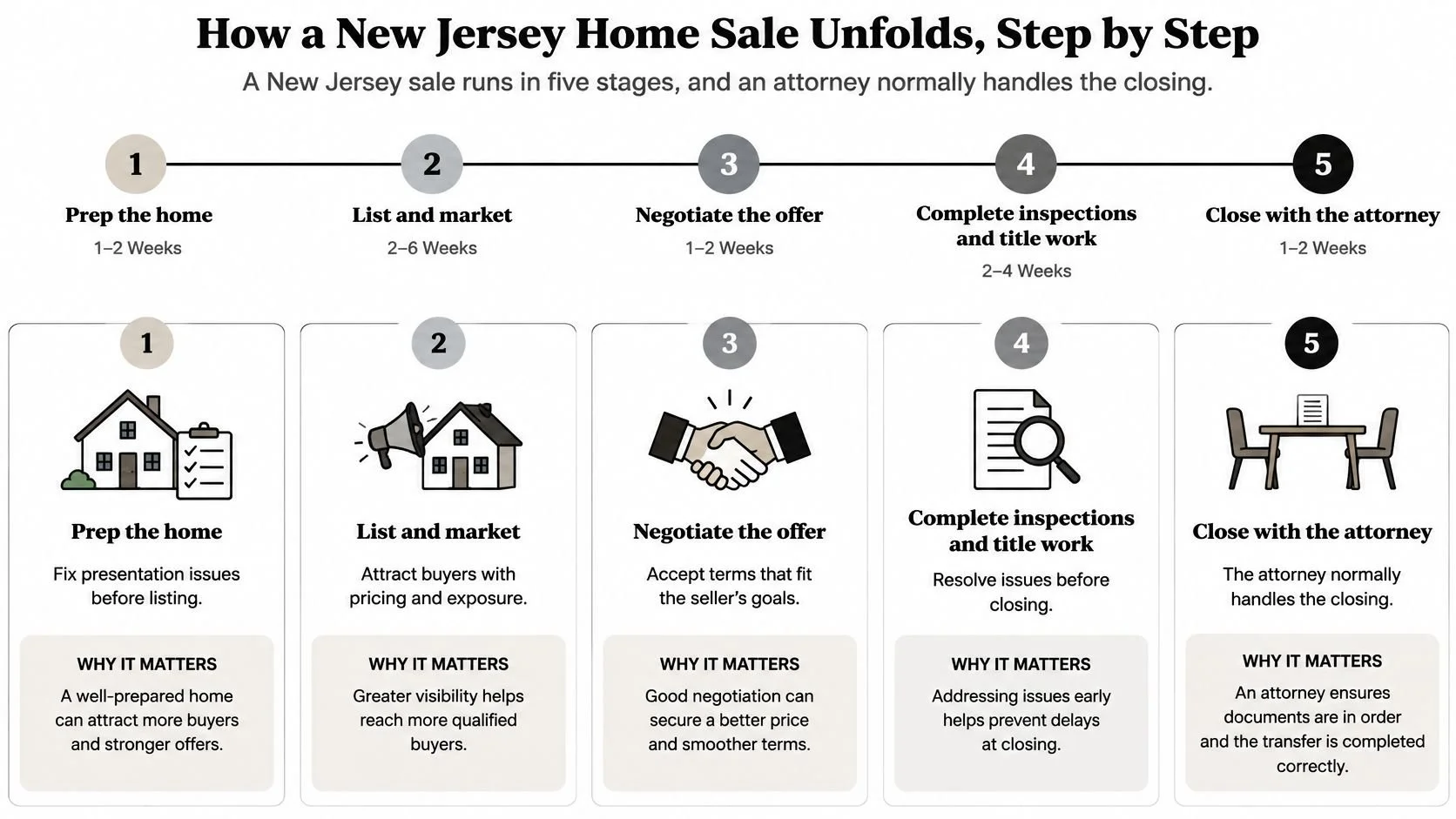
Stages, timing and key documents in a New Jersey home sale
| Stage | What happens | Typical timing | Key document |
|---|---|---|---|
| Preparation and pricing | Repairs, comparable sales review and price setting | 2-4 weeks before listing | Comparative market analysis |
| Listing and showings | MLS listing, open houses and buyer showings | 39 days average time on market statewide in 2025 | Listing agreement |
| Offer and contract | Offer accepted and deposit held | Days after the offer | Contract of sale |
| Inspection and attorney review | Home inspection, repair negotiation and attorney contract review | About 1-2 weeks | Inspection report and repair addendum |
| Closing | Deed signed, Realty Transfer Fee paid and mortgage paid off | Usually 30-60 days after contract | Deed and settlement statement |
The New Jersey Department of Community Affairs report context behind that timing is useful for planning cash and housing while you show the home.
The five stages in order
Prepare and price. Pull comparable recent sales in the same town and list repairs buyers will likely request. Price comes from local comps, not statewide figures. Have the comparative market analysis ready and ask your attorney what title issues could surface.
List and show. Plan for about six weeks of showings and offers. Keep the signed listing agreement handy and ask who schedules access and how you'll receive offers.
Accept and contract. Sign the contract of sale and confirm the buyer's deposit sits in escrow, a neutral holding account. Ask when that deposit becomes nonrefundable.
Inspect and negotiate. The inspection report drives repair requests. Your attorney reviews the contract and every addendum before deadlines pass. If a tax lien appears in title work, read about selling a home when there is an IRS lien before you promise a closing date.
Close. You sign the deed, pay the Realty Transfer Fee, pay off the mortgage, and review the settlement statement line by line. Ask the attorney to show your net figure before you sign, not after.
What the New Jersey Market Looks Like Right Now
New Jersey is a large owner market, which means many future sellers will face the same pricing questions you do. The U.S. Census Bureau QuickFacts for New Jersey estimates 3,827,726 housing units statewide as of July 1, 2025, and 63.8% of units were owner-occupied during 2020-2024.

The statewide median value of owner-occupied housing was $454,400 during 2020-2024. A median is a midpoint. Half of qualifying homes were valued above it and half below it, so it doesn't price your house by itself.
Why local medians change the answer
Essex County had a median owner-occupied housing value of $524,100, while Newark's corresponding median was $373,700. A seller in Essex County outside Newark and a seller in Newark can own similar houses and face different buyer pools, appraisals, and equity. That's why you pull the county and town median first, then compare sold homes on nearby streets.
New Jersey housing and sales figures, 2025-2026
| Indicator | Figure | What it means for a seller |
|---|---|---|
| Housing units statewide (July 1, 2025) | 3,827,726 | Large base of potential sellers |
| Owner-occupied share (2020-2024) | 63.8% | Most homes are owner-occupied |
| Median owner-occupied value, statewide (2020-2024) | $454,400 | Statewide midpoint only |
| Median owner-occupied value, Essex County (2020-2024) | $524,100 | Above the statewide median |
| Median owner-occupied value, Newark (2020-2024) | $373,700 | Below the statewide median |
| Statewide median sale price (2025) | $525,000 | Up 5.4% year over year |
| Single-family median sale price (2025) | $585,000 | Up 6.4% year over year |
| Townhouse and condo median sale price (2025) | $422,000 | Up 2.9% year over year |
| Average time on market (2025) | 39 days | Up 8.3% year over year |
| Average sale-to-list price ratio (2025) | 101.5% | Many homes sell at or above asking |
| Single-family homes listed statewide (December 2025) | 8,978 | Down 7.3% year over year |
What this means when you set a price
A sale-to-list ratio above 100% means sellers, on average, received more than asking. It doesn't guarantee your home will. If your segment has few listings, a well-priced home can still draw competing offers. If it has many, buyers compare harder.
Start with your town, then your street. A statewide median tells you the climate, not the price of your roof, lot, or school district.
Before listing, write down three numbers. Use your town median, three recent sold comps, and your mortgage payoff. Those three frame every later decision.
Realty Transfer Fee and Other Seller Closing Costs
The Realty Transfer Fee (RTF) surprises sellers because it's not a flat percentage. The New Jersey Division of Taxation Realty Transfer Fee page describes it as a seller-side closing cost calculated from the deed's stated consideration, generally the sale price.
It's progressive. Each slice of price is charged at its own rate per $500. Imagine filling buckets. You price the first bucket, then the next, and add them up.
Realty Transfer Fee schedule for sales over $350,000
| Sale price band | Rate per $500 | Band size |
|---|---|---|
| First $150,000 | $2.90 | $150,000 |
| $150,000 to $200,000 | $4.25 | $50,000 |
| $200,000 to $550,000 | $4.80 | $350,000 |
| $550,000 to $850,000 | $5.30 | $300,000 |
| $850,000 to $1,000,000 | $5.80 | $150,000 |
| Above $1,000,000 | $6.05 | Amount above $1,000,000 |
| Sales of $350,000 or less | Confirm the applicable lower-price rules before closing | Different rules; confirm |
A worked example you can check
Say the sale price is $750,000. Work band by band so you can audit the math.
First $150,000. That's 300 units of $500 at $2.90, or $870.
Next $50,000. That's 100 units at $4.25, or $425.
$200,000 to $550,000. That's $350,000, or 700 units at $4.80, which gives $3,360.
$550,000 to $750,000. That's $200,000, or 400 units at $5.30, which gives $2,120.
Add them and you get $6,775. If you see a different estimate for the same price, ask the preparer to show each band against the official schedule before you rely on it. Small band errors compound into the wrong net.
Practical rule: Model the RTF before listing, not at the closing table. It reduces proceeds directly and can change whether a lower offer still works.
Building your net proceeds in order
Use this sequence on paper. Don't skip steps.
Start with the sale price.
Subtract the Realty Transfer Fee.
Subtract the mortgage payoff and any liens that must clear for title to transfer.
Subtract negotiated commissions and attorney fees. Treat these as negotiated variables, not fixed estimates, until you have signed agreements.
The result is estimated cash to you, before any tax withholding or income tax on gain.
Thin equity gets exposed when a seller with a large payoff, a tax lien, or a home equity balance accepts an offer that looks fine on price but still lacks the cash to close. If property taxes themselves are part of the pressure, review how to appeal a property tax assessment well before you list, since an appeal won't fix a closing next month.
Also ask your attorney to review the deed consideration when a transfer isn't a simple arm's length sale. A below-market transfer or an entity-interest deal can change how the fee and paperwork are handled. Get that answer in writing before the buyer books movers.
Capital Gains Exclusion Limits for Homeowners
Tax on a home sale starts with gain, not sale price. Gain is generally your sale price minus your adjusted basis. Basis usually starts with what you paid, plus qualifying improvements and certain closing costs.
That distinction matters. A new roof or addition that you can document may raise basis and lower taxable gain. Routine repairs usually don't work the same way, so keep invoices and sort them with your CPA.
Federal capital gains exclusion limits for a primary residence
| Seller | Exclusion on gain | Requirement |
|---|---|---|
| Single filer | $250,000 | Owned and lived in the home 2 of the last 5 years |
| Married filing jointly | $500,000 | Both spouses meet use test; one meets ownership test |
| Partial exclusion for job change, health or unforeseen event | Prorated by time lived in the home | Qualifying reason; confirm the exact proration calculation with a tax professional |
| Gain above the exclusion | Taxable | Federal rates plus New Jersey income tax |
The ownership and use test in plain terms
For the full limits in the table, you generally need to have owned the home and lived in it as your main home for at least 2 of the last 5 years before the sale. For a married couple filing jointly at the higher limit, both spouses must meet the use test and at least one must meet the ownership test.
A partial exclusion may apply if you sell early because of a job change, health reason, or unforeseen event. It's prorated by time lived in the home. Don't guess the fraction. Have a CPA confirm the exact rule for your dates and reason.
Two examples
Say you're a single seller with $300,000 of gain in a hypothetical example. If you qualify for a $250,000 exclusion, $50,000 remains potentially taxable.
Say a married couple filing jointly has $420,000 of gain in a hypothetical example. If they qualify for the $500,000 limit, there's no excess gain above that limit from those numbers alone.
Gain above an exclusion can be taxed federally and New Jersey taxes gain as income, so confirm state treatment with a CPA before you spend the proceeds. When you report the sale, the Schedule D instructions for Form 1040 help you see where the gain and exclusion belong.
Keep a simple basis folder. Include the purchase settlement statement, improvement receipts, and records of any casualty or depreciation adjustments. That folder can save tax and weeks of hunting at filing time.
Nonresident Withholding When You Sell After Moving Out
Many former residents assume this logic. I moved out, I owe little or no New Jersey tax, so nothing will be withheld. That assumption can break your cash plan at closing.
The New Jersey Division of Taxation Technical Bulletin TB-57(R) explains that a nonresident individual, estate, or trust selling New Jersey real estate generally must make an estimated Gross Income Tax payment before or at closing, even when the seller believes there is no taxable gain.
How the amount is set
The required payment is generally the greater of the applicable tax estimate on gain or 2% of the sale consideration. Read that carefully. The 2% amount is a minimum, not necessarily a cap.
Say you sell for $750,000 after moving out and your actual gain is small. Two percent of the consideration is $15,000. That cash can be withheld at the cierre (closing) even if your final New Jersey tax on the gain ends up far lower.
Withholding is a prepayment toward a return, not a final bill. Confusing the two leads sellers to budget money they won't receive until they file.
Who gets caught by this
Former residents. You moved to Florida, Pennsylvania, New York, or another state, then sold the old New Jersey home.
Heirs, estates, and trusts. The seller may never have lived in the house, yet the property sits in New Jersey.
Investors. Current residency alone doesn't decide whether New Jersey withholding applies to New Jersey real estate.
If you're relocating for work and buying in the new state right away, timing matters most. A withheld amount can shrink your down payment for months, even when you expect it back.
How you reduce or recover it
A seller-assurance form may reduce or eliminate the payment when an exemption applies. Handle it before closing, with your attorney and tax preparer, because the closing table is the wrong place to discover a missing form.
If too much was paid, the withholding is reported on the nonresident return and functions as an estimated payment toward tax on any gain. You claim credit there and request a refund of the excess through that filing process. Keep the closing statement and proof of payment with your tax records.
Before accepting an offer, model two nets. Show cash after ordinary closing costs, then cash after possible nonresident withholding. If the second number doesn't cover your next purchase or debts you planned to pay, renegotiate timing, price, or your move sequence before you sign.
Pricing in a Segmented New Jersey Market
Two homes in different towns can attract very different buyers, even at the same price. Set your asking price using recent sales in your town and price range, then consider what you will keep after seller costs.
The Redfin New Jersey housing market page reported a median sale price of $558,395 in September 2026, up 2.3% year over year. Homes sold declined 4.1%, while total inventory rose 9.0% to 32,962 homes. These statewide figures provide context, but they do not predict what a particular home will sell for. Inventory trends vary by price segment and town.
Price by segment, not by slogan
Start with comparable sales, or “comps,” for homes like yours in the same area. Then check how your home's features compare. A price that seems reasonable statewide may be too high for one town or too low for another.
Entry-level. Buyers may be sensitive to monthly payments. Compare your asking price with recent sales and consider how competing listings affect their choices.
Move-up. School district and bedroom count can shape comparisons. A higher-priced home may prompt buyers to look in a nearby town.
Luxury. Support the price with comparable sales or clear buyer demand. A distinctive feature alone does not establish its value.
Urban. Condo fees, parking, and transit access can affect how buyers compare homes.
Suburban. Use similar lots, property taxes, and commutes to narrow the comparison.
Shore. Seasonality and rental history can influence when buyers shop and what they seek.
For seller meetings, CMA pricing for seller presentations can help organize comparable sales and keep the price discussion tied to evidence.
One net-price example
Suppose you list at $420,000 in a growing entry-level segment. Using the band method, the estimated Realty Transfer Fee (RTF) is $3,407: $870 plus $425 plus $2,112 on the amount from $200,000 to $420,000.
After that fee, $416,593 remains before mortgage payoff and negotiated commissions. That is not your final cash proceeds. Compare the estimated net with recent sold comps, and account for other costs before deciding whether to accept an offer or wait.
What Buyers Pay and Need Before Closing
If you're buying, your timeline is driven by paperwork and the lender. Get these steps in order and you'll avoid most closing delays.
Buyer steps before the cierre
Contract and deposit. You sign the contract of sale and your earnest money deposit is held in escrow until closing.
Financing. Get mortgage pre-approval before you offer. Lender conditions often set the closing date.
Inspection and appraisal. Your inspection can lead to repair requests. The lender's appraisal can trigger price renegotiation if value comes in low. Your attorney reviews any addenda.
Closing disclosure review. Compare the lender's final disclosure with the estimate and ask about every changed line before closing day.
Buyer closing costs to budget
Treat amounts as unknown until the lender's estimate arrives. Typical categories include the lender origination fee, title insurance, attorney fees, prepaid property taxes and insurance, and recording charges.
New Jersey also has a mansion tax paid by the buyer on residential purchases above $1 million. Confirm the current rate and whether your purchase qualifies before you finalize cash to close. Don't assume the seller's Realty Transfer Fee appears on your statement, because that's a seller-side fee in a typical deal.
Gather four documents in one folder. Keep the pre-approval letter, signed contract, inspection report, and lender closing disclosure together. When your attorney or lender asks a question, you'll answer from the file instead of searching email under deadline.
Deciding When to Call a Tax Attorney Before You Sell
Use a simple rule. A standard resident sale with no tax debt, no trust, and no out-of-state move usually needs a real estate closing attorney and a CPA for the gain calculation. You don't need extra tax counsel for every sale.

Call earlier in these cases
Tax debt or a lien. You owe the IRS or New Jersey, or a lien must be cleared before title can transfer.
Out-of-state move. You already left New Jersey and expect nonresident withholding to affect cash at closing.
Inherited property. An heir, estate, or trust is selling and basis, filings, and authority to sell need review.
Rental use. You rented the home, claimed depreciation, or face recapture questions a closing attorney doesn't handle.
A deal is blocked. Your lender or realtor flags a tax issue that stops financing or closing.
A tax attorney's job in these cases is practical. They work to resolve the tax problem so the venta (sale) can close, coordinate with the closing attorney, and protect privilege around sensitive tax facts. Guidance on when to hire a tax attorney can help you separate a routine filing question from a debt or lien problem.
Before that call, gather your estimated sale price, purchase records, the last three years of tax filings, and any IRS or state notices. Bring the payoff figures too. With those in hand, an attorney can tell you whether the sale should pause, proceed with a payoff at closing, or use another path.
Ask at intake whether consultations are available in Spanish if that would help you or a co-owner understand the deed, withholding forms, and settlement statement. Clarity at signing matters as much as price.
If a tax lien, tax debt, or nonresident withholding could keep your New Jersey sale from closing, Tax Attorney Stephen A Weisberg offers a free Tax Debt Analysis to determine whether he can help and how, before any fee is charged to resolve the issue. Bring your estimated sale price, purchase records, recent filings, and any tax notices, then visit Tax Attorney Stephen A Weisberg to start before you sign a contract.
Want to understand your options before you call anyone?
Download my free book — Freedom From Tax Debt — a plain-language guide to how the IRS collections process actually works and what resolution really looks like.
➥ Contact Attorney Stephen A. Weisberg for a free Tax Debt Analysis.
Contact Me Here: https://www.weisberg.tax/contact-1
Email: s.weisberg@weisberg.tax
Phone/Text: (248) 971-0885
Address: 300 Galleria Officentre, Suite 402, Southfield, MI 48034
