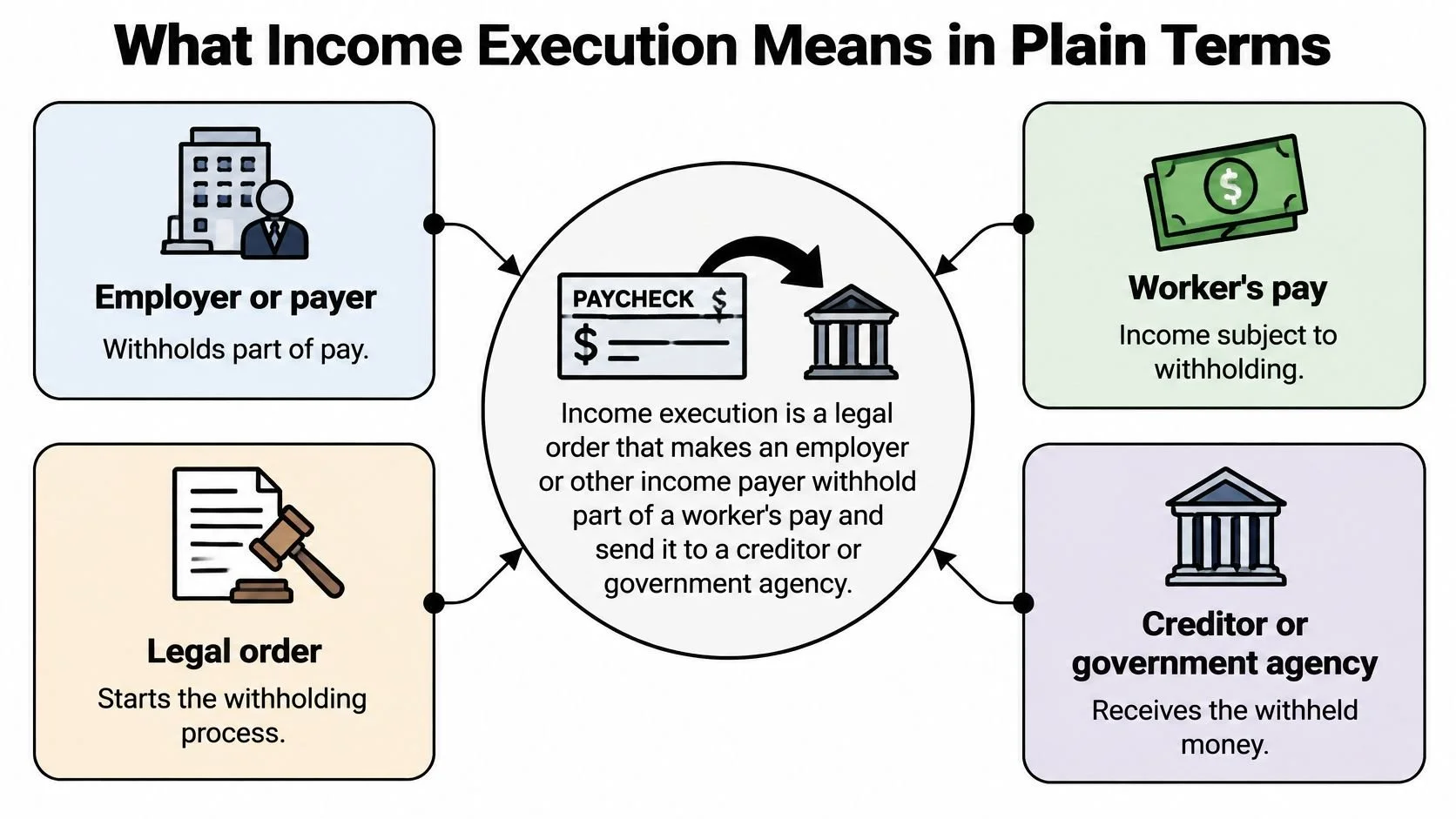
Income execution is a legal order that makes an employer or other income payer withhold part of a worker's pay and send it to a creditor or government agency. If you've just received a notice, the key is to identify who issued it and whether it will affect one payment or keep reducing future income.
The terms can be confusing, especially when a notice arrives close to payday. An employee may see a smaller paycheck, a contractor may learn that a client has received a levy, or a business owner may worry about covering payroll. Knowing which collection tool you're facing helps you understand what happens next and what you can do.
What Income Execution Means in Plain Terms
An income execution puts a legal collection order between a person and their earnings. There are three main parties: the creditor or government agency seeking payment, the debtor whose income is affected, and the employer or other payer responsible for withholding and sending money as directed.
Think of it as a toll gate for part of your pay. The money is taken at the source, before it reaches you, and forwarded to the party collecting the debt.
For example, if an employer receives a valid order, the employee may receive less in each paycheck while the employer sends the required amount to the named creditor or agency.
In the United States, people commonly call collection from earnings wage garnishment when it concerns an ordinary debt, and a wage levy when it concerns federal tax debt.
The U.S. Department of Labor's explanation of garnishment describes it as a legal or equitable procedure requiring some earnings to be withheld to pay a debt. Covered earnings generally include wages, salaries, commissions, bonuses, and pension or retirement income. Tips are ordinarily excluded.
Some orders follow a court judgment. Tax authorities may also use administrative procedures, without first obtaining a conventional civil judgment.
The rules depend on the authority, debt type, and jurisdiction, so don't assume that a term or withholding rule from one place applies everywhere.
An income execution can continue across future paychecks until it's released or the debt is resolved. That's different from a one-time bank levy, which reaches money in an account at the time the levy is applied.
Start by checking the issuing authority, the amount claimed, and the notice date on your paperwork. Those details help show which process you're dealing with and how quickly you need to respond.
Income Execution Compared With Other Collection Tools
| Tool | Who Issues It | Continues Over Time? | Typical Limit |
|---|---|---|---|
| Court-ordered wage garnishment | Creditor holding a court judgment | Yes, each pay period until paid | Applicable federal disposable-earnings rules for the debt |
| IRS wage levy | Internal Revenue Service for federal tax debt | Yes, until released or paid | Exempt amount set by IRS standards for filing status and dependents |
| New York income execution | New York tax authority | Yes, until the liability is satisfied | Up to 10% of gross wages |
| Bank levy | IRS or a creditor with the right to levy | No, one-time seizure of funds in the account | Funds on hand when the levy is applied, subject to applicable protections |
Read across each row, not just down the limit column. A continuing wage tool can reach successive paychecks, while a bank levy takes funds in an account at a particular time.
The limits also come from different rules. A court-ordered garnishment is subject to the federal rules that apply to the debt, an IRS levy uses protected exempt income, and a New York tax income execution uses a state-specific gross-wage rule.
The New York figure is up to 10% of gross wages, but it applies to New York tax income executions, not automatically to other states or federal tax collection.
For a federal levy, the amount you keep depends on the exemption calculation, including factors such as filing status and dependents.
If the table describes a limit by reference to a formula or case-specific calculation, use the notice and the rules for that particular order rather than guessing a flat percentage.
The table compares collection tools, not debts. One person could face more than one type of collection action, and a tax lien is not the same thing as a levy.
For a plain-language comparison of those tax collection terms, see the difference between a tax lien and a levy.
Match the name of the tool on your notice to a row before deciding what to do. If the document uses unfamiliar language, look for the agency named, the income or account it targets, and whether it describes recurring withholding.
How an Income Execution Works From Notice to Last Paycheck
The exact steps depend on the type of debt and the authority involved. These are the usual stages to look for in your paperwork.
The debt is established. A court judgment may authorize collection for a private debt, while a tax agency may rely on an administrative assessment. Check that the amount and the person named on the notice match your records.
The debtor receives notice. For an IRS levy, the agency generally sends a notice of intent to levy, and the taxpayer ordinarily has 30 days from the notice date to request a Collection Due Process hearing, as explained in IRS materials on collection and appeal rights. Keep the notice and note any response deadline right away.
The employer or payer receives the order. The agency or creditor serves the employer or another payer, such as a business that pays a contractor. The recipient generally must follow the order, which makes it important to address a potential error with the issuing authority rather than relying on payroll to disregard the notice.
The withholding is calculated. The employer applies the rules for that particular order and leaves any legally protected income available to the worker. Under an IRS levy, that protected amount is not one universal percentage; the calculation can depend on filing status, dependents, and earnings.
The funds are sent to the creditor or agency. The employer forwards the withheld money to the party identified in the order and keeps payroll records. Check your pay statement to see how the deduction appears and compare it with the notice.
The withholding continues until the order ends. An IRS wage levy can attach to salary, wages, fees, bonuses, commissions, and similar compensation, and continue to reach future payments until it's released, the liability is paid, or another accepted payment arrangement is established, according to IRS administrative guidance on wage levies. That means a later paycheck can be affected even if the first deduction seemed manageable.

The cash-flow effect can reach beyond an individual employee. A contractor who depends on reportable payments from clients may receive less income when a payor has to honor a levy. A business owner who relies on owner compensation to fund operations may also have less available in each cycle, making it harder to plan expenses or meet payroll.
Put your own documents in order and identify the step they describe. You may have received only a notice, or your employer may already be withholding. That difference affects what to do next.
Who Can Issue One and What Employers Must Do
A court can authorize collection after a creditor obtains a judgment. Tax authorities, including the IRS and state taxing agencies, can use administrative collection procedures for tax debts.
Certain government agencies can also collect specific types of obligations, such as child support or other government debts. In general, a private creditor needs a court judgment before it can reach wages, while tax authorities may not need a conventional civil judgment first.
Once an employer or other payer receives an order, the recipient has a compliance role. The duties generally include:
Honor the order: Follow the instructions from the issuing authority unless that authority changes or releases them.
Calculate withholding: Apply the amount and rules stated in the order and any applicable protections.
Send the money: Transmit withheld funds to the named creditor or agency on schedule.
Keep payroll records: Document what was withheld and when it was sent.
Explain the deduction: Tell the employee what was taken from pay.
Federal law generally protects an employee from being fired because of a single garnishment. That protection doesn't mean the order is optional or that every situation has the same employment rules.
An independent contractor can be affected, too. If a client or business is a payer that receives a levy covering reportable compensation, it may have to withhold from payments rather than send the full amount to the contractor.
If an employer thinks an order is wrong or unclear, it should ask the issuing authority for clarification or a corrected notice. It shouldn't ignore the order. Workers should preserve the notice and pay statements, then contact the named authority about errors or relief. Employers should follow the order and keep clear records while seeking clarification.
New York and Federal Tax Levies

Consider an employee in New York who earns $3,000 in gross wages per pay period. If the taxpayer doesn't make voluntary payments, the state may direct the employer to withhold up to 10% of gross wages. The arithmetic is:
Gross pay: $3,000
Potential withholding at 10%: $300
Remaining gross pay before other deductions: $2,700
That example uses gross wages, not take-home pay. The actual amount arriving in the employee's account will also reflect other payroll deductions.
The New York Department of Taxation and Finance's income execution guidance explains that the taxpayer may first have an opportunity to pay voluntarily, and that the employer may be directed to deduct up to 10% of gross wages if voluntary payments aren't made.
The execution can remain in place until the liability is satisfied. That 10% rule is specific to New York tax collection, so don't apply it to federal levies or other states.
A federal wage levy uses a different calculation. For a worker supporting a household of two, the protected amount comes from IRS standards based on the relevant filing status and dependents. The amount available for collection is calculated using those protections, not a universal percentage. Use the information on the notice and the applicable IRS calculation rather than relying on a rounded estimate.
A freelancer should also check which clients or other payors have received the levy. If a client must honor it, the freelancer may receive less from that payment, affecting funds set aside for taxes, household expenses, or business costs.
A business owner should make a similar cash-flow check: identify the affected pay cycle, calculate what will remain available, and determine whether the shortfall could disrupt employee payroll or essential operating costs.
To apply the same reasoning to your own finances, start with the actual pay amount the order uses, identify what the law protects, and then compare the likely withholding with your necessary expenses. For information on how state tax collection can differ, see what a state tax levy is.
Your Rights and How to Challenge an Execution
For an IRS levy, a notice of intent generally gives you 30 days from the notice date to request a Collection Due Process hearing. Treat that date as a working deadline, not an estimate. Gather your records promptly so you can explain what's wrong or why collection creates hardship.
Stopping a levy doesn't automatically settle the tax debt. The liability, interest, filing requirements, liens, and collection deadlines may remain.
The IRS may release a levy that was wrongfully issued or creates economic hardship. Its collection standards consider whether the taxpayer can meet basic living expenses based on household size, location, and individual circumstances.
| Defense | When It Fits | Evidence to Gather |
|---|---|---|
| Wrongful levy | The debt was paid, isn't owed, or the notice names the wrong person | Payment proof, notice, identity documents |
| Economic hardship | Withholding prevents the household from meeting basic living expenses | Household budget, bank statements, bills, household size |
| Pending or active payment arrangement | An installment agreement or Offer in Compromise is pending or in effect | Agreement letter, submission receipt |
| Exempt income miscalculated | The withholding exceeds the protected amount for the filing status | Pay stubs, filing status, dependent count |
| Order exceeds statutory limit | A garnishment takes more than the law allows for the debt type | Pay stubs, order, calculation of disposable earnings |
Evidence matters. For a hardship claim, organize essential expenses such as housing, utilities, food, transportation, and medical costs, then compare those expenses with household income and the amount left after withholding. Self-employed people and small businesses may also need to explain irregular receipts or show how reduced cash flow affects basic operations.
Practical rule: Ask what you need to resolve the debt, not only how to stop the next deduction.
In the first days after receiving a notice, keep every letter and pay stub, identify all taxing authorities involved, bring required filings current, and write down necessary household or business expenses.
Then compare the available options, including levy release, an installment agreement, currently-not-collectible status, or another resolution.
For help understanding wage-garnishment protections and possible steps to protect your paycheck from creditors, use a resource that addresses the type of order you received. You can also review IRS notice and collection appeal rights as you prepare your response.
Choose Your Response Before the Next Payday
Your best response depends on the debt, your finances, and whether the order is legally correct. Consider these paths:
Pay the balance in full: Paying the liability can end the execution once the amount owed is satisfied. Confirm the payoff and release with the issuing authority.
Request an installment agreement: This sets recurring payments toward the balance. A qualifying arrangement may prevent a new levy while it's current; keep required filings and payments up to date. The IRS explains how to set up a tax payment plan.
Ask about currently-not-collectible status: This may fit taxpayers with very limited income and assets who can't meet basic living costs while paying the debt. It can pause collection, but it doesn't erase the balance.
Challenge the levy: If the debt is wrong, the withholding is miscalculated, or collection causes hardship, submit the evidence that supports your position and follow the applicable notice procedure.
Start with this action list:
Pull the notice and write down the response deadline.
List your income, expenses, assets, and debts.
Confirm which authority issued the order and how much it claims.
Choose the response path that fits your facts.
Contact the issuer in writing before the deadline and keep a copy.
A licensed tax professional may be useful when the debt is substantial, the finances are complex, or an IRS revenue officer or criminal investigation is involved. Before engaging anyone, ask for a written scope of work and fee. This article is general information, not legal advice. If you have a notice in hand, act on the deadline first and get advice second.
Tax Attorney Stephen A Weisberg represents individuals, businesses, and business owners dealing with IRS and state tax debt, including wage levies and collection notices. He offers a Tax Resolution Plan that includes a review of IRS transcripts, an attorney-led financial analysis, and a personalized action plan. Visit Tax Attorney Stephen A Weisberg to learn more.
Want to understand your options before you call anyone?
Download my free book — Freedom From Tax Debt — a plain-language guide to how the IRS collections process actually works and what resolution really looks like.
➥ Contact Attorney Stephen A. Weisberg for a free Tax Debt Analysis.
Contact Me Here: https://www.weisberg.tax/contact-1
Email: s.weisberg@weisberg.tax
Phone/Text: (248) 971-0885
Address: 300 Galleria Officentre, Suite 402, Southfield, MI 48034
