For an ordinary consumer debt, the federal maximum is the lesser of 25% of your weekly disposable earnings or the amount above $217.50, which is 30 times the $7.25 federal minimum wage. If your weekly disposable earnings are $217.50 or less, nothing can be taken under that federal formula.
So why do two workers with the same paycheck sometimes lose very different amounts? Because how much is a garnishment of wages doesn't have one answer until you know what kind of debt is behind the order.
A credit card judgment, a child support order, and an IRS levy can each follow a different calculation, and confusing them is where most estimates go wrong. Start with your pay stub, identify the legal basis on the paperwork, and then run the matching arithmetic.
How Much Can Be Taken From Your Paycheck
For an ordinary consumer debt, the U.S. Department of Labor garnishment guidance sets the federal baseline as the lesser of 25% of disposable earnings or the amount by which disposable earnings exceed 30 times the federal minimum hourly wage.
That guidance defines disposable earnings as pay remaining after legally required deductions, such as federal, state, and local taxes and Social Security, while voluntary deductions generally don't reduce the calculation.
That definition is the first place readers get tripped up. Disposable earnings aren't your gross pay, and they aren't always the same as the take-home pay printed at the bottom of your stub.
If you voluntarily pay for health insurance or contribute to a retirement plan, you can't subtract those amounts before running the garnishment math, even though they reduce the money that reaches your bank account.
The Three Zones on a Weekly Paycheck
Because the federal minimum wage is $7.25 per hour, 30 times that wage is $217.50 for a weekly pay period. That single number creates three zones you can check before you do any harder math.
At or below $217.50: An ordinary consumer debt garnishment is prohibited under the federal formula.
Above $217.50 but below $290: Only the amount above $217.50 can be garnished.
At $290 or more: The ceiling becomes 25% of disposable earnings.
| Weekly disposable earnings | 25% of earnings | Amount above $217.50 | Federal maximum |
|---|---|---|---|
| $217.50 | $54.38 | $0 | $0 |
| $250 | $62.50 | $32.50 | $32.50 |
| $290 | $72.50 | $72.50 | $72.50 |
| $500 | $125 | $282.50 | $125 |
| $600 | $150 | $382.50 | $150 |
| $1,000 | $250 | $782.50 | $250 |
Look at the $250 row closely, because it shows why the answer isn't always a quarter of your pay. Twenty-five percent would be $62.50, but you only earn $32.50 above the protected threshold. The lower figure wins, so the federal maximum is $32.50.
Run the Calculation in Order
Use the same sequence every pay period, because overtime, bonuses, and unpaid time can move you from one zone to another.
Start with gross pay: Use the gross amount for that specific pay period, not your annual salary divided roughly by paydays.
Subtract legally required deductions: Remove federal, state, and local taxes and Social Security to find disposable earnings.
Ignore voluntary deductions: Don't subtract health premiums, retirement contributions, union dues you chose, or other voluntary items for this step.
Calculate 25%: Multiply disposable earnings by 0.25.
Calculate the excess: Subtract $217.50 for a weekly period. For a biweekly example, the corresponding protected amount would be $435, which is twice the weekly threshold.
Take the lower figure: That's your federal maximum for an ordinary consumer debt.
Check state law: Apply a lower state cap if your state gives you more protection.
Say your weekly disposable earnings are $500. The first calculation is $125, which is 25% of $500. The second is $282.50, which is $500 minus $217.50. Your employer can withhold no more than the lower amount, $125, under the federal rule for that week.
Now change the pay period. Say you have $1,000 in biweekly disposable earnings as a worked example. Twenty-five percent is $250, and the amount above a $435 biweekly threshold is $565, so the lower figure, and therefore the maximum, is $250.
Practical rule: Always calculate both numbers. If you only multiply by 25%, you'll overstate the garnishment for lower-paid weeks and miss the protection built into the threshold.
Why the Threshold Moves With the Minimum Wage
The federal regulation at 5 C.F.R. § 582.402 reflects a framework created by Title III of the Consumer Credit Protection Act of 1968, which became effective on July 1, 1970. That framework tied protection to the minimum wage instead of locking in one permanent dollar amount.
In the historical example using a $1.60 federal minimum wage, earnings of $48 or less for a workweek were fully protected, earnings between $48 and $64 could be garnished only above $48, and earnings of $64 or more were subject to the 25% ceiling. The wages have changed, but the structure is identical to the $217.50, $290, and 25% zones you use today.
One more protection matters if paperwork piles up. The federal limit generally applies to the aggregate amount withheld even when your employer receives multiple ordinary garnishment orders. Two ordinary creditors don't each get a separate 25% slice under that federal approach.
Before you challenge or accept a withholding, write down four facts from the pay period in question. Record your gross pay, your disposable pay, the amount withheld, and the date the order was received. Those four lines let you, your employer, or an adviser spot whether the error is in the pay figure, the formula, or the paperwork itself.
Why Different Debts Face Different Limits
A credit card judgment, child support order, federal student loan collection, and IRS levy follow different rules. The legal authority behind the order determines which limit applies.
| Garnishment type | Typical ceiling | How the amount is set |
|---|---|---|
| Ordinary consumer debt (creditor judgment) | Lesser of 25% of disposable earnings or amount above 30 times federal minimum wage | Federal Consumer Credit Protection Act formula |
| Child support | 50% of disposable earnings if supporting another family; 60% if not; plus 5% if arrears are 12 weeks or more | Support order |
| Federal tax levy (IRS) | No percentage cap; an exempt amount is kept and the rest is levied until paid | Exempt amount based on filing status, standard deduction, and dependents; calculated using a weekly amount |
| Federal student loan (administrative wage garnishment) | Up to 15% of disposable pay | Federal administrative wage garnishment rules |
Child support has its own limits. The federal regulations on garnishment in Part 582, Subpart D describe ceilings of 50% of disposable earnings when the worker supports another spouse or dependent, or 60% when not. An additional 5% may apply if support payments are at least 12 weeks overdue.
IRS levies also use a separate calculation. Federal tax obligations are excluded from the ordinary CCPA percentage ceiling.
The IRS protects an exempt amount based on filing status, the standard deduction, and dependents, then calculates the weekly exempt amount under IRS Publication 1494. Wages above that protected amount may be levied until the liability is paid or the levy is released.
When Several Orders Reach One Paycheck
A payroll department must identify the legal basis of each order before calculating withholding. A support order, IRS levy, and ordinary creditor judgment use different formulas. Child support orders are often processed ahead of ordinary creditor garnishments, so the amount left after support withholding can affect what is available for another order.
Ask for a copy of each order. Check the issuing court or agency, then compare each withholding line on your pay stub with the calculation used for that order.
Applying the consumer debt formula to an IRS levy can substantially understate the amount taken.
The reverse mistake can also distort your estimate: treating a support order like a credit card judgment may understate the withholding. Identify the debt type first, then apply its rule and check the arithmetic.
State Rules That Can Lower the Amount
Federal law gives you a baseline, not a guaranteed final answer. A state can protect more of your paycheck through a lower percentage cap or a higher protected amount, but for ordinary consumer debts it can't use state law to let a creditor take more than the federal ceiling allows. When the two rules differ, you use the rule that leaves you with more pay.
| State | Rule for ordinary consumer debt | What it means for paychecks |
|---|---|---|
| Texas | Generally no wage garnishment for ordinary consumer debt | Wages generally protected from ordinary creditors |
| North Carolina | Generally prohibits wage garnishment for most consumer debt | Wages generally protected from ordinary creditors |
| Pennsylvania | Generally prohibits wage garnishment for most consumer debt | Wages generally protected from ordinary creditors |
| South Carolina | Generally prohibits wage garnishment for most consumer debt | Wages generally protected from ordinary creditors |
| All other states | Federal 25% or $217.50 formula, unless state law sets a lower cap | Use the lower of the federal and state limits |
Those four state examples come with an important boundary. A general prohibition on ordinary consumer debt garnishment doesn't erase child support, taxes, or certain federal student loan collections. You still have to classify the debt before you decide that your wages are protected.
A Simple State Comparison
Say a worker has $500 in weekly disposable earnings and faces an ordinary consumer judgment. In a state that follows the federal formula, the federal maximum from the weekly table is $125.
In Texas, North Carolina, Pennsylvania, or South Carolina, that same ordinary consumer creditor generally can't use wage garnishment at all, although exceptions for support, taxes, and certain federal student loans still need checking. The paycheck is identical. The state rule changes the result.
That doesn't mean every other state copies federal law. Some states set lower caps or larger exempt amounts, and those details can change.
Start with your state labor agency or consumer protection agency, then read the exemption statute and the court papers served with the garnishment.
If you're dealing with a state tax order rather than a private creditor, our guide on how to stop a state tax garnishment explains the separate state tax process.
Use the lower of the federal and state limits, and confirm the state figure against current law before you make a payment decision.
Don't rely on an old forum post or a creditor's summary for that check. Statutes change, exemptions get amended, and the order in your hand may cite the rule your employer is supposed to apply. If the order and the current state rule don't match, raise the discrepancy in writing with payroll and the issuing court or agency.
How the IRS Calculates a Tax Levy
How can an IRS levy take a different share of your paycheck than a consumer-debt garnishment? The answer is the calculation: an ordinary garnishment often uses a percentage limit, while an IRS wage levy protects a set exempt amount and can reach the pay above it.

Under IRS levy rules, the exempt amount depends on the taxpayer's filing status, standard deduction, personal exemption amount, and qualifying dependents. IRS Publication 1494 provides the applicable tables. Payroll applies the amount to the employee's pay schedule and sends the remainder to the IRS.
The calculation starts with what you earn, then subtracts the amount the rules protect. For example, two employees with the same pay may have different levy amounts if their filing statuses or number of dependents differ. A larger exempt amount leaves less available for the levy.
Same Pay, Different Levy
Suppose one employee files as single with no dependents, while another files jointly and has two qualifying children. The second employee's exempt amount is larger, so less of the same paycheck may be sent to the IRS.
There is no single percentage that reliably gives you the answer. Check the current tables in Publication 1494, using the correct filing status, dependents, and pay frequency. The IRS wage levy formula and exempt-amount tables explain how those figures apply to wages.
Why Business Owners Face Wider Exposure
A wage levy can affect an employee's salary, commissions, bonuses, and certain other income. Separate IRS collection actions may also reach bank accounts or business receivables, putting money intended for payroll, rent, or suppliers at risk.
Employee wages: The employer applies the exempt amount and sends the remainder under the levy.
Commissions and bonuses: Variable pay can change the amount available for levy when it is paid.
Business receivables: Customer payments owed to a business may be a collection target, as can funds already in an account.
A notice of intent to levy, commonly Letter 1058 or LT11, gives you appeal rights and a deadline to respond. Keep the notice and any proof of mailing or delivery, and check the levy calculation before that deadline passes.
Ways to Reduce or Stop a Garnishment
Don't start by asking which option sounds strongest. Start with the step that tells you whether the amount is even correct. The right remedy depends on whether you're facing a consumer judgment, a support order, or a tax levy, and using a tax remedy for a court judgment, or a creditor negotiation for an IRS levy, wastes the time you have.
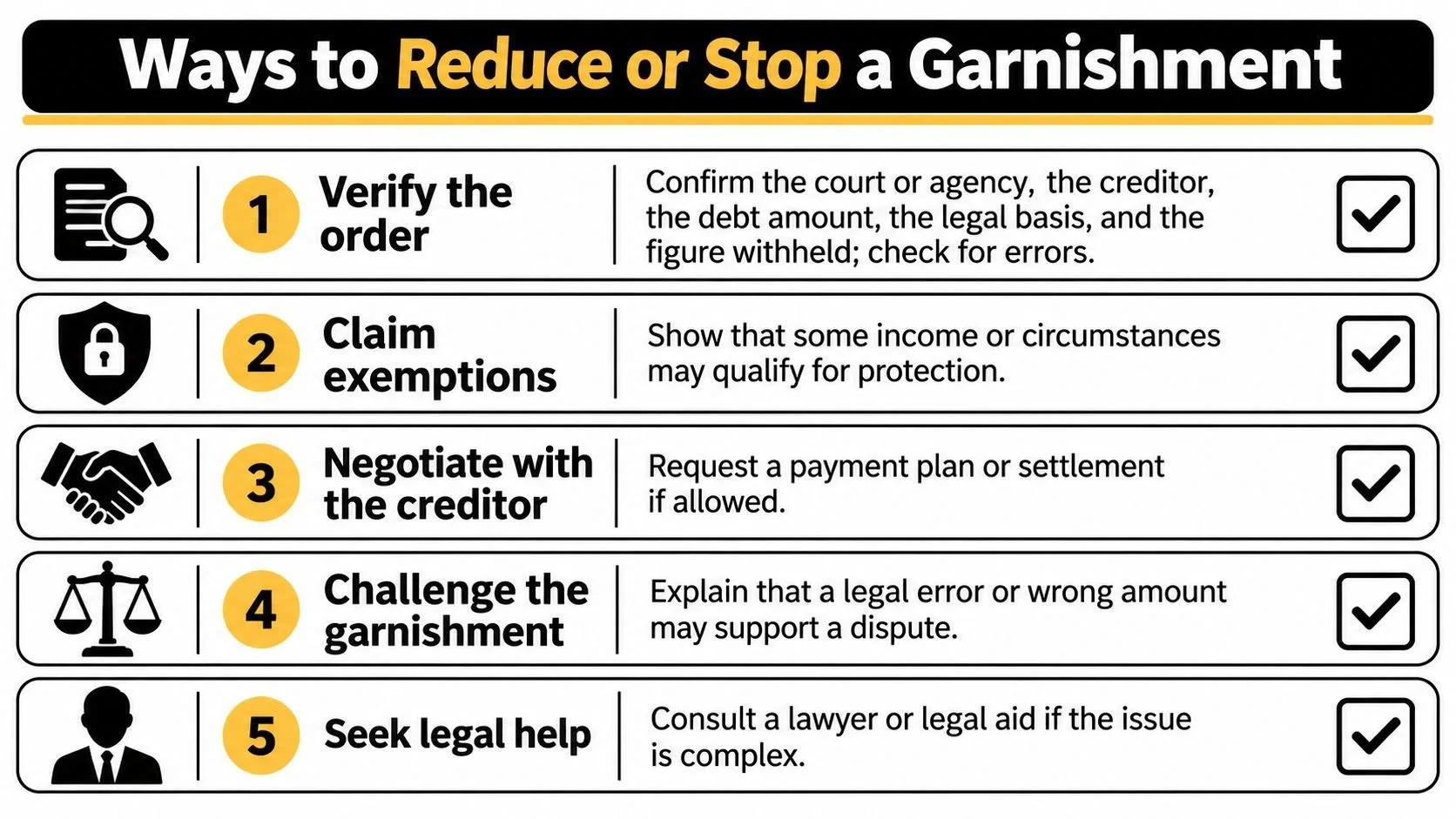
Work Through the Options in Order
Verify the order: Confirm the court or agency, creditor, debt amount, legal basis, and figure withheld. Check for errors such as the wrong disposable earnings figure, voluntary deductions handled incorrectly, a missing exemption, or an order applied after the balance changed. This fits every garnishment type and can often be done in days.
Claim an exemption or hardship: File the exemption form with the court or agency that issued the order. Attach a household budget showing rent, utilities, food, transport, medical costs, and other necessities. You're not just saying the garnishment hurts. You're proving the amount leaves you unable to cover basic living expenses.
Negotiate a payment arrangement: Contact the creditor and propose payments you can sustain. Once payments are current under an agreement, the creditor may withdraw or pause the garnishment order. Get the terms in writing before you rely on them, and confirm that payroll receives the release or amended order.
Consider bankruptcy carefully: A Chapter 7 or Chapter 13 filing can pause many ordinary consumer garnishments through the automatic stay, and a discharge can end collection on debts that qualify. The limit is important. Many tax debts are not discharged in bankruptcy, especially more recent tax debts or trust fund liabilities like payroll taxes. Child support and many student loan obligations also need separate analysis, so don't assume a filing stops every deduction on your stub.
Use IRS resolution options for an IRS levy: Review an installment agreement, Currently Not Collectible status, or an offer in compromise, and act before the deadline on your notice. Our guide on how to set up a tax payment plan explains the installment agreement route. An attorney can stop wage garnishment collections within 24 to 48 hours by filing documents that show financial hardship, which is why timing matters when a levy is about to hit or has just begun.
Match the Remedy to the Debt
Steps one through three are usually the practical starting point for consumer judgments and many support order disputes. You verify the paperwork, claim any protection the issuing court or agency allows, and negotiate only after you know the lawful amount.
For support, a change in income or family circumstances may require a formal modification through the issuing authority rather than a private agreement with the other parent.
Steps four and five fit larger or tax related debts, but they take longer. Verification and an exemption filing can be completed in days. Bankruptcy, an installment agreement, and an offer in compromise can take weeks or months, and each requires financial records that support the request.
Timing check: File the quick correction or exemption first if money is already leaving your paycheck, even while you evaluate a longer solution.
Keep copies of everything you send and note who received it. Payroll departments act on documents, not phone promises. If a creditor agrees to stop a garnishment, confirm that the release reached your employer before the next pay cycle closes.
Confirm Your Garnishment Before You Act
Put three piles on the table before you call anyone. First, gather recent pay stubs showing gross pay and each deduction, the garnishment order or levy notice, and any letters from the creditor, court, agency, or IRS. If you want broader background on how debt collection affects your paycheck, Debt Help U provides a useful overview of creditor wage garnishment.
Second, run your own numbers and compare them with the amount withheld. A gap can mean payroll used the wrong formula, the wrong pay figure, the wrong pay frequency, or the wrong debt category. Our article on an IRS notice of levy can help you identify what type of IRS notice you're holding and what deadline it carries.
Know When to Escalate
Consider a tax attorney when an IRS levy notice carries a deadline, several orders or agencies are involved, your income includes self-employment earnings or business receivables, bank accounts or other valuable assets are at risk of seizure, or an IRS revenue officer has been assigned.
Owing more than $5,000 to the IRS is a listed situation in which an attorney is needed for IRS tax matters.
Hiring a tax attorney is also advisable when you're facing tax debt over $5,000, a criminal investigation, IRS revenue officer involvement, a complex financial situation, foreign account issues, valuable assets at risk of seizure, or large liability exposure over $1,000,000.
Tax Attorney Stephen A. Weisberg is the contact for readers who want a professional review of an IRS or state tax collection matter. That review matters most before you agree to payments you can't sustain or miss a deadline that narrows your options.
Do one concrete thing now. Write down the amount withheld and the order date, then schedule a review before your next paycheck if the amount looks wrong or any notice in your pile carries a deadline.
If an IRS levy or state tax garnishment is already reducing your pay, Tax Attorney Stephen A Weisberg can review the notice, your transcripts, and your paycheck calculation to identify whether hardship relief, an installment agreement, or another resolution fits your situation. You don't have to guess which formula the IRS used or wait for the next payday to find out. Visit Tax Attorney Stephen A Weisberg to request a review before another levy payment is taken.
Want to understand your options before you call anyone?
Download my free book — Freedom From Tax Debt — a plain-language guide to how the IRS collections process actually works and what resolution really looks like.
➥ Contact Attorney Stephen A. Weisberg for a free Tax Debt Analysis.
Contact Me Here: https://www.weisberg.tax/contact-1
Email: s.weisberg@weisberg.tax
Phone/Text: (248) 971-0885
Address: 300 Galleria Officentre, Suite 402, Southfield, MI 48034
