The usual advice is to check your IRS balance and set up a payment plan. That skips an important question: what does the balance include, and will your proposed payment resolve it? A payment can post correctly while your total tax debt still grows.
Treat your IRS tax debt balance as a moving liability, not a fixed bill. Before choosing a solution, separate the underlying tax from additions, reconcile the records, and check whether you're keeping up with current filing and payment obligations.
What Makes Up Your IRS Tax Debt Balance
A balance on an IRS notice is a dated snapshot, not necessarily the amount needed to pay off the debt today. It also doesn't prove that every item in the total is correct.
The number generally reflects four parts:
Assessed tax: Tax the IRS has recorded as owed, based on a filed return or an IRS adjustment.
Penalties: Charges tied to noncompliance, such as failing to pay or, for employers, failing to deposit payroll taxes.
Interest: A charge on unpaid amounts that changes over time.
Payments and credits: Amounts that reduce the balance when the IRS applies them to the account.
The assessed tax is the starting amount. Interest adds to it over time, while payments and credits reduce it. A payment can lower the total without removing penalties or stopping interest from accruing on what remains.
Gross debt isn't the same as collectible debt

The total recorded as tax debt and the amount realistically recoverable are different measures. The historical IRS financial report reported approximately $166 billion in total tax debt at the end of fiscal year 1994, while IRS estimates identified only about 20%, approximately $35 billion, as potentially collectible. That broad distinction does not tell you what the IRS can collect from any one taxpayer.
For your account, consider both whether the debt is legally owed and what your financial circumstances may allow you to pay. An amount can be legally owed even if your current income and assets make full payment unrealistic. On the other hand, being able to pay an assessment doesn't make an incorrect amount accurate.
Starting point: List assessed tax, penalties, interest, payments, and credits separately. The breakdown helps you see what is driving the total.
An old balance or financial hardship alone doesn't show whether a debt has expired or whether collection is possible. Those questions depend on the details of the account and your circumstances.
Where to Check Your Balance and Which Number Is Right
| Source | What It Shows | What It Can Miss |
|---|---|---|
| IRS Online Account | Current balance and payment history | Pending adjustments not yet posted |
| Account transcript | Assessments, payments and penalties by tax period | Newest penalties and interest |
| IRS notice | Amount due as of the notice date | Growth since the notice date |
| Payment-plan screen | Monthly payment amount | Full payoff amount |
These records answer different questions. When their totals disagree, the explanation may be timing rather than an IRS error.
Your IRS Online Account is a useful starting point for seeing the displayed balance and checking payment activity. Save a dated copy rather than relying on your recollection of what the screen showed.
An account transcript provides the transaction history behind the total. It helps you identify assessments, credits, reversals, and other entries for a particular tax period, but it isn't necessarily a complete payoff calculation.
Compare matching records
An IRS notice describes the account at the time the notice was prepared. A payment that posted afterward won't necessarily appear on that notice, and a later adjustment may change the amount in either direction.
A payment-plan screen answers a different question: what payment the arrangement calls for. Don't multiply the displayed monthly payment by the proposed number of payments and assume you've established the final cost.
The right number is the number for the right tax period, tax type, and effective date.
Before treating a discrepancy as an error, confirm:
Tax period: Are both records discussing the same return period?
Tax type: Is this individual income tax, employment tax, or another liability?
Effective date: Were the balances calculated at the same time?
Payment application: Did the IRS credit the payment to the intended account?
A representative with appropriate power-of-attorney authorization can obtain and interpret transcripts. Authorization gives the representative access to investigate; it doesn't itself correct an entry or establish what you owe.
For a planned payoff, ask for an amount calculated through the date you expect to pay. Keep that confirmation with the payment receipt.
How Interest and Penalties Keep the Balance Growing
A payment agreement changes how you pay, not whether carrying the debt has a cost. The IRS guidance on payment options explains that unpaid tax accrues interest compounded daily and that interest and applicable penalties continue during installment payments.
Daily compounding means interest calculations incorporate previously accrued interest. Applicable late-payment penalties can add another charge, although a penalty's duration, limits, and available relief require separate review.
Test the direction before choosing the payment
Use this basic account equation:
Opening balance + new interest + new penalties + new assessments − payments − credits = closing balance
For a worked comparison without assuming an IRS rate, call the month's combined interest and penalties A, and the payment P. Assuming no other account activity:
| Payment relationship | Visible arithmetic | Result |
|---|---|---|
| Payment exceeds additions | Opening balance + A − P | Total balance falls |
| Payment equals additions | Opening balance + A − A | Total balance stays level |
| Payment is below additions | Opening balance + A − P | Total balance rises |
This is a simplified model, not a payoff quote. Actual posting dates, payment allocation, and changes to the account affect the calculation.
Say an independent contractor makes every agreed payment but also files a new return showing unpaid tax. The old account may be moving in the right direction while total IRS debt increases because of the new assessment. That's a different problem from an installment payment failing to cover ongoing additions.
Project through the expected payoff date
Ask for a projection that separates the assessed liability, expected interest, applicable penalties, and scheduled payments. Don't judge the arrangement solely by whether its opening payment looks manageable.
Longer repayment generally means carrying the unpaid liability longer. A smaller monthly payment may provide necessary breathing room, but it can increase the total cost.
Practical rule: If a proposed payment doesn't exceed ongoing additions, investigate how the arrangement will resolve the debt before accepting it.
A partial payment can still help. The important distinction is between reducing what you owe and having a complete strategy to finish paying it.
How to Reconcile Your Balance Step by Step
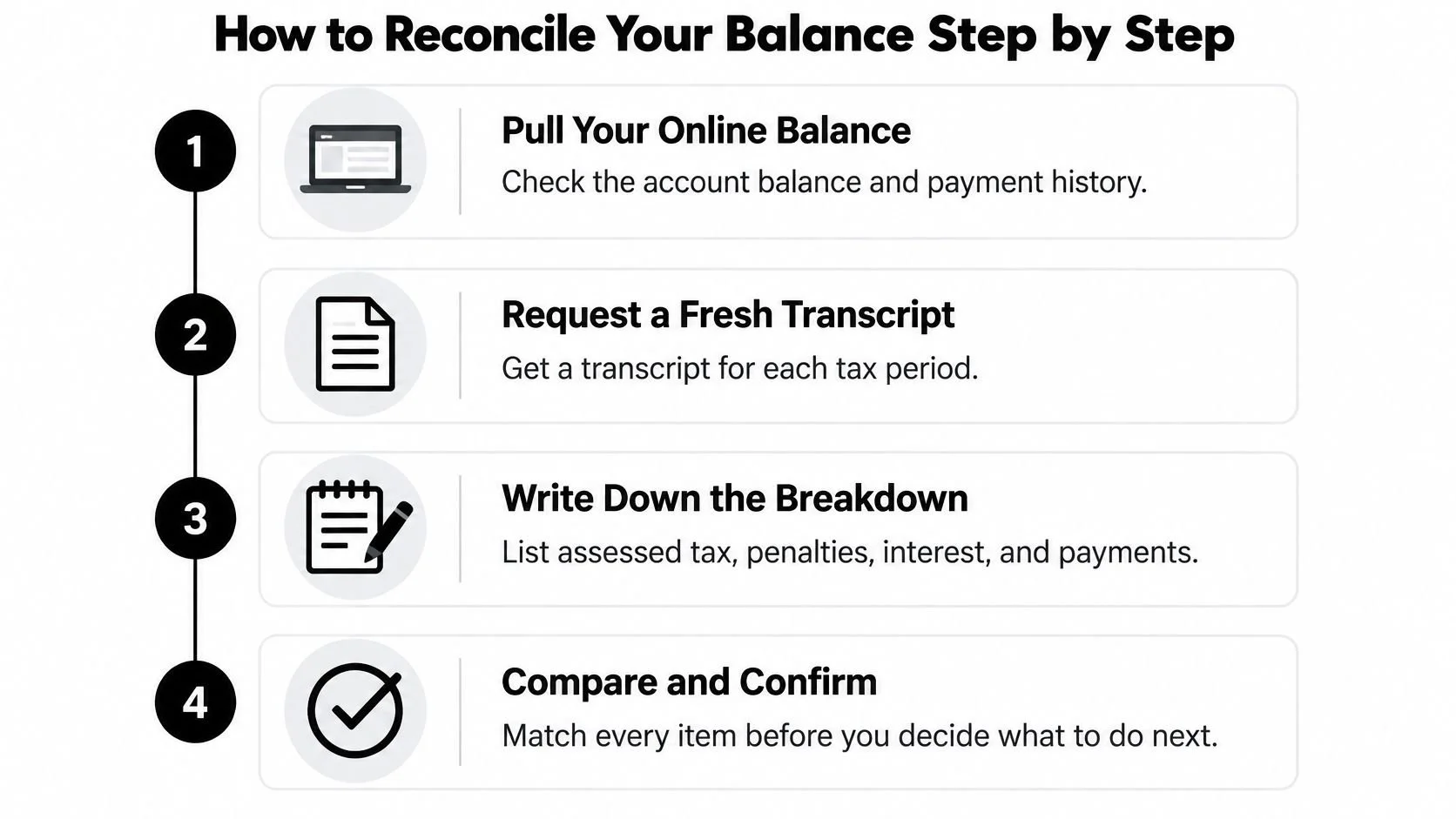
Create a worksheet for each tax period rather than combining everything immediately. Keep supporting records beside the worksheet so every entry can be traced to a document.
Collect and separate the entries
Pull the online balance and payment history. Save the displayed information with the date you accessed it. The common slip is recording the total without preserving the payment details that explain it.
Request a fresh account transcript for each tax period. Use an account transcript to investigate account activity, rather than assuming a copy of the return shows everything that happened afterward. Our guide to reading an IRS transcript explains how to approach the entries.
List the components separately. Record assessed tax, penalty assessments, interest entries, payments, credits, and adjustments in distinct columns. Don't subtract a payment again if the displayed balance already includes it.
Match each payment to its destination. Compare your bank record and payment confirmation with the transcript's period and tax type. A bank withdrawal proves money left your account, but it doesn't establish where the IRS applied it.
Resolve timing and compliance gaps
Compare the notice date with the account activity. Identify transactions that occurred after the notice was prepared before deciding that the notice and online account conflict. Keep unexplained differences on a separate list instead of inserting an unsupported adjustment to make the totals match.
Check whether the account is administratively current. Verify that required returns have been filed and that current withholding, estimated taxes, and any payroll deposits are being handled. The IRS guidance on paying taxes on time explains the importance of continuing compliance, including required filings before applying for an online agreement.
Record a dated working payoff figure. Label unresolved items, pending credits, and any interest calculation that still needs confirmation. Before sending a final payment, obtain an updated amount through the intended payment date rather than treating your worksheet as an official payoff quote.
For a sole proprietor, the compliance check includes current business income that may require estimated payments. For an employer, it includes payroll deposits and employment-tax returns, not just the owner's personal income-tax account.
Reconciled doesn't mean resolved. It means you can explain the figure, identify what remains uncertain, and make a repayment decision using records rather than assumptions.
Common Balance Errors and How to Dispute Them
| Error | Evidence to Gather | Dispute Route |
|---|---|---|
| Payment not credited | Bank record and IRS payment confirmation | Respond to the notice with proof |
| Payment applied to wrong period | Account transcript by period | Written request to reallocate |
| Penalty assessed in error | Notice and filing history | Penalty abatement request |
| Penalty with reasonable cause | Records of illness or professional advice | Reasonable cause abatement request |
| Balance from wrong or unfiled return | Return copies and transcripts | File or amend the return |
| Duplicate assessment | Transcripts for both assessments | Written dispute with the notice |
Your response should identify the notice, tax period, disputed entry, and correction requested. Follow the notice's response instructions and preserve proof of submission.
Payment and assessment problems
Missing payment: Supply the payment confirmation and evidence that the payment cleared. Don't send another payment solely because an earlier one hasn't appeared without first investigating its status.
Wrong period: Show where the credit posted and where you intended it to go. Request reallocation in writing and review both affected periods afterward, since moving a credit changes each account.
Wrong or unfiled return: Determine whether the assessment reflects your filed return, an IRS adjustment, or an IRS-prepared substitute. Filing an original or amended return may be appropriate, but the correct procedure depends on how the liability arose and whether review deadlines apply.
Possible duplicate: Similar-looking transcript entries aren't necessarily duplicate tax charges. Compare the underlying assessments and any reversals before requesting removal.
Penalty relief is a separate inquiry
An incorrectly assessed penalty calls for evidence showing why it shouldn't apply. A correctly calculated penalty may still qualify for relief under an available abatement standard.
Penalty abatement can reduce or eliminate IRS penalties, including reasonable-cause relief when illness or incorrect professional advice led to noncompliance. Relief isn't automatic: explain what happened, when it happened, how it prevented compliance, and what you did to correct the problem.
Our explanation of first-time penalty abatement addresses another relief path worth evaluating separately.
Bring in a representative when you can't identify the assessment's origin, the IRS rejects documented corrections, or collection action threatens wages, bank funds, or business operations. A dispute letter alone shouldn't be assumed to suspend collection or preserve every appeal right.
Testing Whether a Payment Plan Is Affordable

Approval and affordability are different questions. A plan can meet IRS eligibility requirements while leaving your household or business without enough money to stay compliant.
The IRS Simple Payment Plan guidance says individuals may qualify when assessed tax, penalties, and interest total $50,000 or less, while most taxpayers may receive up to 10 years to pay; it also warns that longer terms add interest and penalties.
Run separate cash-flow and payoff tests
Start with take-home income after necessary household expenses. For a business owner, deduct legitimate operating costs before treating business receipts as available personal income.
Then test:
Monthly cash demand: The proposed installment payment plus current taxes not already withheld.
Budget cushion: Money available for irregular expenses and weaker income periods.
Refund dependence: Whether the budget assumes a refund that may instead be applied to unpaid taxes.
Payoff progress: Whether projected payments cover ongoing account additions and reduce the liability.
Don't automatically add interest to your household cash requirement if it's already being handled within the projected installment payment. Account for it in the payoff projection without counting the same cost twice.
Match the test to your income
Steady salary: Use actual pay statements and verify withholding. A predictable paycheck makes planning easier, but insufficient withholding can create another balance when the next return is filed.
Seasonal sole proprietor: Build the budget around the weak season, not the busiest month. Set aside current estimated taxes before deciding how much business cash is available for old debt.
Fluctuating household income: Test the payment against a lean month and identify which expenses are unavoidable. If the arrangement depends on overtime or commissions that aren't reliable, consider whether a financially reviewed alternative is more appropriate.
The IRS uses allowable-expense standards when evaluating financial capacity. Document actual costs carefully rather than assuming every expense will be accepted or that every expense above a benchmark must be rejected.
Missed installments or missing returns can jeopardize an agreement. Seek a review promptly if income changes instead of skipping payments.
Use our guide to setting up a tax payment plan to prepare the application after the budget supports it.
Choosing a Route to Resolve the Balance
The IRS balance is a moving liability, and the amount owed is only part of the decision. A route should fit both what you can pay and what the IRS can collect based on your financial circumstances.
| Route | Fits when | Watch for |
|---|---|---|
| Pay in full | Available cash covers the confirmed balance | Interest and penalties stop once the balance is paid in full |
| Short-term plan | You can clear the balance within 180 days | No setup fee; interest and penalties continue until paid |
| Long-term installment agreement | A monthly payment fits a verified budget | Interest and penalties continue, increasing the total repayment cost |
| Currently Not Collectible | Paying would cause serious hardship | The balance remains owed and interest continues |
| Offer in Compromise | You cannot realistically pay the full balance | Your finances and compliance must be reviewed; acceptance is not automatic |
Choose by capacity, not preference

Paying in full can stop further accruals, but only if the money is available after essential expenses and current payroll obligations. A short-term plan may suit a temporary cash gap if you have a reliable source of funds to clear the balance within 180 days.
A long-term installment agreement depends on sustainable monthly capacity. Use the budget you have verified, not an optimistic estimate of future income. If paying would cause serious hardship, Currently Not Collectible status may pause collection activity, though the debt remains. An Offer in Compromise may let you settle for less than the full amount if you qualify. Read more about settling debt with the IRS.
Check the complications before committing
Unfiled returns, asset equity, and payroll-related trust fund liabilities can affect which route is practical. Many tax debts are not discharged in bankruptcy, particularly recent debts and trust fund liabilities, so bankruptcy may not resolve the balance.
Revenue-officer involvement, disputed assessments, or assets at risk can make legal representation useful. Hiring a representative does not automatically stop collection activity. Tax Attorney Stephen A Weisberg's practice focuses on IRS and state tax problems, and its Tax Debt Resolution Plan provides an attorney-led investigation and personalized roadmap for resolving tax debt.
Prepare your dated payoff figure, current transcripts, IRS notice, payment records, and affordability worksheet before discussing options. For broader coordination of tax obligations and financial decisions, explore tax advisory services.
Tax Attorney Stephen A Weisberg offers a paid Tax Debt Analysis to review a taxpayer's situation and identify possible next steps. After the analysis, clients who decide to proceed with services can receive help resolving their IRS issues. Visit Tax Attorney Stephen A Weisberg to discuss your balance and payment capacity.
Want to understand your options before you call anyone?
Download my free book — Freedom From Tax Debt — a plain-language guide to how the IRS collections process actually works and what resolution really looks like.
➥ Contact Attorney Stephen A. Weisberg for a free Tax Debt Analysis.
Contact Me Here: https://www.weisberg.tax/contact-1
Email: s.weisberg@weisberg.tax
Phone/Text: (248) 971-0885
Address: 300 Galleria Officentre, Suite 402, Southfield, MI 48034
